

A new kind of Ebola?
POSTED BY: SIGNYM
UPDATED: Wednesday, October 15, 2014 02:42
VIEWED: 11272
PAGE 7 of 11

Those are interesting statistics. I woudn't know the mechanism(s) that led to them.
As for new reports, it was splashed all over the news that the WHO said Ebola numbers are vastly underestimated. But then, they always are. People go back to their isolated villages, which are then wiped out without accounting. Even in 'normal' times where there are no known outbreaks, it's assumed there are minor outbreaks that decimate entire isolated villages that go undetected. Is this outbreak MORE vastly underestimated than normal? Hard to say.
So, the usual msm outlets in the US reported both that it was vastly underestimated, but then also quickly reported that Médecins Sans Frontières estimated the outbreak would be controlled in up to 6 months. ? http://www.washingtonpost.com/news/to-your-health/wp/2014/08/15/who-to
ll-of-ebola-outbreak-has-been-vastly-underestimated/ is a pretty good example.
English language al Jazeera reported similarly but more completely.
The Guardian put a whole different angle on it - far more alarmist. http://www.theguardian.com/global-development/2014/aug/15/ebola-outbre
ak-vastly-underestimated-world-health-organisation "has been vastly underestimated and will require “extraordinary measures, on a massive scale” if it is to be contained, the World Health Organisation has warned. The admission came as Médecins sans Frontières (MSF), the medical charity, said the disease was spreading “faster than we can respond to”, and accused the WHO of being too slow to react." and "MSF, which warned almost a month ago that the outbreak was already “out of control”, issued a bleak assessment of the situation on Friday. “It is deteriorating faster – and moving faster – than we can respond to,” said Joanne Liu, MSF international president. “It is like wartime.”"
SAGAN: We are releasing vast quantities of carbon dioxide, increasing the greenhouse effect. It may not take much to destabilize the Earth's climate, to convert this heaven, our only home in the cosmos, into a kind of hell.
NOTIFY: N | REPLY | REPLY WITH QUOTE | PERMALINK | TOP | HOME
Both India and China have a lot of nationals in western Africa.
Kenya is a hub of transportation which connects west Africa to places farther east. Kenya has one of the largest slums in the world (Kibera).
*waits for news*
--------------
THUGR is a know-nothing militarist.
NOTIFY: Y | REPLY | REPLY WITH QUOTE | PERMALINK | TOP | HOME

In case anyone is wondering, the 2 patients who were flown back to the US for treatment have fully recovered and were released from Emory Hospital yesterday.
Far less media attention has been spent on them walking out of the hospital than was given to them being brought.
2 wins for the good guys.
NOTIFY: N | REPLY | REPLY WITH QUOTE | PERMALINK | TOP | HOME
Dates............new.......deaths
Aug 14 to 16....125 .......99
Aug 17 to 19 ...221*.......106
* Highest "new case" count so far. Everyone, including WHO, agrees that these counts are greatly underreported. Fortunately this isn't a new kind of Ebola, just the old kind of Ebola with an R of about 1.5. Unfortunately, it's the old kind of Ebola in a new kind of (urban slum) setting.
Entire neighborhoods and villages are being cordoned off. Food isn't getting in. Society is breaking down. None of this is widely reported.
We should start a betting pool on when this will turn around and how many deaths will occur before this ends. (Estimated actual deaths, not just WHO-reported ones.) Medicins sans Frontiere's guess is about six months on the duration, and my guess on the deaths is tens of thousands. Any takers?
--------------
Yes, RAPPY, one for the good guys. In looking up Ebola, it seems that people don't actually bleed to death ... most victims don't develop hemorrhagic symptoms anyway... but die from lost blood pressure and organ failure. Sounds more like sepsis-type symptoms. With sufficient supportive care... infusions, vasopressors etc ... many more people could survive.
--------------
THUGR is a know-nothing militarist.
NOTIFY: Y | REPLY | REPLY WITH QUOTE | PERMALINK | TOP | HOME
The video shows how Ebola might have spread from bushmeat to humans, but right now the only vector is human-to-human. Lack of health care, general filth and squalor, and lack of education are creating a threat of potential worldwide proportions.
But that's what happens when you trample on your nation's poor in order to suck up more wealth. Sooner or later, it comes to bite you- either in the form of epidemic, or economic collapse, or revolution.
I was talking about Ebola with Rue (some of you may remember). We were discussing a paper which tracked the many genetic changes that this virus has demonstrated, just since the beginning of this particular outbreak.
One of the points that Rue brought up, while noticing the lower death rate, is that a very "hot" virus which kills its hosts quickly is subject to genetic pressure to be not quite so deadly. Because variants which drop the victim on the spot never have a chance to spread. OTOH, viruses in the milieu of a crowded urban environment would seem to have an open pathway towards becoming more transmissible. In other words, those variants which survive longer in the air or on common surfaces would be selected for reproduction.
So maybe while the original kind of Ebola was NOT a new kind of Ebola, maybe it's becoming a new kind of Ebola during this epidemic. This has implications not only for the epidemic itself, but also for vaccines and other immunological treatments being developed.
Ebola hits fifth W. African state as Senegal confirms first case
Quote:
Dakar (AFP) - The Ebola epidemic that has killed more than 1,500 people across West Africa spread to a fifth country in the region on Friday with the first confirmed case of the deadly virus in Senegal.
The case marks the first time a new country has been hit by the outbreak since July and comes a day after the World Health Organization warned the number of infections was increasing rapidly....
Senegal's health ministry said the country's first Ebola patient was a young Guinean man who was immediately quarantined at a Dakar hospital, where he was in a "satisfactory condition".
The man is believed to have been infected in Guinea's capital Conakry, and may have travelled to Senegal before Dakar closed its land border with Guinea on August 21.
Authorities are now scrabbling to piece together where he went and who he encountered, in a bid to halt the spread of the deadly virus.
http://news.yahoo.com/senegal-reports-first-case-ebola-health-ministry
-130949860.html
--------------
You can't build a nation with bombs. You can't create a society with guns.
NOTIFY: Y | REPLY | REPLY WITH QUOTE | PERMALINK | TOP | HOME
So far Ebola is still the same old Ebola in one very important way - it's not airborne.
But this epidemic has the chance of becoming unlike any other in modern history. According to recent publications, it could spread worldwide into megacities - and I'll add, their superslums. Myself, a source at USC and Signy just came up with a very incomplete list - Mumbai, Rio, Mexico City, Johannesburg, Dhaka, Manila, and Jakarta. There is nothing I can think of that makes those superslums any different from Liberia.
Can you imagine Ebola in Mexico City? From there it would inevitably cross into the US population. It might then take root in our most disadvantaged areas. Which are only a car ride away from the population as a whole.
http://www.wired.com/2014/09/r0-ebola/
The Mathematics of Ebola Trigger Stark Warnings: Act Now or Regret It
By Maryn McKenna | 09.14.14 | 12:07 pm

The Ebola epidemic in Africa has continued to expand since I last wrote about it, and as of a week ago, has accounted for more than 4,200 cases and 2,200 deaths in five countries: Guinea, Liberia, Nigeria, Senegal and Sierra Leone. That is extraordinary: Since the virus was discovered, no Ebola outbreak’s toll has risen above several hundred cases. This now truly is a type of epidemic that the world has never seen before. In light of that, several articles were published recently that are very worth reading.
The most arresting is a piece published last week http://www.eurosurveillance.org/ViewArticle.aspx?ArticleId=20894 in the journal Eurosurveillance, which is the peer-reviewed publication of the European Centre for Disease Prevention and Control (the EU’s Stockholm-based version of the US CDC). The piece is an attempt to assess mathematically how the epidemic is growing, by using case reports to determine the “reproductive number.” (Note for non-epidemiology geeks: The basic reproductive number — usually shorted to R0 or “R-nought” — expresses how many cases of disease are likely to be caused by any one infected person. An R0 of less than 1 means an outbreak will die out; an R0 of more than 1 means an outbreak can be expected to increase. If you saw the movie Contagion, this is what Kate Winslet stood up and wrote on a whiteboard early in the film.)(my note: briefly considering it, I can't think of any mathematical expression that will allow for a geometric increase rather than an exponential one.)
The Eurosurveillance paper, by two researchers from the University of Tokyo and Arizona State University, attempts to derive what the reproductive rate has been in Guinea, Liberia and Sierra Leone. (Note for actual epidemiology geeks: The calculation is for the effective reproductive number, pegged to a point in time, hence actually Rt.) They come up with an R of at least 1, and in some cases 2; that is, at certain points, sick persons have caused disease in two others.
You can see how that could quickly get out of hand, and in fact, that is what the researchers predict. Here is their stop-you-in-your-tracks assessment:
In a worst-case hypothetical scenario, should the outbreak continue with recent trends, the case burden could gain an additional 77,181 to 277,124 cases by the end of 2014.
That is a jaw-dropping number.
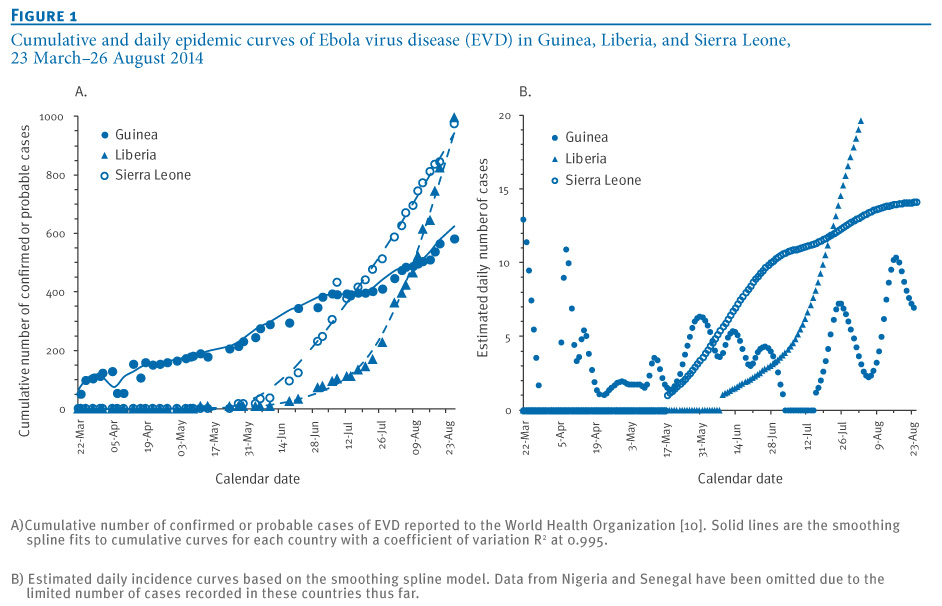
The epidemic curves of the Ebola epidemic; look especially at the line for Liberia. From Nishiura and Chowell.
What should we do with information like this? At the end of last week, two public health experts published warnings that we need to act urgently in response.
First, Dr. Richard E. Besser: He is now the chief health editor of ABC News, but earlier was acting director of the US CDC, including during the 2009-10 pandemic of H1N1 flu; so, someone who understands what it takes to stand up a public-health response to an epidemic
NOTIFY: N | REPLY | REPLY WITH QUOTE | PERMALINK | TOP | HOME
bump
SAGAN: We are releasing vast quantities of carbon dioxide, increasing the greenhouse effect. It may not take much to destabilize the Earth's climate, to convert this heaven, our only home in the cosmos, into a kind of hell.
NOTIFY: N | REPLY | REPLY WITH QUOTE | PERMALINK | TOP | HOME
Just a few comments...
A few weeks ago, when the UN (CDC?) was predicting the ultimate number of cases, my brain took up the task and guessed "hundreds of thousands" and possibly more. I really don't see a natural end to this epidemic.... it could conceivably continue in slums/impoverished megacities throughout the world until every vulnerable person was infected and half had died. Millions. Hundreds of millions. Maybe even billions. When THEY were at the time touting 20,000 I assumed I must be wrong.
This is like global warming: it's easy to deny a mathematical certainty as long as the denier is personally comfortable. It's not until danger is literally at the doorstep that many people actually react, and by then it's too late.
And what is the USA sending??? Doctors? Nurses? Protective gear? Field tents? Infusion solutions and vasopressors? Bleach?
NOPE!
Soldiers!
Because, yanno, no good crisis should be ignored as an oppty to place American soldiers on every square mile of foreign soil!
Yeesh.
--------------
You can't build a nation with bombs. You can't create a society with guns. 
NOTIFY: Y | REPLY | REPLY WITH QUOTE | PERMALINK | TOP | HOME
Quote:
The UN security council has called the Ebola outbreak "a threat to international peace and security" and urged the world to provide health experts, field hospitals and medical supplies.
A resolution adopted unanimously by the UN's most powerful body at an emergency meeting with an unprecedented 130 countries as co-sponsors reflected the rising global concern at the outbreak.
It was only the second time that the security council has addressed a public health emergency, the first being the HIV/Aids pandemic.
The UN health chief, Dr Margaret Chan, said the "deadly and dreaded Ebola virus got ahead of us" and it was time to urgently catch up.
"This is likely the greatest peacetime challenge that the United Nations and its agencies have ever faced," she said.
The UN secretary general, Ban Ki-moon, said the number of Ebola cases was doubling every three weeks. He called for a 20-fold increase in aid totalling almost $1bn (£600m) to tackle the crisis over the next six months.
Ban said the largest outbreak of Ebola in history "demands the attention of the world" and "unprecedented" action.
The UN is leading the global response to contain and eradicate Ebola and Ban announced that he was establishing a UN emergency mission to tackle the growing challenge.
He thanked the US president, Barack Obama, for sending 3,000 troops to provide expertise in logistics, training and engineering. He also credited about 20 other countries which have responded with contributions and urged all nations coming to the UN general assembly ministerial meeting next week to follow suit.
After the emergency UN meeting, Dr Joanne Liu, the international president of Médecins Sans Frontières, said: "MSF welcomes the emergency Ebola meeting of the UN security council.
"We call on member states and others to follow the lead of countries who have committed to join the fight against Ebola. We need concrete action on the ground now.
"Speed is of the essence. Although dangerously late, the pledges such as those of the US and UK are ambitious, but they must be implemented now. We do not have months or even weeks to wait. Thousands of lives are at stake. Other countries must commit to deploying assets and staff to the affected region as soon as possible.
"We are in uncharted waters. It is impossible to predict if the current pledges are enough because we do not know how the situation will degenerate in the coming weeks.
"There is no response too large. Flexibility to adapt to this unpredictable situation is paramount. Field hospitals, trained staff and coordination are desperately needed bring Ebola under control. Today."
The security council encouraged the governments of Liberia, Sierra Leone and Guinea to accelerate the rapid diagnosis and isolation of suspected Ebola cases and launch public education campaigns about the virus. It also encouraged the three governments "to continue efforts to resolve and mitigate the wider political, security and humanitarian dimensions of the Ebola outbreak".
The resolution addresses the "detrimental effect" of the isolation of the affected countries, especially on their economies. It calls for the lifting of travel and border restrictions, a resumption of shipping and air service to the affected countries and increased efforts to deliver health workers and supplies.
Jackson Niamah, a team leader for MSF at a treatment centre in the Liberian capital, Monrovia, told the council by videoconference that there were not enough centres and beds. People "are sitting at the gates of our centres, literally begging for their lives" and "are dying at our front door", he said.
"They rightly feel alone, neglected, denied left to die a horrible, undignified death," Naimah said. "We are failing the sick because there is not enough help on the ground. If the international community does not stand up, we will be wiped out."[/quoteNOTIFY: Y | REPLY | REPLY WITH QUOTE | PERMALINK | TOP | HOME
An effective response to the epidemic would require billions, possibly hundreds of billions, not statements by the UN.
--------------
You can't build a nation with bombs. You can't create a society with guns. But by god, we keep trying!
NOTIFY: Y | REPLY | REPLY WITH QUOTE | PERMALINK | TOP | HOME