

Conservatives have no ideas what to do about recessions
POSTED BY: kpo
UPDATED: Monday, March 9, 2026 17:30
VIEWED: 29022
PAGE 5 of 25

Quote:You figure this out by applying the scientific method, and the logic of cause and effect. You DON'T figure this out by being an ideologue.
So liberals credit deficit spending, like they always do, and conservatives credit tax cuts, as they always do. Who's right?
For example, I can point to the Bush II era. He applied tax cuts, and the Fed accommodated the resulting massive (wartime) deficit spending by keeping interest rates low. But what followed after that wasn't prosperity, but the 2nd largest crash ever since industrialization.
Wow. EPIC FAIL, NO?
It fit in with my hypothesis... the hypothesis that caused me to PREDICT the crash in early 2008 (while rappy was rah-rahing the economy being ON FIRE!). That hypothesis looks at unequal income distribution. The problem with unequal income distribution is that the wealthy, by hoarding most of the available money (and yes, I mean greater than 50%, i.e. "most") have quite literally impoverished the markets they're trying to sell to. For a while, you can float the demand for goods and services on a sea of consumer loans.... home loans, credit card loans, payday loans... but eventually even THAT squeezes itself dry, as lenders try to wrest more and more $ out of a further impoverished class. Demand drops. Layoffs result. Creditors are stuck with non-performing loans. Banks fail. A downward-spiral of a crash ensues.
So by mid-2008, our economy was at the greatest inequality since 1929. Which was historic, and predictive. Because the same thing happened in 2008 that happened in 1929. That part of the theory appears correct. The difference THIS time the loans were on real estate (not stocks) and THIS time the crash was spread by interlocking "insurances" (credit default swaps) which "allowed" the banks to loan far more fictitious money and which tied them together. Rather than making them all stronger, the crash reached a tipping point which overwhelmed the capacity of the CDSs to shore up individual bond failures, and instead pulled all of the financials down together.
But... what about the EU? Technically, they had much flatter income distribution (GINI) and should have been immune.. or at least less susceptible... to the financial crash.
After I asked myself that question (after all, if one is going to be scientific about the whole thing, one has to explain countervailing data) I realized there was a lot more going on than "income". The rich HAD hoarded money, in British, Irish, Scottish, German, Finnish, Nederlander, and Icelandic banks. Wanting to realize a return, the wealthy lent it out to a number of specious projects: real estate in the UK, self-dealing in Iceland, and private infrastructural projects in Spain and Portugal. Government debt was only a factor in Greece.
But once the real estate bubble in the UK started collapsing, the financials realized there were only so many chairs, and that once the music stopped, SOME of them would be on the floor.
It was the smaller nations that took it on the chin. Altho their banks didn't do the lending, and their governments weren't indebted, the EUs' structured response was to "loan" money to the PIGS in return for "austerity for the people". National wealth flowed from the PIGS primarily to German, Finnish and Nederlander banks. (Iceland followed a different course.) The lesson that I got out of that is that it's not enough to follow "income". When banks make loans, they don't loans their cash-on-hand. No, they LITERALLY CREATE MONEY: $20 created for every $1 on-hand.
People who bitch and whine about the debasement of the currency really should look at banking operations, because the banks, in total, create (again, literally create: Add more zeros to their balance sheets) far more money than Federal deficit spending can account for. What the banks had done with their loans was balloon the money supply with fict
NOTIFY: Y | REPLY | REPLY WITH QUOTE | PERMALINK | TOP | HOME
Quote:Why should I? Isn't asking questions and finding out the truth the reason for discussion?
I'll drop it if SignyM does.
And, since GWB's economic debacle of 2008, we have SO MANY MORE data points to look at!
For example, we can rule out trade barriers as a cause of recessions/ depressions. Trade has never been so free as now, and yet... sigh... the financial system crashed anyway. (BTW, you would reach the same conclusion by detailed analysis of the Great Depression, which was already well under way by the time tariffs and trade wars started.)
Quote:I'm going to put in my $0.02 here: The point is that KPO suggests that the cause of the GD was murky, but the cure was very plain: massive government spending on a scale far greater than had been engaged in any any New Deal policy. And, it didn't HAVE to be war. War was simply the motivation that allowed politicians to leap over their previous reservations about government spending. Do try to keep up.
If you consider having a world war with tens of millions of deaths an acceptable price for ending a depression, this might be a valid point. However, the Keynesian solution did not work for the first 10 years of the Great Depression. But you don't want to debate the Great Depression, so why bring it up?
Oh, and please read my previous post, and my linked post, with comprehension this time. Because this will be approximately the 10th time I've repeated the same concepts since 2007. And I'm getting a little irritated with I didn't see it! and Signy didn't say so! and Let Signy prove it!.
NOTIFY: Y | REPLY | REPLY WITH QUOTE | PERMALINK | TOP | HOME

Quote:
Originally posted by SIGNYM:
BTW GEEZER, there was a huge recovery under FDR from 1930-1936. By the spring of 1937, production, profits, and wages had regained their 1929 levels. But in 1936, the Federal Reserve had tightened the money supply, and the US Treasury had insisted in budget cuts and increased taxes to "balance the budget". As a result, the economy took a swift downturn in 1937. Your reading of the Great Depression, and the lessons to be learned from it, is superficial at best.
Thanx , Sig. That is the conventional theory of how the history went. I was gonna post that same point in refutation of Geezer, that's how I remembered learning it when I studied 20th Century history. YOU had the facts at hand quicker and better than I did. I also remember Congress starting to vote against FDR ( after the '36 election? ) and the Supreme Curt declaring some of the New Deal programs unconstitutional.
Caused a second downturn, from which the U.S. DIDN'T recover until WW2.
And if Hoover was a "progressive", as Geez claims, ( Was he? Economically? Can't say I remember that. More than Calvin Coodlidge certainly, but that ain't sayin' much.) that would make FDR a way far out there leftist. Maybe the "Socialist" or "pinko" or even "Commie" that Right WIngers have always accused him of being.
NOTIFY: Y | REPLY | REPLY WITH QUOTE | PERMALINK | TOP | HOME

Quote:
Originally posted by Geezer:
So liberals credit deficit spending, like they always do, and conservatives credit tax cuts, as they always do. Who's right?
Liberals. You can't find an example of a recession ending after only cuting taxes.
I do not fear God, I fear the ignorance of man.
NOTIFY: Y | REPLY | REPLY WITH QUOTE | PERMALINK | TOP | HOME

Quote:
Originally posted by Geezer:
July 1981 – November 1982: 14 months (Reagan)
July 1990 – March 1991: 8 months (Bush I)
March 2001 – November 2001: 8 months (Bush II)
March 2003 – May 2004: 14 months (Bush II)
December 2007 – June 2009: 18 months (Bush II and Obama)
Per your own cite, this latest "great" recession lasted just five more months after Obama came into office in late January. That seems to indicate that liberal policies seem to end recessions more quickly than conservative policies (8 months to 18 months for conservatives, 5 for liberals.)
I'm sure a few more months doesn't mean much to anyone, especially those who are suffering, jobless, and just had their unemployment eliminated by conservative policies.
NOTIFY: Y | REPLY | REPLY WITH QUOTE | PERMALINK | TOP | HOME

Quote:
I'd appreciate a cite for the non-liberal ideas tried, and their effect.
You do realise that the first three years of the great depression a Republican was in charge? Have you only read revisionist libertarian history that told you Herbert Hoover was a liberal, or something?
Non liberal policies:
1. Balanced budgets during an economic downturn
Both Hoover and Roosevelt were keen to keep a balanced budget, even while the economy had not recovered. From Wiki:
Quote:
Regarding the policies of President Hoover, economists like Barry Eichengreen and J. Bradford DeLong point out that President Hoover tried to keep the federal budget balanced until 1932
Quote:
In June 1937, the Roosevelt administration cut spending and increased taxation in an attempt to balance the federal budget.[94] The American economy then took a sharp downturn, lasting for 13 months through most of 1938.
Quote:
Calls for greater government assistance increased as the U.S. economy continued to decline. He (Hoover) was also a firm believer in balanced budgets (as were most Democrats), and was unwilling to run a budget deficit to fund welfare programs.
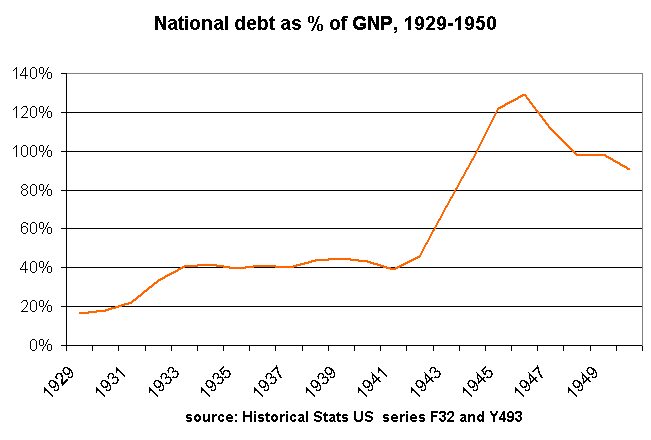
This can all be seen from this graph, which shows that US debt was flat for most of the GD - in other words no deficit spending - against what Keynes pleaded for.
2. Protectionism
Again, from Wiki:
Quote:
In June 1930, over the objection of many economists, Congress approved and Hoover reluctantly signed into law the Smoot–Hawley Tariff Act. The legislation raised tariffs on thousands of imported items. The intent of the Act was to encourage the purchase of American-made products by increasing the cost of imported goods, while raising revenue for the federal government and protecting farmers. However, economic depression had spread worldwide, and Canada, France and other nations retaliated by raising tariffs on imports from the U.S. The result was to contract international trade, and worsen the Depression.[110]
So you see, the idea that the GD was just 10 years of unrestricted liberal policies is a disingenuous libertarian fantasy.
Now. Back to the graph above. When did the US debt explode, and deficit spending really begin? The onset of WWII right? As I've been telling you - that's when Keynesianism really kicked in.
Quote:
If you consider having a world war with tens of millions of deaths an acceptable price for ending a depression, this might be a valid point
What exactly about WWII do you think ended the GD?? You think it was all the killing, and destruction? You think European bombing raids, gas chambers and ground offensives spurred US economic growth?
You're pretty confused here aren't you. Well I'll help you, and answer the question for you, but first I think I need to explain basic Keynesian theory to you. Keynes proposed that a government could theoretically spend money digging holes in the ground, and then burying jars of banknotes inside, and then leave it to private enterprise to dig up the jars of money for their own profit - and that this would boost employment, and the economy. And if the policy was carried out on a large enough scale it could boost a country out of a depression.
I'm telling you that this is exactly the role WWII played for the US economy. The US didn't put people to work digging holes in the ground and filling them in, but it did employ millions in the US military, and put them to work shooting and bombing Nazis and Japanese. The US didn't bury money for private companies to dig up, but it did give billions of $$$ of war materials/munitions contracts to US factories.
WWII was a massive (economic) waste of US money, manpower and resources - just like burying money in the ground - but it boosted the economy, just as Keynes' theory predicted it would.
It's not personal. It's just war.
NOTIFY: Y | REPLY | REPLY WITH QUOTE | PERMALINK | TOP | HOME

Quote:
Originally posted by SIGNYM:Quote:You figure this out by applying the scientific method, and the logic of cause and effect. You DON'T figure this out by being an ideologue.
So liberals credit deficit spending, like they always do, and conservatives credit tax cuts, as they always do. Who's right?
You do realize how funny it is for you to say this, don't you?
"When your heart breaks, you choose what to fill the cracks with. Love or hate. But hate won't ever heal. Only love can do that."
NOTIFY: Y | REPLY | REPLY WITH QUOTE | PERMALINK | TOP | HOME
Quote:
Originally posted by SIGNYM:
Oh, and please read my previous post, and my linked post, with comprehension this time. Because this will be approximately the 10th time I've repeated the same concepts since 2007. And I'm getting a little irritated with I didn't see it! and Signy didn't say so! and Let Signy prove it!.
I read your previous post. It's pretty funny that you complain about ideologues then go on an ideological "But Bush..." rant yet again.
And you seem to be in the same boat as KPO, deciding that if it takes a world war to end a depression, then that's a good thing. Somehow, I'm not too comfortable with that. It must be a liberal thing.
"When your heart breaks, you choose what to fill the cracks with. Love or hate. But hate won't ever heal. Only love can do that."
NOTIFY: Y | REPLY | REPLY WITH QUOTE | PERMALINK | TOP | HOME
Quote:
Originally posted by NewOldBrownCoat:Quote:
Originally posted by SIGNYM:
BTW GEEZER, there was a huge recovery under FDR from 1930-1936. By the spring of 1937, production, profits, and wages had regained their 1929 levels. But in 1936, the Federal Reserve had tightened the money supply, and the US Treasury had insisted in budget cuts and increased taxes to "balance the budget". As a result, the economy took a swift downturn in 1937. Your reading of the Great Depression, and the lessons to be learned from it, is superficial at best.
Thanx , Sig. That is the conventional theory of how the history went. I was gonna post that same point in refutation of Geezer, that's how I remembered learning it when I studied 20th Century history.
Unemployment right before the recession of 1937-38 was 14.3%. This is a success? Not sure how it refutes anything.
"When your heart breaks, you choose what to fill the cracks with. Love or hate. But hate won't ever heal. Only love can do that."
NOTIFY: Y | REPLY | REPLY WITH QUOTE | PERMALINK | TOP | HOME
Quote:
Originally posted by kpo:
You do realise that the first three years of the great depression a Republican was in charge? Have you only read revisionist libertarian history that told you Herbert Hoover was a liberal, or something?
(Funny. I thought you didn't want to discuss the Great Depression since it was so murky and all. But if you insist.)
Nope. Read wiki.
Quote:
When the Wall Street Crash of 1929 struck less than eight months after he took office, Hoover tried to combat the ensuing Great Depression with government enforced efforts, public works projects such as the Hoover Dam, tariffs such as the Smoot-Hawley Tariff, an increase in the top tax bracket from 25% to 63%, and increases in corporate taxes.[3] These initiatives did not produce economic recovery during his term, but served as the groundwork for various policies incorporated in Franklin D. Roosevelt's New Deal.
http://en.wikipedia.org/wiki/Herbert_Hoover
Quote:
Non liberal policies:
1. Balanced budgets during an economic downturn
Both Hoover and Roosevelt were keen to keep a balanced budget, even while the economy had not recovered. From Wiki:Quote:
Regarding the policies of President Hoover, economists like Barry Eichengreen and J. Bradford DeLong point out that President Hoover tried to keep the federal budget balanced until 1932Quote:
In June 1937, the Roosevelt administration cut spending and increased taxation in an attempt to balance the federal budget.[94] The American economy then took a sharp downturn, lasting for 13 months through most of 1938.Quote:
Calls for greater government assistance increased as the U.S. economy continued to decline. He (Hoover) was also a firm believer in balanced budgets (as were most Democrats), and was unwilling to run a budget deficit to fund welfare programs.
This can all be seen from this graph, which shows that US debt was flat for most of the GD - in other words no deficit spending - against what Keynes pleaded for.
Interesting. Per the Treasury, the actual amount of the national debt increased from $16 billion in 1929 to $48 billion in 1941. Not sure that this qualifies as keeping the budget balanced. http://www.treasurydirect.gov/govt/reports/pd/histdebt/histdebt_histo3
.htm
Quote:
2. Protectionism
Again, from Wiki:Quote:
In June 1930, over the objection of many economists, Congress approved and Hoover reluctantly signed into law the Smoot–Hawley Tariff Act. The legislation raised tariffs on thousands of imported items. The intent of the Act was to encourage the purchase of American-made products by increasing the cost of imported goods, while raising revenue for the federal government and protecting farmers. However, economic depression had spread worldwide, and Canada, France and other nations retaliated by raising tariffs on imports from the U.S. The result was to contract international trade, and worsen the Depression.[110]
So you see, the idea that the GD was just 10 years of unrestricted liberal policies is a disingenuous libertarian fantasy.
Smoot-Hawley was gone by 1934. The Depression remained.
Quote:
Now. Back to the graph above. When did the US debt explode, and deficit spending really begin? The onset of WWII right? As I've been telling you - that's when Keynesianism really kicked in.
Not if you look at the actual amount of debt as shown in my cite. Actual dollars of debt went up steadily from 1929 to 1941.
Quote:
What exactly about WWII do you think ended the GD?? You think it was all the killing, and destruction? You think European bombing raids, gas chambers and ground offensives spurred US economic growth?
You're pretty confused here aren't you.
Nope. I get the point of Keynesian theory. Throw enough money at it and recession/depression goes away. The problem is that you can't convince folks to dig hole
NOTIFY: Y | REPLY | REPLY WITH QUOTE | PERMALINK | TOP | HOME