

Conservatives have no ideas what to do about recessions
POSTED BY: kpo
UPDATED: Monday, March 9, 2026 17:30
VIEWED: 29022
PAGE 7 of 25

Quote:Because you still have failed to grasp the other part of what we were saying: Government spending worked. It's just that a LOT MORE was needed than what FDR and his economic advisors anticipated, and more than what conservatives would allow. It wasn't until WWII came along and squashed the objections of the conservatives by confronting them with a such a compelling challenge (world war) that they were FORCED to spend. Also, FDR, the old dog, apparently knew that the Japanese were going to bomb Pearl Harbor and allowed it to happen, knowing that this would get the ditherers off their seats- not only in terms of spending but also in terms of confronting a world threat.
I'm listening to you and SignyM tell me that the liberal policies of Hoover and Roosevelt took six years to reduce unemployment to 14.3%, and that the 1936 recovery wasn't sustainable and failed. I am still not finding this persuasive proof that liberal ideas of how to end a depression/recession work all that great.
But I think Keynes doesn't have it quite right. Under Keynesian theory, pumping up the money supply is good enough. In HIS theory, it doesn't matter where the money get injected. But the reality is that economies ARE driven by demand, and unless you can boost demand you can pump all kinds of money into th wealthy class and all you will do is drive up the cost of diamonds, fine art, and yachts. And that doesn't create enough demand to power an economy.
The point I keep making is that money is like blood: It doesn't do any good unless it's circulating. The rate of exchange of money is called it's velocity]: A dollar bill can be used to power one exchange per year, or it can be used to power 1000. The higher the velocity, the more the economic activity. Adding more money to a moribund economy is a bit like infusing a corpse: unless that money is going to power purchases of goods, which powers employment, which creates further demand for more goods and services etc all you will do is bloat up the body. As long as money is being hoarded and sequestered by the wealthy, who really DON'T create demand, the stimulus will bypass the vast majority of people.
All you have to do is look at the USA and the EU for examples of what NOT to do.
The EU is an extreme example. They not only didn't do the right things, they specifically did the wrong things. The EU technocrats were extremely worried about "the value of the EU". So in response to the financial crisis (created by private banks) the EU banking technocrats did two things: (1) They did not backfill the failing banks with money from the European Central Bank (ECB) or any of the other stabilization mechanisms that they had on-hand. Instead they required that the individual national governments take up that task. (Why, I don't know, since the national governments neither borrowed the money nor wrote the laws under which the EU banks operated). And (2) They required that the national government not create additional debt (deficit spending) in order to fill bank coffers. Instead, the national governments had to take money out of their social programs ... literally, money from the mouths of the hungry... in order to prop up the banks.
The result? An economic depression which is still going on in some nations... 70% youth unemployment, sharp drops in GDP, riots, starvation, the works.
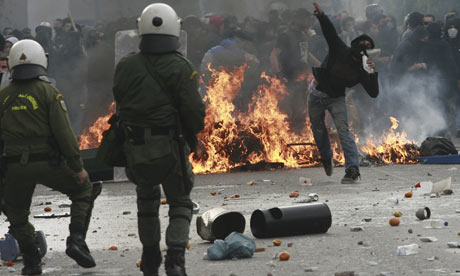
And an "economic recovery" is some nations which is creating hordes of newly-poor. So Britain, for example, altho technically in recovery is experiencing the biggest fall in individual standard of living since Victorian times.
http://www.independent.co.uk/news/uk/politics/the-poorest-pay-the-pric
e-for-austerity-workers-face-biggest-fall-in-living-standards-since-victorian-era-8991842.html
As far as the USA is concerned, let's take a look at GWB's policy to
NOTIFY: Y | REPLY | REPLY WITH QUOTE | PERMALINK | TOP | HOME
GEEZER Also, government spending 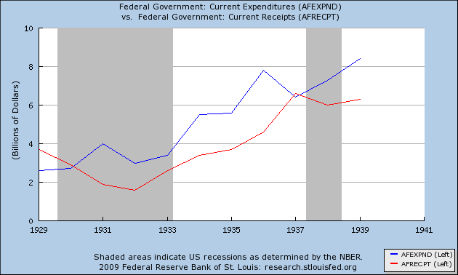
I assume you see the drop in spending? So much wrongness in just a few posts, I can't even begin to address it all.
NOTIFY: Y | REPLY | REPLY WITH QUOTE | PERMALINK | TOP | HOME

Quote:
Originally posted by Geezer:
Talk to KPO. He thinks that the FDR administration, despite tripling the national debt, wasn't spending enough until WWII came along and bailed the Keynesians out.
With the debt of the Great Depression it is very likely there was not enough spending.
Quote:
Originally posted by Geezer:
Sort'a like what Coolidge was doing after WWI. He dropped the national debt from $26 billion to $16 billion by cutting government spending and cutting taxes.
Yes, it could be argued that he should have simple cut the spending and kept the taxes near where they were to lower the debt even more and offering even more of a cooling effect.
I do not fear God, I fear the ignorance of man.
I do not fear God, I fear the ignorance of man.
NOTIFY: Y | REPLY | REPLY WITH QUOTE | PERMALINK | TOP | HOME

Quote:
Talk to KPO. He thinks that the FDR administration, despite tripling the national debt, wasn't spending enough
First of all, the national debt before FDR was small, so tripling it does not necessarily mean FDR spent massively. Secondly, again, look at the graph of debt/GDP -

FDR came in in 1933, and kept debt as a proportion of GDP steady. So although the debt increased in dollar amounts, FDR practiced fiscal restraint and kept the debt burden steady - against what Keynes recommended. So yes, I would say FDR didn't spend enough - the GD could've ended much sooner!
Quote:
until WWII came along and bailed the Keynesians out.
Do you have your own, non-Keynesian explanation for how WWII ended the Great Depression? If not then wouldn't it have been much better if FDR had spent massively in 1933, instead of 1941, and pulled America out of the GD sooner?
Another two points about Keynesian spending:
1. It's only ever practised when the economy is in a mess.
2. It's usually practised on a half-hearted scale, with too many people fretting about deficits
These two facts together mean that the result of stimulus spending is rarely resoundingly successful, and usually the economy will still be in a weak state afterwards (though better than it was, and would've been). So people will question whether the stimulus did anything at all. The answer is invariably yes, but the spending was not big enough.
It's not personal. It's just war.
NOTIFY: Y | REPLY | REPLY WITH QUOTE | PERMALINK | TOP | HOME
Oh BTW- this sums up Keynes quite nicely.
http://en.wikipedia.org/wiki/Keynesian_economics
If you use Wikipedia, please donate. I do.
NOTIFY: Y | REPLY | REPLY WITH QUOTE | PERMALINK | TOP | HOME

Quote:
Originally posted by SIGNYM:
Because you still have failed to grasp the other part of what we were saying: Government spending worked. It's just that a LOT MORE was needed than what FDR and his economic advisors anticipated, and more than what conservatives would allow. It wasn't until WWII came along and squashed the objections of the conservatives by confronting them with a such a compelling challenge (world war) that they were FORCED to spend. Also, FDR, the old dog, apparently knew that the Japanese were going to bomb Pearl Harbor and allowed it to happen, knowing that this would get the ditherers off their seats- not only in terms of spending but also in terms of confronting a world threat.
I grasp what you and KPO are saying. I'm just appalled by it.
You're saying that a world war every once in a while is GOOD for the economy, and apparently should be encouraged, including losing lives in a 'surprise' attack you knew was coming to get those 'ditherers off their seats'. I'm surprised that you don't absolutely love Bush II for keeping us in wars for most of his term. Or maybe they just weren't big enough for you.
Quote:
But I think Keynes doesn't have it quite right. Under Keynesian theory, pumping up the money supply is good enough. In HIS theory, it doesn't matter where the money get injected. But the reality is that economies ARE driven by demand, and unless you can boost demand you can pump all kinds of money into th wealthy class and all you will do is drive up the cost of diamonds, fine art, and yachts. And that doesn't create enough demand to power an economy.
Sort'a like Storymark's cites about the income inequality arising from the Obama Administration's response to the 2008 recession?
Quote:
The point I keep making is that money is like blood: It doesn't do any good unless it's circulating. The rate of exchange of money is called it's velocity]: A dollar bill can be used to power one exchange per year, or it can be used to power 1000. The higher the velocity, the more the economic activity. Adding more money to a moribund economy is a bit like infusing a corpse: unless that money is going to power purchases of goods, which powers employment, which creates further demand for more goods and services etc all you will do is bloat up the body. As long as money is being hoarded and sequestered by the wealthy, who really DON'T create demand, the stimulus will bypass the vast majority of people.
Interesting that what you see as 'hoarded and sequestered' I see as invested. I'm assuming that your method of getting money moving would be to take it from those more well off and start a new version of the CCC to distribute it to those less well off. (Oh. As I read farther I see that it is)
Quote:
The EU is an extreme example. They not only didn't do the right things, they specifically did the wrong things. The EU technocrats were extremely worried about "the value of the EU". So in response to the financial crisis (created by private banks) the EU banking technocrats did two things: (1) They did not backfill the failing banks with money from the European Central Bank (ECB) or any of the other stabilization mechanisms that they had on-hand. Instead they required that the individual national governments take up that task. (Why, I don't know, since the national governments neither borrowed the money nor wrote the laws under which the EU banks operated). And (2) They required that the national government not create additional debt (deficit spending) in order to fill bank coffers. Instead, the national governments had to take money out of their social programs ... literally, money from the mouths of the hungry... in order to prop up the banks.
But isn't backing up the banks an example of Keynesian interventionism? Sort'a like this?
http://www.beyondthemargin.net/2009/09/keynesian-ec
NOTIFY: Y | REPLY | REPLY WITH QUOTE | PERMALINK | TOP | HOME
Quote:
Originally posted by M52NICKERSON:Quote:
Originally posted by Geezer:
Sort'a like what Coolidge was doing after WWI. He dropped the national debt from $26 billion to $16 billion by cutting government spending and cutting taxes.
Yes, it could be argued that he should have simple cut the spending and kept the taxes near where they were to lower the debt even more and offering even more of a cooling effect.
Checking here...
http://www.usgovernmentrevenue.com/breakdown_1929USmt_15ms1n
...total government revenue, even with tax cuts, went up every year from 1923 to 1929. Tax cuts put more money in circulation so income (and income taxes), government fees, etc. went up.
As noted before, during this period the national debt was also reduced by more than a third.
"When your heart breaks, you choose what to fill the cracks with. Love or hate. But hate won't ever heal. Only love can do that."
NOTIFY: Y | REPLY | REPLY WITH QUOTE | PERMALINK | TOP | HOME
Quote:
So it was Hoover and Roosevelt who had no idea what to do about recessions?
They both did poorly. This shouldn't be a surprise - we're talking about the Great Depression here. A lot of FDR's policies promoted long term growth, which was good, but not the short term growth that was needed.
Quote:
So Smoot-Hawley may have had an effect
Good. So no more talk about '10 years of liberal policies', as if there are no other variables.
Quote:
Quote:
2. Things started to improve around that time (until 1937, when FDR enacted austerity)
Because the Keynesians couldn't convince enough folks to bury jars of money?
That's a foolish statement, and a non sequitur.
Quote:
And this was all Smoot-Hawley's fault? Nothing else caused it?
If you owned an export business then yes, it's likely that Smoot-Hawley killed your factory. But the only person blaming the GD on a single factor is yourself, Geezer. I'm saying there are many factors.
Quote:
This graph shows Federal spending as a percent of GDP went from less than 4% in 1929 to almost 11% in 1936. Doesn't look like spending was being brakes much to me.
http://www.usgovernmentdebt.us/spending_chart_1920_1940USp_15s1li011mc
n_F0f_US_Federal_Spending
Nice graph. Yes spending went up, BUT revenues increased at about the same rate. So the government was putting money into the economy at about the same rate that it was taking it out. Not what Keynesianism calls for. As I said, the US was being fiscally neutral at a time when Keynes called for deficit spending
Quote:
You and others talk about the unlikeliness of selling Libertarian philosophy to the masses. I suggest that your version of Keynesian economics would be just as hard a sell.
I don't recall saying that about Libertarianism, but regarding Keynesian economics - absolutely! People have an emotional reaction to it. They're offended by it. That doesn't mean it's wrong though.
It's a question of the lesser of two evils. Ramping up the debt and paying it back later when the economy is healthy, or keeping the economy in the doldrums, and leaving millions unemployed and in hardship.
Quote:
I grasp what you and KPO are saying. I'm just appalled by it.
You're saying that a world war every once in a while is GOOD for the economy
You apparently don't have a clue what we're saying.
Quote:
So when Bush created debt through deficit spending it was BAD, but when Obama created debt through deficit spending it was GOOD
SignY, M52, do either of you want to take this or shall I?
Quote:
But...But... KPO blamed tariffs
KPO and Signy are two different people...
Quote:
...total government revenue, even with tax cuts, went up every year from 1923 to 1929. Tax cuts put more money in circulation
The economy grew. Don't jump to conclusions that this was down to tax cuts.
It's not personal. It's just war.
NOTIFY: Y | REPLY | REPLY WITH QUOTE | PERMALINK | TOP | HOME
Quote:
Originally posted by Geezer:Quote:
Originally posted by M52NICKERSON:Quote:
Originally posted by Geezer:
Sort'a like what Coolidge was doing after WWI. He dropped the national debt from $26 billion to $16 billion by cutting government spending and cutting taxes.
Yes, it could be argued that he should have simple cut the spending and kept the taxes near where they were to lower the debt even more and offering even more of a cooling effect.
Checking here...
http://www.usgovernmentrevenue.com/breakdown_1929USmt_15ms1n
...total government revenue, even with tax cuts, went up every year from 1923 to 1929. Tax cuts put more money in circulation so income (and income taxes), government fees, etc. went up.
As noted before, during this period the national debt was also reduced by more than a third.
"When your heart breaks, you choose what to fill the cracks with. Love or hate. But hate won't ever heal. Only love can do that."
Okay, but that has little to do with Keynesian economics. If does not matter how much or how little the government debt is. What matter is how much money the government is puting into the economy as opposted to how much it is talking out.
Had government spending been lower, and taxes stayed high the economy of the 20's may not have been as roaring but it might have helped prevent the Great Depression.
I do not fear God, I fear the ignorance of man.
NOTIFY: Y | REPLY | REPLY WITH QUOTE | PERMALINK | TOP | HOME
Quote:And yet, you're not appalled by the fact that the top 1% of our population take in more than the bottom 50% of total national income? Why not?
I grasp what you and KPO are saying. I'm just appalled by it.
Quote:No, we're saying that the spending required to re-ignite the economy would need to be the EQUIVALENT OF a war. I even lined out an entire spending program which... amazingly... has not one war in it! Despite the fact that we have REPEATEDLY said... over and over... that war per se is not the answer, why do you keep insisting that is our goal? Please DON'T BRING THIS UP AGAIN, or you will look like even more of a tool than you already do.
You're saying that a world war every once in a while is GOOD for the economy
Quote:Just because the wealthy have money piled somewhere doesn't mean it's being "invested" in economically productive ventures. Not sure if you know this, but the wealthy are "investing" their money either in already-produced unique items (diamonds, gold, Bitcoins, fine art) or in futures/ hedge funds. This is part of a complex discussion about what happens to "savings", already addressed by Keynes and other economists.
Interesting that what you see as 'hoarded and sequestered' I see as invested.
Quote:No. The main point of Keynesianism is to increase the money supply. If all you're doing to back up the banks is to take money from somebody else, that's not part of the plan.
But isn't backing up the banks an example of Keynesian interventionism? Sort'a like this?
Quote:No, you missed the point (again). When Bush created debt thru government spending and increased the wealth gap, that was bad. When Obama created debt through government spending and provided long-term unemployment, that was good. However, since he hasn't been able to reduce the wealth gap, he hasn't made any progress. The seeds of the next recession/ depression are still with us.
So when Bush created debt through deficit spending it was BAD, but when Obama created debt through deficit spending it was GOOD and should have been allowed to continue. No ideologues here.
Quote:KPO and I don't agree on everything. Indeed, I don't agree with Keynes 100% either, but I agree with him a lot more than almost any other economist.
But...But... KPO blamed tariffs, specifically Smoot-Hawley, for worsening the Great Depression. And wouldn't tariffs be more a conservative thing?
Quote:In a tit-for-tat trade war, we'd come out ahead.
Got no problem with decreasing need for oil and gas, but still think it'll take a long time to accomplish, especially if you want to boost agriculture (which is particularly oil-dependent) at the same time. I might also point out that if we impose manufacturing tariffs on other countries, I'd bet they'll impose agricultural tariffs on us. Then we got lots of food we can't sell.
Quote:Not if you increase production at the same time. That is the OTHER part of my plan: Increase production (manufacturing specifically).
And the price of everything goes up. Not saying this is a bad thing, but its something of which you need to be aware.
Quote:And so...?? During our most economically prosperous times, the highest marginal tax rate was 90%. Other than your knee-jerk reaction, do you have a specific objection?
Saw that coming. [Increase taxes on the wealthy, and eliminate corporate tax loopholes.]
Quote:
My point being that 'a raised minimum wage, single-payer health care, higher taxes in the rich, reduced military spending, and so forth' isn't what you and KPO have been selling here. You're selling deficit spending at massive rates, preferably powered by world war.
 Are you being stupid on purpose? T
NOTIFY: Y | REPLY | REPLY WITH QUOTE | PERMALINK | TOP | HOME