

Mal4Prez nails the climate change debate...
POSTED BY: kpo
UPDATED: Tuesday, October 11, 2011 04:17
VIEWED: 12057
PAGE 2 of 11

Plus ça change, plus c'est la même troll.
HKCavalier
Hey, hey, hey, don't be mean. We don't have to be mean, because, remember, no matter where you go, there you are.
NOTIFY: Y | REPLY | REPLY WITH QUOTE | PERMALINK | TOP | HOME

Well, the last time little Rappy tried to have a thought, it was that the inhaler being taken off the market MUST be Obama's fault - just like everything else! A notion he clung to even after the FDA press release was posted citing the Montreal Protocol and the CFC propellant. You could almost see him beaming with pride 'cause > HE < figured the propellant MUST be absorbed. Except he figured wrong. No wonder he clings to other people's ideas - his own thinking has let him down so terribly. It goes awfully, horrendously wrong. And then he gets confused. And doesn't know what to think.
Remember when teachers, public employees, Planned Parenthood, NPR and PBS crashed the stock market, wiped out half of our 401Ks, took trillions in taxpayer funded bailouts, spilled oil in the Gulf of Mexico, gave themselves billions in bonuses, and paid no taxes?
Yeah, me neither....
NOTIFY: N | REPLY | REPLY WITH QUOTE | PERMALINK | TOP | HOME

Quote:
Originally posted by mal4prez:
OK, if my post starts a thread, I get to define a rule: it shall not be taken over by back and forths with he who posts the same long ago refuted shit with absolutely no supporting facts or links. You all know what I mean.
If this thread doesn't become another yawn-fest of prove-Rappy-wrong, I'll finally get down to posting pictures I took of a museum exhibit in Fairbanks, AK last summer. (It took me this long to find the cable and connect to my camera.) Very disturbing images and data - yes DATA - about changes in temperature and glacier size up there.
I'd do it now, but I'm heading out the door. Should have time this afternoon.
BTW, thank you KPO. I feel the compliment!
-----------------------------------------------
hmm-burble-blah, blah-blah-blah, take a left
Oh, and by the way M4P, if I didn't say it in the other thread, you DID nail this, well and truly. You nailed it like Martin Luther nailing his Ninety-Five Theses to the church door.

We don't see eye to eye on some things (a very few things, it seems), but as I've said before, you are 37 kinds of awesome.

"Although it is not true that all conservatives are stupid people, it is true that most stupid people are conservatives." - John Stuart Mill
NOTIFY: Y | REPLY | REPLY WITH QUOTE | PERMALINK | TOP | HOME

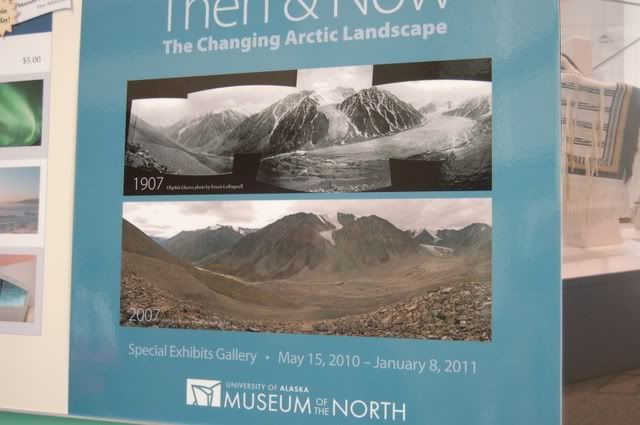
University of Alaska – Fairbanks Museum Exhibit, July 2010
Notes from mal4prez: I wasn’t allowed to use a flash in the museum, so the pictures are a bit blurry. The text will be hard to read, so I’ve typed it in, as well as the descriptions that were hanging on the walls next to the glacier photographs.
There were a lot more photographs in the exhibit, but not all of them came out well on my old camera. There’s enough here to get the point. I’ll put my comments in italics, though I’ll try not to make many.
And bear with me for a minute – I’ll likely have to do some picture resizing.
Shrinking Glaciers
Glaciers are valuable indicators of climate change because ice responds directly to temperature and precipitation. Repeat photos can dramatically capture the advance or retreat of glaciers.
Climate is the main factor affecting all glaciers. But not all glaciers behave the same. Over centuries, some tidewater glaciers (those that end at the ocean) go through a natural cycle of advance and retreat, independent of climate.
Glaciers in Alaska’s Brooks Range only retreat as a result of changes in climate. Aerial images and repeat photos show that all Brooks Range glaciers are shrinking. Some have disappeared entirely. Emphasis theirs.
Okpilak Glacier: photographed in 1907 by Ernest Leffingwell, 2007 by Matt Nolan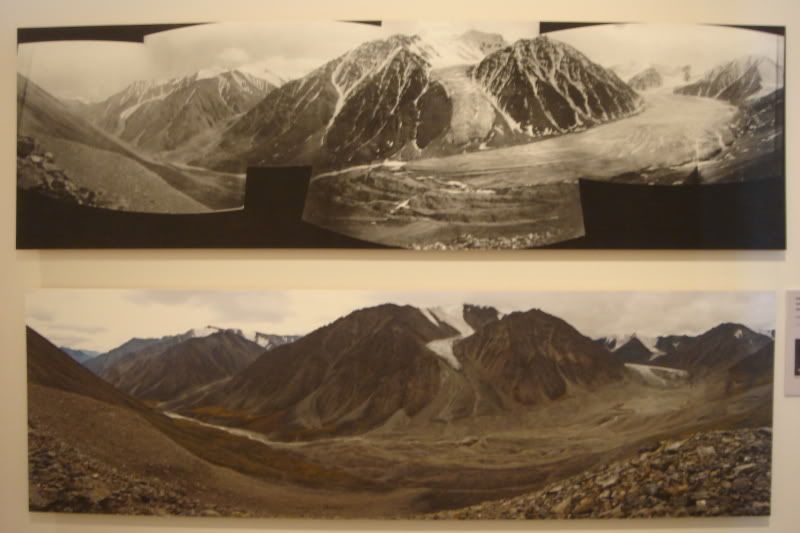
I didn’t photograph the caption of this one: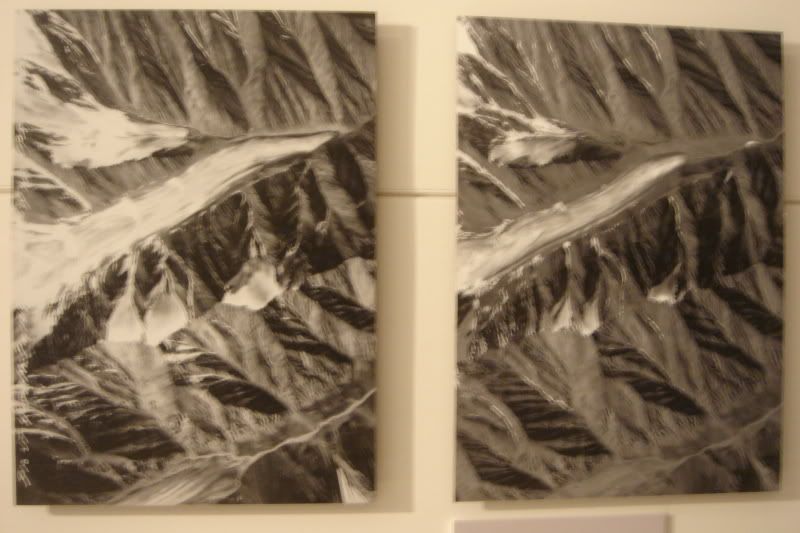
Unnamed glaciers, eastern Brooks Range. Attempts to repeat the entire old photo were hampered by bad weather. Individual repeat photographs from a helicopter show glaciers that are retreating. Photograph from 1950: Col-photo [?] collection, 2007 by Ken Tape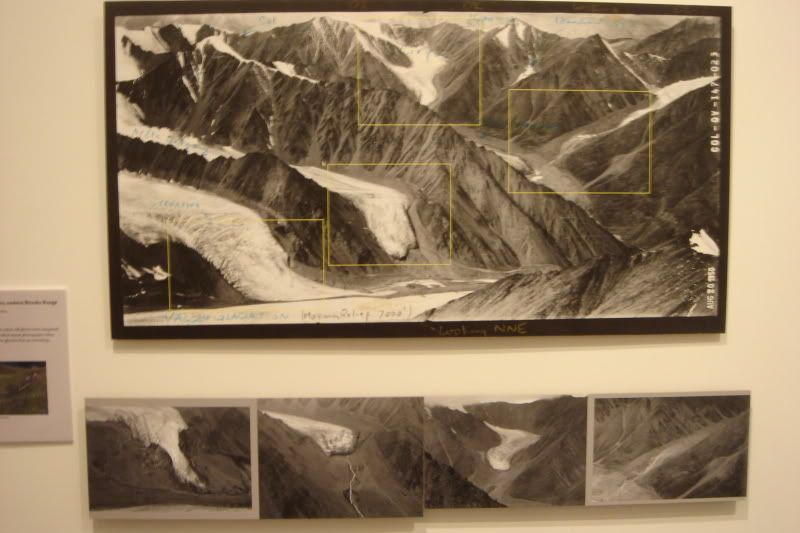
-----------------------------------------------
hmm-burble-blah, blah-blah-blah, take a left
NOTIFY: Y | REPLY | REPLY WITH QUOTE | PERMALINK | TOP | HOME
The Arctic and Beyond
When temperature and precipitation patterns change, so does the landscape. Repeat photos from Alaska’s Arctic tell a story of more shrubs and less ice.
Changes in the Arctic ultimately affect the heat balance of the entire earth. While polar regions have warmed quicker, the rest of the planet is not far behind. Changes here foreshadow changes elsewhere.
(smaller font) The total change in average annual temperature from 1951-2009 for the hemisphere (right) and from 1949-2009 for Alaska (below).
Note – the colorscale is
white: 0˚F
yellow: 0.36 – 0.9 ˚F
orange: 0.9 – 1.8 ˚F
dark orange: 1.8 – 3.6˚F
red: 3.6 - 7.2˚F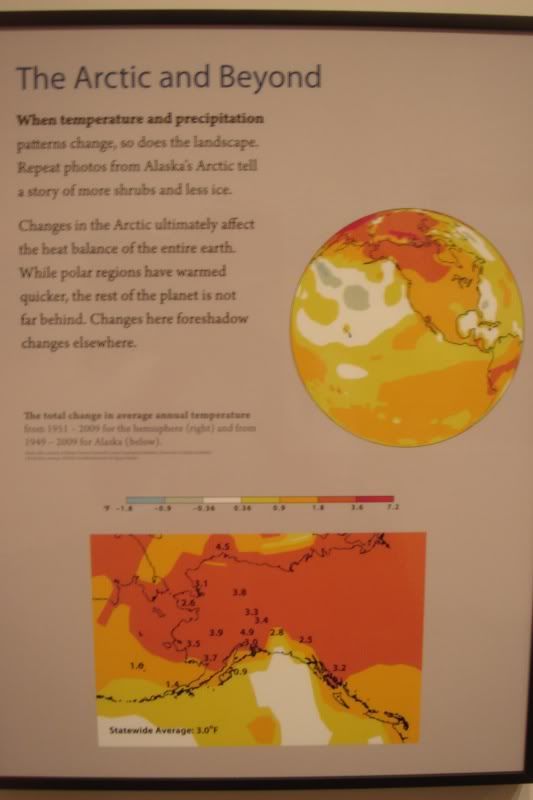
Fairbanks – Barrow Mean July temperature
from 1930 to today, vertical scale varies from 44˚F to 56˚F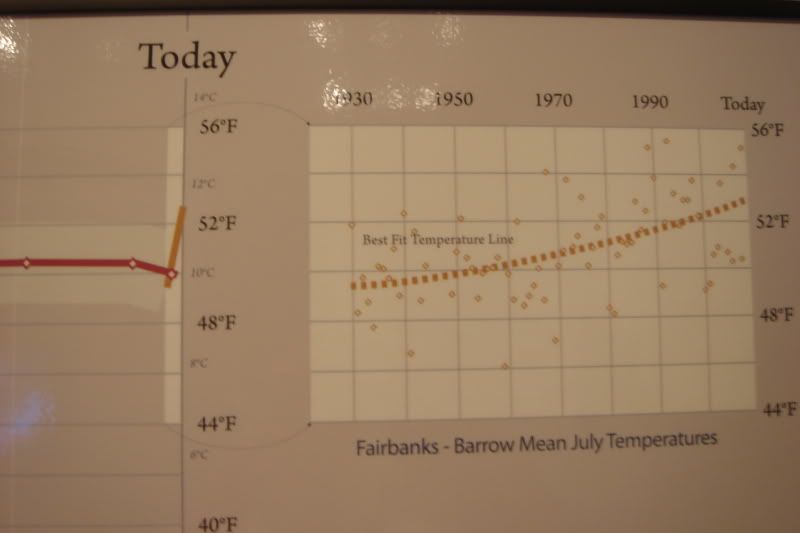
Note the end of the graph to the left. The sharply upward turning orange line is the trend from the plot on the right. The rest of the graph on the left stretches the scale back 20,000 years. That’s to the last ice age. I could only get it in one picture from an angle. You can see how sharp the upturn is, and that the temperature is now hotter than it's been since the last ice age.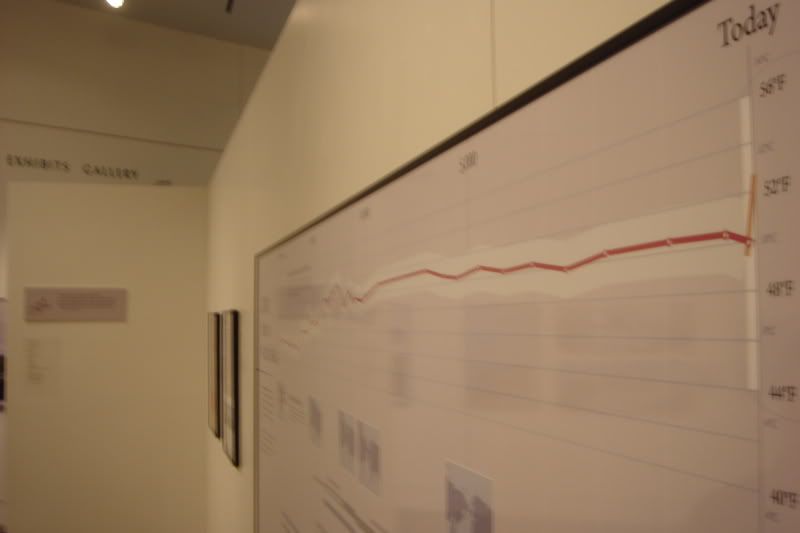
And how do they know temperatures going back 20,000 years? From a side board:
Discovering Past Temperature
Scientists sometimes use unusual methods. To learn about past climates, they have found tiny midge flies helpful.
Midge fly larvae live in lakes. As they change into adults they leave behind part of themselves in the sediment at the lake’s bottom. Scientists can take a core of lake sediment and date the mud layer by layer. There are many different species of midge flies, and some survive better than others at different temperatures. By sorting and counting the proportion of different midge species within a layer, the average summer temperature for a given time period can be estimated.
Other methods can also be used to find past temperatures. Core cores from ice sheets, scientists have learned about earth’s climate up to 700,000 years ago. The lake sediment method provides a more localized estimate of temperature.
At Burial Lake in Alaska’s Arctic, scientists have cored deep enough to reconstruct the temperature 20,000 years in to the past.
-----------------------------------------------
hmm-burble-blah, blah-blah-blah, take a left
NOTIFY: Y | REPLY | REPLY WITH QUOTE | PERMALINK | TOP | HOME
The exhibit addressed the past 100 years and the past 20,000 years. So how about further back? For that, see Plows, Plagues, and Petroleum by Ruddiman. I’ll sum up his findings here with a few figures. (I’ve posted this stuff before, twice I believe. But what the hell.)
True, the earth’s climate goes through natural cycles of ice ages. Ice cores and geological data show that earth has had at least 4 regular cycles 100,000 years or so in length. Each cycle has about 80,000 years of ice age with 20,000 year breaks for warm weather. We’re in one of those breaks right now.
That’s right - ice ages are the more common state of things. I hadn’t realized it, but there’s convincing evidence of it.
The ~100,000 year long cycles have been shown to correspond very well to orbital variations caused by the location of the other planets. When the Earth is in an orbit where it gets more intense summer sun at the northern latitudes, (so the orbit is highly elliptical and perihelion falls at the summer solstice), ice sheets in Canada, Alaska and Siberia melt enough in the summer that they shrink. Ice sheets draw back from the US and Europe and central Asia, the long ice age ends, and the short break begins.
Evidence: see the peaks at present day (far left), then at 120 kya (kya = 1000 years ago), 240 kya, 340 kya. These are peaks in temperature, atmospheric CO2, and atmospheric methane. This is all from Volstok Ice cores. Orbital variations (modeled) are on the bottom. There are some time shifts, likely due to error in aging the ice cores, but the pattern corresponds quite well with variations in heavy oxygen in the atmosphere – an indicator of temperature. That’s in the second to bottom plot.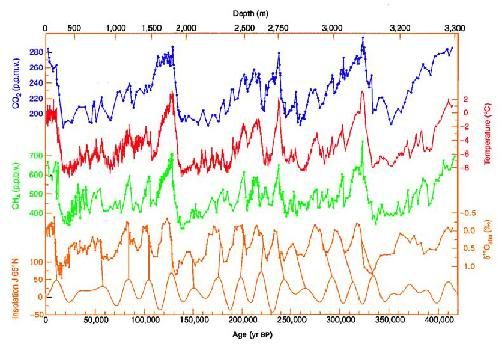
And now from Ruddiman: methane levels and solar radiation at 65˚ North latitude, graph below. Hot sun = more methane in the atmosphere. Even before humans. But wait – what’s that happening at the far right. (Present day is to the right on this graph, opposite from the one above.) Why haven’t the methane levels fallen as solar radiation decreases? What has been different in this past 10,00 years that wasn’t around in the 200,00 years before?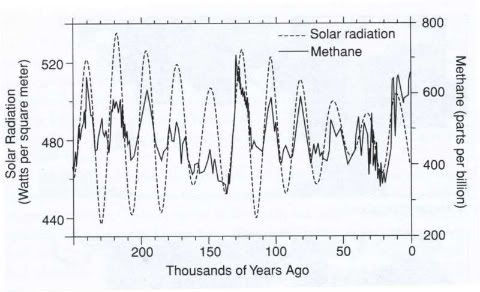
-----------------------------------------------
hmm-burble-blah, blah-blah-blah, take a left
NOTIFY: Y | REPLY | REPLY WITH QUOTE | PERMALINK | TOP | HOME
And my last post:
The last end-of-ice-age happened about 20,000 years ago. Which means we’re due to go back under the ice sheets. At this point of the last 4 cycles, (geological evidence of this is described and referenced in Ruddiman’s book) ice was growing in northeast Canada. But it’s not this time. In fact, this cycle the glaciers are melting, disappearing completely. (See Fairbanks museum above.)
So again - what’s different this time? What’s happened during this break in the ice eras, over the last 20,000 years, that never happened before? What started 8000 years ago that might have affected CO2 levels?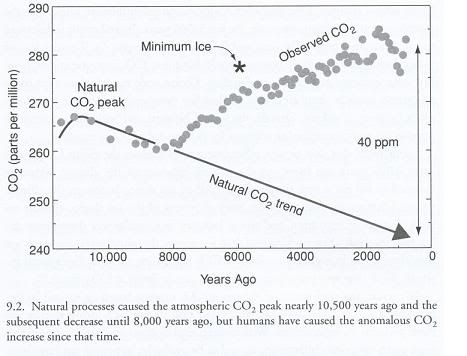
And 5000 years ago that might have affected methane levels?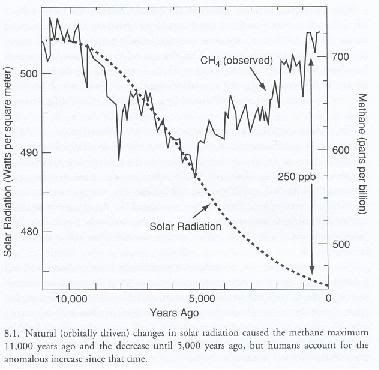
And if agriculture and rice irrigation did this, (which is how Ruddiman answers the 8000 and 5000 year ago questions) what could be the effect of pulling tons of carbon out of the earth and dumping it into the atmosphere in an extremely short time?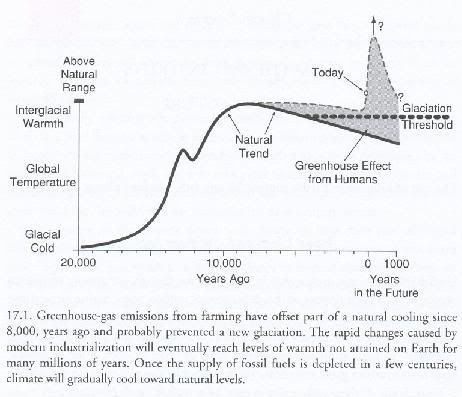
Enough to stop an ice age? Enough to throw off the natural cycles of the earth's climate?
-----------------------------------------------
hmm-burble-blah, blah-blah-blah, take a left
NOTIFY: Y | REPLY | REPLY WITH QUOTE | PERMALINK | TOP | HOME

Hehe...
You and your environmentalist ways....
Reminds me of how I question every day if there was a god.
I wish I had your conviction.
I've never been so sure about anything so unpredictable and unprovable as what you're talking about in my life.
God, how I envy you. 
"A government is a body of people, usually notably ungoverned."
NOTIFY: Y | REPLY | REPLY WITH QUOTE | PERMALINK | TOP | HOME

I'm a pretty ardent environmentalist and I feel this particular issue is buried, and was decided in auraptor's favor.
I posted the relevant math here several times and tried to draw attention to the science so that we could actually debate it, but no one was at all interested in discussing the issue from a science perspective.
If I have to classify this one, I'll put it in the Alex Jones corner, something Pirate News probably already thought of: It's a form of panic-mongering to get the people to enact radical policy, much like the war on terror and other dubious dangers.
There are very real and damaging effects on the environment caused by humans. IMHO, this is not one of them. This is a distraction from the cause, much like animal rights, anti-nuclear power, etc.
The issues I feel represent a serious threat to life on earth, ourselves included, re: the environment are species loss; habitat loss; population depletion; deforestation; overfishing; pollution (air, water, earth); the contamination of our food with non-comestibles; environmental degradation done by radical mining practiced (mountaintop removal, fracking, the alberta-pipeline project) etc.
But the fractional change in co2, which is not caused by industrial emissions, is not having a deleterious effect on the planet. The change in weather patterns is also not all that remarkable, weather patterns change all the time.
This to me is like focusing on sharia law as a threat to american liberty while ignoring the patriot act, the war, gitmo, torture, habeas corpus, etc. etc. etc.
Focus, people.
Peace out.
ETA: Correlation doesn't prove causality. Even so, what would you rather have for a co2 level? Also, the ice age ended more recently than that, and no, we're not due for another one. It's not coming, actually. There is no end of the world here, but we could lose a lot of what we have if we don't stop and pay attention to the real world. I'm afraid this story is fantasy.
Consider the output of industrial co2, compared with the yearly intake and output of the planet. The co2 level is rising because of deforestation, even a cursory look at the math makes that obvious.
On the other hand, the co2 rise itself is not a threat. There's not really a strong historical correlation, in spite of those charts. Look longer term. Sure, if it got up into the thousands you might see a greenhouse effect. Not a deadly runaway burning planet, but a rise in temp. However, you can't get up into the thousands because there's not enough free carbon left on the Earth. it's all trapped in limestone as the result of aeons of microscopic shelfish.
Maybe in a few hundred million years, that could be a problem. I'm more worried about what could happen in the next 20 if we don't change our policies on forests, fishing, water and air pollution and our own exposure to toxics and the consumption of food substitutes.
One milliliter of TCE in your water can kill you. Doesn't it bother you that the president's energy plan currently calls for pouring a million gallons of it into your water supply? Yes, it's the evil corporations, yes, it's the evil govt., yes it's the evil republicans, yes, it's the evil democrats. It's the evil. Stop the evil. Don't fuss around with fantasyland. Deal with the real consequences.
IIRC, when I did the math on this one I estimated the annual consumption of carbon to be somewhere around 50 trillion tons. There isn't that much carbon of course. That's because it gets cycled through many times over.
If it seems like I'm belittling the issue, that's because I am. This is a science fiction translation of "the end is nigh."
The co2 consumption of photosynthesis is 2,000 times the total human industrial production. The reason co2 is rising is that we cut the consumption through environmental destruction. Ergo, it will continue to rise until the equation balances out. There's not really anything we can do about it, except stop destroying the planet. But no change in US fossil fuel consumption will have an effect
NOTIFY: Y | REPLY | REPLY WITH QUOTE | PERMALINK | TOP | HOME
Quote:
Consider the output of industrial co2, compared with the yearly intake and output of the planet. The co2 level is rising because of deforestation, even a cursory look at the math makes that obvious.
So after agreeing with Rappy, you just threw him under the bus with that paragraph. That *IS* man-assisted global warming, right there. Or do you think those forests are chopping themselves down?
NOTIFY: Y | REPLY | REPLY WITH QUOTE | PERMALINK | TOP | HOME