

Vertical Farming
POSTED BY: Khyron
UPDATED: Thursday, June 21, 2007 09:06
VIEWED: 3487
PAGE 1 of 1

What do y'all think of this?
http://www.verticalfarm.com/
Questions are a burden to others. Answers are prison for oneself.
NOTIFY: N | REPLY | REPLY WITH QUOTE | PERMALINK | TOP | HOME
Incredibly resource-intensive. Given that we run this place for profit, I can't imagine that anyone would build VFs no matter how much they may be needed.
---------------------------------
Always look upstream.
NOTIFY: Y | REPLY | REPLY WITH QUOTE | PERMALINK | TOP | HOME
Quote:How do you figure?
Originally posted by SignyM:
Incredibly resource-intensive.
Questions are a burden to others. Answers are prison for oneself.
NOTIFY: N | REPLY | REPLY WITH QUOTE | PERMALINK | TOP | HOME
A) The capital outlay for the structure, pumps, etc. The structure has to be very strong because it's mostly windows, so that eliminates cheap concrete structures and requires steel for the suports and "floors" of each level. The "floors" will need to be resistant to corrosion from humic acids.... possibly we're talking stainless steel The windows SHOULD be able to pass broad-spectrum light because chlorophyll absorbs partially in the UV. Pumps will be needed to carry the water to the tops of the tower. YOU MAY need shades to control the temperature.
B) Operating costs: pumps, ventilation*, temperature control. (*Plants do not do THAT well in high-CO2 atmospheres.)
---------------------------------
Always look upstream.
NOTIFY: Y | REPLY | REPLY WITH QUOTE | PERMALINK | TOP | HOME
A) Have you seen what skyscrapers, even supertalls, are made out of these days? Concrete and glass cladding ( http://www.skyscrapercity.com/). If you look at the VF website, the estimated building cost is around $83.7 million, which is very little compared to the cost of most skyscrapers that are currently being built.
B) The website addresses those points.
Even if your points were decent, which I don't think they are, do you think something like this would be more resource-intensive than conventional modern agriculture?
Questions are a burden to others. Answers are prison for oneself.
NOTIFY: N | REPLY | REPLY WITH QUOTE | PERMALINK | TOP | HOME

Not viable, believe me, it wouldn't work, but it would take an engineer to give you a detailed explaination.
-F
NOTIFY: N | REPLY | REPLY WITH QUOTE | PERMALINK | TOP | HOME

"do you think something like this would be more resource-intensive than conventional modern agriculture?"
The only people I know of who make money on this kind of resource intensive farming are pot-growers.
***************************************************************
"Global warming - it's not just a fact, it's a choice."
NOTIFY: N | REPLY | REPLY WITH QUOTE | PERMALINK | TOP | HOME
Have any of you even read what's written on the website!?
Here we have a seemingly good, eco-friendly idea that's being dismissed out of hand by the so-called environmentalists on this board, without valid explanation or reason.
Fremd, there's no question that some minor aspects will present engineering challenges, but I'm curious to know what specifically you were referring to, and why this would make the project unviable.
Rue, the point is that it's less resource-intensive. But the fact that the only people you know who make money from "this kind of" farming are pot-growers tells us a lot about what kind of acquaintances you have and how limited your knowledge on the subject is.
Questions are a burden to others. Answers are prison for oneself.
NOTIFY: N | REPLY | REPLY WITH QUOTE | PERMALINK | TOP | HOME
Khyron - I didn't say I KNEW these people, I said I knew ABOUT them. And you immediately jumped to an (ill-aimed) insult. Says something about you in a lot of ways, not the least of which is your inability to read with understanding.
http://www.wolvertonenvironmental.com/
Wolverton (NASA researcher studied creating space-bound natural air and water purification systems) wrote several books - "how to grow fresh air" and "growing fresh water" both of which I've read. They are not directed toward intensive crop production but they do highlight the extent one has to go to to create these type of intensive systems.
I looked at various parts of the site and read a lot of the papers, ALL of which are extremely short on details.
They seem very hyped on the concept of greenhouses in general. They CLAIM that a multi-story greenhouse will have all the benefits - multiplied. What they don't seem to know is that, in real life, greenhouses use a LOT of pesticide and fertilizer. That's b/c they are always moist (an invitation to fungus and insects), and b/c as a tightly-spaced monoculture they are vulnerable to catastrophic infestations. And since growers are looking to make a profit they can't just blow-off a growing season OR a structure to blight. Hence, fertilizers and pesticides. As a food supply, a tightly spaced monoculture is a food disaster waiting to happen should an insect/ fungus/ bacteria come along.
There are other problems such a light penetration to the interior (indeed, every drawing with any detail showed plants growing on the outermost edge only, not in the interior).
While this MAY be feasible it probably won't be profitable for several reasons - the main one being the cost of 'utility rich" and urban land. Paying off the mortgage in tomatoes and leeks would take a long, long time.
Lastly, I'm not sure we know what needs to be in the soil and thus the plants for our own health, and what needs to be kept out as well. (hormones from sewage, anyone?)
I'd like to think humanity can come up with answers, but in a world that I think will be shorter and shorter of resources, I can't imagine most places being able to ante-up for start-up and on-going resource demands.
***************************************************************
"Global warming - it's not just a fact, it's a choice."
NOTIFY: N | REPLY | REPLY WITH QUOTE | PERMALINK | TOP | HOME
Thanks for the response, Rue, that was the sort of informed response I was hoping to get and was disappointed with the out-of-hand dismissals of the idea that were being posted. I'll respond to your objections in a bit more detail later.
PS: I'm sorry I missed the "of" in your first post. I was annoyed by the gist of your post and I didn't bother reading it in detail, that's why I missed that preposition. But it doesn't change the fact that lots of other people are using greenhouses to profitably produce agricultural produce (the Southern coast of Spain is full of them). This idea would effectively just stack greenhouses on top of each other.
Questions are a burden to others. Answers are prison for oneself.
NOTIFY: N | REPLY | REPLY WITH QUOTE | PERMALINK | TOP | HOME

Quote:
Originally posted by Khyron
PS: I'm sorry I missed the "of" in your first post. I was annoyed by the gist of your post and I didn't bother reading it in detail, that's why I missed that preposition.
See, that right there is a problem. Because that right there is what you accused everyone who disagreed with the concept of doing. When people came back and said it wouldn't work you immediatly assumed they hadn't read the material properly and weren't getting it.
You've posted the website and argued your case. Don't jump don't the throats of people who disagree. Not everyone has the time to post long, detailed arguments on this site. They were just voicing their opinions.
As for me... I really know squat about farming and most farmers I know are the dairy kind, but I'll pass this along to people I think may be interested and see what they think.


Banners, Avatars, LJ Icons and other fun stuff at www.desktophippie.com
NOTIFY: N | REPLY | REPLY WITH QUOTE | PERMALINK | TOP | HOME
DH, you're not serious, are you?
I was in no way jumping down the throats of people who disagree. I was jumping down the throats of people who dismissed the idea for no good reason and didn't give it a chance from the get-go. There's a difference. A big one.
And the "of" in Rue's first post makes no difference to what she was trying to say, which is what I disagreed with. There's no way that me missing an "of" and other people dismissing a novel idea without valid explanation or reason is comparable.
Questions are a burden to others. Answers are prison for oneself.
NOTIFY: N | REPLY | REPLY WITH QUOTE | PERMALINK | TOP | HOME
Quote:They do have details and give a lot of references, but what they also have is a bit too much hype. Sometimes the details get lost in a flood of "oh, isn't it wonderful" sentiments, and that makes reading it and finding details a bit harder. But they're there if you look for them.
Originally posted by rue:
I looked at various parts of the site and read a lot of the papers, ALL of which are extremely short on details.
Quote:They claim that the produce would be grown organically. A strictly controlled environment and constant monitoring of the plants would eliminate the need for too many pesticides, and regarding the fertilisers, from http://www.verticalfarm.com/pdf/report2006/Commercially%20Crops.pdf:
They CLAIM that a multi-story greenhouse will have all the benefits - multiplied. What they don't seem to know is that, in real life, greenhouses use a LOT of pesticide and fertilizer. That's b/c they are always moist (an invitation to fungus and insects), and b/c as a tightly-spaced monoculture they are vulnerable to catastrophic infestations. And since growers are looking to make a profit they can't just blow-off a growing season OR a structure to blight. Hence, fertilizers and pesticides.
Indoor farming modalities proposed for the vertical farm will vary by location of the farm and the desired crop product. Systems to consider
include: hydroponics systems (liquid medium and float systems), aquaponics, soilless solid systems and aeroponics.
These systems would obviously require a nutrient base, but not necessarily fertilisers in the usual sense.
Quote:That's definitely true. Constant monitoring of the plants and strict compartmentalisation of the floors would be necessary.
As a food supply, a tightly spaced monoculture is a food disaster waiting to happen should an insect/ fungus/ bacteria come along.
Quote:Not this one:
There are other problems such a light penetration to the interior (indeed, every drawing with any detail showed plants growing on the outermost edge only, not in the interior).
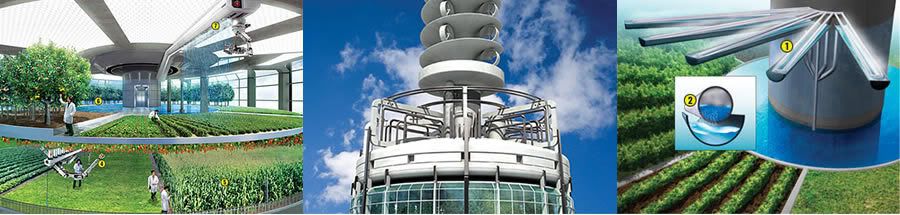 (the one on the left).
Intense solar radiation isn't actually necessary for many plants, in fact many greenhouses have cloudy windows or plastic roofs and walls. Plus one could have solar energy penetrating into the interiors by having a mirror on the roof direct sunlight down a shaft, which delivers natural light to the inside.
Quote:My guess is that one would eventually build these in the suburbs where more people live, land is cheaper and not too many highrises would block off the light. For profitability, have a look at this: http://www.verticalfarm.com/plans-2k6_eco.htm. Of course, some of the numbers may be inflated to make the proposal seem more attractive, but even so, that doesn't mean that it wouldn't at some stage be profitable. Existing greenhouses are profitable and consume more resources per unit area than vertical farming would. As does conventional farming, for that matter.
While this MAY be feasible it probably won't be profitable for several reasons - the main one being the cost of 'utility rich" and urban land. Paying off the mortgage in tomatoes and leeks would take a long, long time.
Quote:For common types of fruits and vegetables we do know this kind of stuff. http://www.verticalfarm.com/plans-2k3.htm (scroll down to the tables). Careful monitoring of the nutrient base would have to be done to make sure that no significant amounts of unwanted substances find their way into it, but it's not as if most contemporary farms do this and we eat their stuff without a moment's thought.
Lastly, I'm not sure we know what needs to be in the soil and thus the plants for our own health, and what needs to be kept out as well. (hormones from sewage, anyone?)
Quote:
I'd like to think humanity can come up with answers, but in a world that I think will be shorter and shorter of resources, I can't imagine most places being able to ante-up for start-up and on-NOTIFY: N | REPLY | REPLY WITH QUOTE | PERMALINK | TOP | HOME
It's 5Am and I've been up all night so I'm just going to post a short one -
"Indoor farming modalities proposed for the vertical farm will vary by location of the farm and the desired crop product. Systems to consider include: hydroponics systems (liquid medium and float systems), aquaponics, soilless solid systems and aeroponics."
It was this very phrase that made me go back and re-read the first time through. The are a lots of 'coulds', 'mights', 'considers', 'options', and so on, but very little actual calculations that say specifically if and how it would work - where's the pencil whipping? I grow plants indoors as a hobby. The biggest limiting factor is light - it's literally food for the plants, and without enough they ail and die. (And I wasn't entirely joking when I said the only people I know of who make a profit at that kind of farming are pot-growers. Even here where there are nurseries and greenhouses, MOST plants spend most of their lives out-doors.)
***************************************************************
"Global warming - it's not just a fact, it's a choice."
NOTIFY: N | REPLY | REPLY WITH QUOTE | PERMALINK | TOP | HOME
Quote:I'm not exactly sure what the problem is. So the proposal is new and they haven't worked out all the details yet. How does this differ from virtually any other new engineering project?
Originally posted by rue:
The are a lots of 'coulds', 'mights', 'considers', 'options', and so on, but very little actual calculations that say specifically if and how it would work - where's the pencil whipping?
"Hey, if we use this type of rocket, we could go to the moon!"
"COULD!? What do you mean could!? You mean you're not sure!? You haven't worked out all the details yet!? Well, then forget the whole damn thing, we should just stick to what we know!".
I'm not sure what type of "pencil whipping" you're looking for, but they do have a bit of detail on there, otherwise you might want to try the references. Some of the details you're after might not be available because they haven't been worked out yet, or they're too technical to be explained on a website.
Quote:Right, so one can use lamps or filter natural light through the building using mirrors and shafts. As far as engineering challenges go, it's hardly a challenge.
I grow plants indoors as a hobby. The biggest limiting factor is light - it's literally food for the plants, and without enough they ail and die.
Quote:Never heard of that happening before. Are the greenhouses in your area used for commercial purposes?
Even here where there are nurseries and greenhouses, MOST plants spend most of their lives out-doors.
Questions are a burden to others. Answers are prison for oneself.
NOTIFY: N | REPLY | REPLY WITH QUOTE | PERMALINK | TOP | HOME
"So the proposal is new and they haven't worked out all the details yet."
I wasn't looking for details but a certain amount of estimation would be helpful to gauge feasibility. Wolverton spent quite a bit of time studying this, in the end NASA went with chemical/ electronic systems for space stations b/c these systems are much more defined and less liable to unexpected failure. The 'pencil whipping' I was referring to would be things like -
By first figuring out the plant basics ...
- needs and limitations for a specific area - light needs (lumens, spectra), type of plant (long day/ short day/ long night/ short night), temperatures, growing season, pollination requirements
- utility - balanced nutrition
- productivity
- stability/ reliability
- seed/ hybrid sources
then given the basic plant and human factors you can then go on to work out the engineering requirements ...
- supplemental lighting (if needed)
- supplemental heating/ cooling (if needed)
- soil and water characteristics
- flexible systems
which can then be used to estimate the cost/ benefit under different scenarios ...
- energy expense
- land expense
- human expense
If they expect the idea to be taken seriously they're going to have to do a lot of spade-work (so to speak) to solidify the choices, coulds, mights, maybes etc.
"so one can use lamps or filter natural light through the building using mirrors and shafts." It's not an inconsiderable problem. Even three feet from a window is too little light for many plants - and most productive garden plants.
"Are the greenhouses in your area used for commercial purposes?"
Yes, they are ALL commercial. The biggest issue is land cost. Especially if you have to grown something for any length of time, you are paying for the cost of the land which could be used more profitably. Here the power grid right-of-way is leased out to commercial plant growers as there is not much else it can be used for. So you'll see large outdoor nurseries under the power lines.
***************************************************************
"Global warming - it's not just a fact, it's a choice."
NOTIFY: N | REPLY | REPLY WITH QUOTE | PERMALINK | TOP | HOME
Quote:Strange, they addressed a lot of those issues, and I bet some of those they haven't could probably be found in the references.
Originally posted by rue:
I wasn't looking for details but a certain amount of estimation would be helpful to gauge feasibility. [...] The 'pencil whipping' I was referring to would be things like -
By first figuring out the plant basics ...
- needs and limitations for a specific area - light needs (lumens, spectra), type of plant (long day/ short day/ long night/ short night), temperatures, growing season, pollination requirements
- utility - balanced nutrition
- productivity
- stability/ reliability
- seed/ hybrid sources
then given the basic plant and human factors you can then go on to work out the engineering requirements ...
- supplemental lighting (if needed)
- supplemental heating/ cooling (if needed)
- soil and water characteristics
- flexible systems
which can then be used to estimate the cost/ benefit under different scenarios ...
- energy expense
- land expense
- human expense
http://verticalfarm.com/pdf/report2006/Commercially%20Crops.pdf
http://verticalfarm.com/plans-2k3.htm
http://verticalfarm.com/plans-2k4.htm
http://verticalfarm.com/plans-2k5.htm
etc.
Did you maybe forget to scroll down when you looked at those pages before?

Quote:Yes, just ignore the work they have done, ignore the references to previous work done on related topics, ignore the fact that this project is still in its conceptual stages and that many things will remain uncertain until a proper full-scale trial run, then claim they haven't done any significant amount of work, and it therefore follows, somehow, that the ground-breaking idea can't be expected to be taken seriously. Brilliant. You should write a book on debating.
If they expect the idea to be taken seriously they're going to have to do a lot of spade-work (so to speak) to solidify the choices, coulds, mights, maybes etc.
Quote:As I said: "so one can use lamps or filter natural light through the building using mirrors and shafts."
"so one can use lamps or filter natural light through the building using mirrors and shafts." It's not an inconsiderable problem. Even three feet from a window is too little light for many plants - and most productive garden plants.

Quote:Ah, costs again. Given the nature of the project, I doubt funding will be a major issue since investors and governments will see the benefits, but in any case, how about they use one or two floors to cultivate plants used by the pharmaceutical industry? That should be a nice pot of gold right there. Also, one can build a prototype where land is cheap, then, after feasibility has been proven and the technical kinks worked out, get Al Gore, Leonardo di Caprio, Sheryl Crow, etc, to hype it up. I think local governments in many places would be very keen to attach themselves to the idea and land costs should be less of a problem.
"Are the greenhouses in your area used for commercial purposes?"
Yes, they are ALL commercial. The biggest issue is land cost.
Questions are a burden to others. Answers are prison for oneself.
NOTIFY: N | REPLY | REPLY WITH QUOTE | PERMALINK | TOP | HOME

With regard to profitability, one thing is clear: food is not negotiable. Like oil it is one of those things the economy adjusts around. If we run out of farmable land and cannot increase the output of that land to fit the population, then compact greenhouses could likely become a solution. Another possibility, that is already being considered, is urban agriculture projects where farms are built on the rooftop of buildings. Not only is it beneficial to the building in that it provides insulation where there was once a huge heat sink, but it also benefits the agriculture by increasing the growing season. In time vertical farming would likely the next progression.
Nihil est incertius vulgo, nihil obscurius voluntate hominum, nihil fallacius ratione tota comitiorum.
Nothing is more unpredictable than the mob, nothing more obscure than public opinion, nothing more deceptive than the whole political system.
-- Cicero
NOTIFY: Y | REPLY | REPLY WITH QUOTE | PERMALINK | TOP | HOME
These are quotes from your first link -
http://verticalfarm.com/pdf/report2006/Commercially%20Crops.pdf
Experimental crops to be considered, based on economic profitability, yield increases, nutritional value and genetic modifiability include: sugar cane and sugar beets, corn, wheat, rice, fish (tilapia) and others.
as current indoor agricultural techniques continue to evolve
Thus one must decide which crops are the most cost effective, nutritionally relevant, and economically plausible and which can be processed in a vertical farm setting. (Hmmm, I think they're making my point.)
No pencil-whipping here, just could, mights, possiblies ...
The same is true of your second link http://verticalfarm.com/plans-2k3.htm
The third link http://verticalfarm.com/plans-2k3.htm has some estimation calculations, but neglects some very important drawbacks to the plan - namely, the cost of a grey-water system and the quality of the water.
The fourth link http://verticalfarm.com/plans-2k5.htm again contains some estimation calculations but has serious holes in the analysis (which I may get to at the end of the day).
"Did you maybe forget to scroll down when you looked at those pages before?" "Yes, just ignore the work they have done, ignore the references to previous work done on related topics, ignore the fact that this project is still in its conceptual stages and that many things will remain uncertain until a proper full-scale trial run, then claim they haven't done any significant amount of work, and it therefore follows, somehow, that the ground-breaking idea can't be expected to be taken seriously. Brilliant. You should write a book on debating. " Was this snark necessary ? I did read the pages, I do have OTHER sources to draw on (which I shared) and MY caveats, oddly, look like THEIRS.
YOU can't keep the discussion, at a minimum, neutral. So rather than read through links and actually discuss - I'll judge the proposal by its proponent and give it a big: 
added: I've developed many first-time ever things. The first think you have to have is a goal - which this is missing. Gee, maybe that might be nice is not a goal. The fact that they slew between profitability, sustainability and localism indicates to me they don't know what they're looking for. And the second thing is to identify and either eliminate or work around the fatal hitches. B/c it doesn't matter how good 99.99% is, if that little important bit doesn't work, nothing works. What I see is a lot of hand-waving. That makes me nervous about their seriousness and their abilitites. These things HAVE to be done, and there doesn't seem to be anyone heading in that direction.
***************************************************************
"Global warming - it's not just a fact, it's a choice."
NOTIFY: N | REPLY | REPLY WITH QUOTE | PERMALINK | TOP | HOME
Quote:Oh ffs I'm so bored of this. SO THINGS AREN'T SET IN STONE YET! THE IDEA IS STILL BEING WORKED ON! "As current indoor agricultural techniques continue to evolve" - why is that such a huge deal for you!? Technologies are still evolving. The reports also say that this thing is possible with existing technology. Better technologies would just make it more efficient. They also give the estimates for various crops, any of which might be chosen, depending on necessity of the locale and other aspects. Sheesh...
Originally posted by rue:
These are quotes form your first link -
http://verticalfarm.com/pdf/report2006/Commercially%20Crops.pdf
Experimental crops to be considered, based on economic profitability, yield increases, nutritional value and genetic modifiability include: sugar cane and sugar beets, corn, wheat, rice, fish (tilapia) and others.
as current indoor agricultural techniques continue to evolve
Thus one must decide which crops are the most cost effective, nutritionally relevant, and economically plausible and which can be processed in a vertical farm setting. (Hmmm, I think they're making my point.)
No pencil-whipping here, just could, mights, possiblies ...
The same is true of your second link http://verticalfarm.com/plans-2k3.htm
Quote:Estimated cost of the recycling system is $500,000 (on the website, can't be bothered to post the links for you anymore). The quality of the water... well, what's the quality of the water that the usual water purification plants produce?
The third link http://verticalfarm.com/plans-2k3.htm has some estimation calculations, but neglects some very important drawbacks to the plan - namely, the cost of a grey-water system and the quality of the water.
Quote:I bet the "serious holes in the analysis" will just end up being in your mind, but please do tell.
The fourth link http://verticalfarm.com/plans-2k5.htm again contains some estimation calculations but has serious holes in the analysis (which I may get to at the end of the say).
Quote:It seemed appropriate.
"Yes, just ignore the work they have done" Was that snark necessary ?
Quote:Yes, one source, Wolverton... and I still don't see his relevance to the discussion.
I did read the pages, I do have OTHER sources to draw on (which I shared)
Quote:Can't say I'm shocked. You come across as the sort of "environmentalist" who loves to preach about how much more caring you are about the environment than others and how not enough is being done, and when an idea comes across that could have some serious environmental benefits you look for any possible trivial (and flawed) counterargument you can find simply because you don't like the messenger. As far as keeping this discussion neutral, that's a joke, you were vehemently opposed to it from the beginning because you were, once again, just following SignyM's cue. I'm sure that had he started this thread you'd think VF would be the greatest thing humanity ever thought of.
So you know something, since YOU can't keep the discussion, at a minimum, neutral - I'll judge the proposal by its proponent and give it a big:
Quote:Pick one:
added: I've developed many first-time ever things. The first think you have to have is a goal - which this is missing.
Quote:
Year-round crop production; 1 indoor acre is equivalent to 4-6 outdoor acres or more, depending upon the crop (e.g., strawberries: 1 indoor acre = 30 outdoor acres)
No weather-related crop failures due to droughts, floods, pests
All VF food is grown organically: no herbicides, pesticides, or fertilizers
VF virtually eliminates agricultural runoff by recycling black water
VF returns farmland to nature, restoring ecosystem functions and services
VF greatly reduces the incidence of many infectious diseases that are acquired at the agricultural interface
VF converts black and gray water into potable water by collecting the water of
evapotranspiration
VF addNOTIFY: N | REPLY | REPLY WITH QUOTE | PERMALINK | TOP | HOME
My very first post was a semi-humerous one on pot farming that was, in the end, MY HONEST opinion. Nothing personal, no sniping, all clean and above-board.
I'm sorry that you're so narrow-minded you can't stand a viewpoint different from yours.
BTW - ethanol from cellulose - YES ! Hygrogen gas as fuel - NO ! IC car engines - NO ! Direct electric drive - YES !
My rejection of 'new' ideas is based on my estimation of their potential overall benefit. Some I accept, some I reject. This idea has not yet convinced me.
***************************************************************
"Global warming - it's not just a fact, it's a choice."
NOTIFY: N | REPLY | REPLY WITH QUOTE | PERMALINK | TOP | HOME
Oh, I LOVE opinions other than my own. As long as people can justify them properly.
Questions are a burden to others. Answers are prison for oneself.
NOTIFY: N | REPLY | REPLY WITH QUOTE | PERMALINK | TOP | HOME
And I've given facts and analysis, alternate sources and the benefit of my experience. I'm sorry you can't credit them b/c of the source, but that's your problem, not mine ...
***************************************************************
"Global warming - it's not just a fact, it's a choice."
NOTIFY: N | REPLY | REPLY WITH QUOTE | PERMALINK | TOP | HOME
I don't see it as economically feasible when we already grow a substantive surplus of food as it is on existing land, with more that could potentially be converted fairly quick - unless logistics of moving it becomes an insurmountable problem which is very unlikely.
Time/cost/labor vs profitabilty aspect sucks.
From the folks I asked to give it the once over who have some engineering backround, the general consensus is that it would not work, but they went beyond my technical knowledge quickly in even trying to explain why.
So, beyond that, I've nothing more useful to add.
-Frem
It cannot be said enough, those who do not learn from history, are doomed to endlessly repeat it
NOTIFY: N | REPLY | REPLY WITH QUOTE | PERMALINK | TOP | HOME
Quote:I guess that depends on what area one is living in, though. I'm sure there are many areas, some of them possibly even in the States, where arable land is very limited and food needs to be imported from far away (at extra cost). Although admittedly I doubt Manhattan is in such a situation (currently the study's main area of focus, since the researchers are from New York).
Originally posted by Fremdfirma:
I don't see it as economically feasible when we already grow a substantive surplus of food as it is on existing land, with more that could potentially be converted fairly quick - unless logistics of moving it becomes an insurmountable problem which is very unlikely.
Quote:I don't see what those insurmountable engineering problems could be (in fact the study points out that such a project could be done with existing technology), but fair enough.
From the folks I asked to give it the once over who have some engineering backround, the general consensus is that it would not work, but they went beyond my technical knowledge quickly in even trying to explain why.
Questions are a burden to others. Answers are prison for oneself.
NOTIFY: N | REPLY | REPLY WITH QUOTE | PERMALINK | TOP | HOME