

human actions, global climate change, global human solutions
POSTED BY: 1kiki
UPDATED: Sunday, September 6, 2026 19:38
VIEWED: 60750
PAGE 90 of 111

Climate Change Deniers in Texas Government want to INCREASE greenhouse gases with low-interest loans to build natural gas power plants
July 2, 2024 • Claire Hao, San Antonio Express-News, TNS
Texas Gov. Greg Abbott and Lt. Gov Dan Patrick will seek to expand a taxpayer-backed program that primarily funds low-interest loans to build natural gas power plants across the state to $10 billion from $5 billion "as soon as possible," they said Monday.
The move comes in response to new estimates from the Electric Reliability Council of Texas, the state's power grid operator, that the state could need 152 gigawatts of power in six years, roughly doubling the current record of 85.5 gigawatts. Though the projection has been public since April, there has been fresh concern among state leaders — including a sharp turn by some against the cryptocurrency industry — after ERCOT CEO Pablo Vegas spooked lawmakers in June with his testimony at legislative hearings regarding the grid.
https://www.governing.com/finance/texas-seeks-to-double-taxpayer-backe
d-fund-for-natural-gas
The Joss Whedon script for Serenity, where Wash lives, is Serenity-190pages.pdf at https://www.mediafire.com/two
NOTIFY: Y | REPLY | REPLY WITH QUOTE | PERMALINK | TOP | HOME
Global warming, local benefits
The international dimension of climate change is what makes it so hard to solve
Matthew Yglesias | Aug 14, 2024
https://www.slowboring.com/p/global-warming-local-benefits
Since the 2008 presidential campaign and the 2009 UN climate summit in Copenhagen, I feel like there’s been significant unlearning of the fact that addressing climate change involves a complicated global coordination problem.
This problem is extremely difficult to solve, and as a result, it basically hasn’t been.
The response of much of the climate advocacy community, its associated lobbying apparatus, and much of what passes for climate journalism has been to ignore the global coordination aspect of the problem and bluster ahead. This leads to bad judgment about specific issues, to a tendency to set incorrect priorities, and also to a lot of confusion.
Last week, I was talking to someone who doesn’t follow policy closely, who voted for Biden in 2020 but isn’t sure about 2024. She told me her top issue is climate change, which she described in fairly apocalyptic terms. I told her that Biden had enacted historic climate legislation and that Democrats had made this their top priority. She said if they’d really solved climate change, she would surely have heard about it. At which point I tried (and failed) to convince her that climate worst-case scenarios were, in fact, now off the table, while also conceding that Biden’s climate actions had only a modest impact on global average temperature projections. But that’s not because the IRA energy provisions aren’t a big deal. It’s because the United States has a modest (and falling) share of global emissions.
What share of global CO2 emissions are emitted by the US?
https://ourworldindata.org/co2/country/united-states#what-share-of-glo
bal-co2-emissions-are-emitted-by-the-country
Summary of Inflation Reduction Act (IRA) provisions related to renewable energy
https://www.epa.gov/green-power-markets/summary-inflation-reduction-ac
t-provisions-related-renewable-energy
The Joss Whedon script for Serenity, where Wash lives, is Serenity-190pages.pdf at https://www.mediafire.com/two
NOTIFY: Y | REPLY | REPLY WITH QUOTE | PERMALINK | TOP | HOME
The disagreement between two climate scientists that will decide our future
In his new paper, Hansen ( http://www.columbia.edu/~jeh1/ ) argues that if the atmospheric concentration of greenhouse gases remains close to its current level, the surface temperature will stabilise after several hundred years between 8°C and 10°C above the pre-industrial level.
Of this, at least 2°C will emerge by mid-century, and probably a further 3°C a century from now. A temperature increase of this magnitude would be catastrophic for life on Earth. Hansen adds that to avoid such an outcome, brightening Earth is now necessary to halt the warming in the pipeline from past emissions.
Time for reflection
The differences between Mann and Hansen are significant for the global response to climate change.
Mann says that allowing emissions to reach net zero by mid-century is sufficient, while Hansen maintains that on its own it would be disastrous and that steps must now be taken in addition to brighten the planet.
Brightening Earth could also reverse the reductions in reflectivity already caused by climate change. Data indicates that from 1998 to 2017, Earth dimmed by about 0.5 watts per square metre, largely due to the loss of ice.
Given what’s at stake, we hope Mann and Hansen resolve these differences quickly to help the public and policymakers understand what it will take to minimise the likelihood of imminent massive and widespread ecosystem destruction and its disastrous effects on humanity.
While 1.5°C may be dead, there may still be time to prevent cascading system failures. But not if we continue to squabble over the nature and extent of the risks.
More at https://theconversation.com/the-disagreement-between-two-climate-scien
tists-that-will-decide-our-future-217759
The Joss Whedon script for Serenity, where Wash lives, is Serenity-190pages.pdf at https://www.mediafire.com/two
NOTIFY: Y | REPLY | REPLY WITH QUOTE | PERMALINK | TOP | HOME

Disney cruise ship sails past Amsterdam due to Extinction Rebellion blockade
https://nltimes.nl/2024/08/25/disney-cruise-ship-sails-past-amsterdam-
due-extinction-rebellion-blockade
NOTIFY: N | REPLY | REPLY WITH QUOTE | PERMALINK | TOP | HOME
In 2021, the South Korean National Assembly passed a law requiring the government to reduce its greenhouse gas emissions by at least 35 percent by 2030 and to become carbon neutral by 2050. In response to the law, the government set a goal of reducing carbon emissions by 40 percent by 2030, which the plaintiffs argued was insufficient to protect their fundamental right to life and a clean environment.
The court, which examines the constitutionality of laws, ruled that the intermediary 2030 goal was adequate — but it ordered the National Assembly to develop additional concrete plans to ensure that progress continues at a robust pace after 2030, in order to meet the 2050 goal of carbon neutrality. The decision is a partial victory for plaintiffs, and it requires the National Assembly to revise the existing climate law by the end of February 2026.
“The Korean constitutional court is very conservative,” Byung-Joo Lee, an attorney for the plaintiffs, told Grist. “But the court made it very clear that the climate crisis is a scientific and legal fact, and they acknowledged that the state has a duty to protect people from climate change. It’s a clear, constitutional right of the people.”
https://grist.org/international/south-korea-climate-lawsuit/
The Joss Whedon script for Serenity, where Wash lives, is Serenity-190pages.pdf at https://www.mediafire.com/two
NOTIFY: Y | REPLY | REPLY WITH QUOTE | PERMALINK | TOP | HOME
Donald Trump gets everything wrong about the climate crisis
By Bill McKibben | Fri 6 Sep 2024 08.36 EDT
https://www.theguardian.com/us-news/ng-interactive/2024/sep/06/preside
ntial-election-climate-crisis-project-2025-trump
Here is the biggest thing happening on our planet as we head into the autumn of 2024: the Earth is continuing to heat dramatically. Scientists have said that there’s a better than 90% chance that this year will top 2023 as the warmest ever recorded. And paleoclimatologists were pretty sure last year was the hottest in the last 125,000 years. The result is an almost-cliched run of disasters: open Twitter/X anytime for pictures of floods pushing cars through streets somewhere. It is starting to make life on this planet very difficult, and in some places impossible. And it’s on target to get far, far worse.
Here’s the second-biggest thing happening on our planet right now: finally, finally, renewable energy, mostly from the sun and wind, seems to be reaching some sort of takeoff point. By some calculations, we’re now putting up a nuclear plant’s worth of solar panels every day. In California, there are now enough solar farms and wind turbines that day after day this spring and summer they supplied more than 100% of the state’s electric needs for long stretches; there are now enough batteries on the grid that they become the biggest source of power after dark. In China it looks as if carbon emissions may have peaked – they’re six years ahead of schedule on the effort to build out renewables.
And here’s the third biggest thing in the months ahead: the American presidential election, which looks as if it is going down to the wire – and which may have the power to determine how high the temperature goes and how fast we turn to clean power.
Donald Trump gave an interview last week, in which he laid out his understanding of climate change:
Quote:I’ve quoted this at length because this could again be the most important man on the planet, talking about the most important issue the planet has ever faced. And he’s gotten every word of it wrong. It’s gibberish.
You know, when I hear these poor fools talking about global warming. They don’t call it that any more, they call it climate change because you know, some parts of the planet are cooling and warming, and it didn’t work. So they finally got it right, they just call it climate change. They used to call it global warming. You know, years ago they used to call it global cooling. In the 1920s they thought the planet was going to freeze. Now they think the planet’s going to burn up. And we’re still waiting for the 12 years. You know we’re down almost to the end of the 12-year period, you understand that, where these lunatics that know nothing, they weren’t even good students at school, they didn’t even study it, they predict, they said we have 12 years to live. And people didn’t have babies because they said – it’s so crazy. But the problem isn’t the fact that the oceans in 500 years will raise a quarter of an inch, the problem is nuclear weapons. It’s nuclear warming … These poor fools talk about global warming all the time, you know the planet’s going to global warm to a point where the oceans will rise an eighth of an inch in 355 years, you know, they have no idea what’s going to happen. It’s weather.
But it’s gibberish in the service of something very important and very dangerous: doing all that he can to block the energy transition, in America and around the world. His friends at Project 2025 have laid out in considerable detail how you translate that gibberish into policy. It lays out in loving detail many of the steps his administration would use to bolster oil, gas and coal while sidetracking sun and wind.
More at https://www.theguardian.com/us-news/ng-interactive/2024/sep/06/preside
ntial-election-climate-crisis-project-2025-trump
The Joss Whedon script for Serenity, where Wash lives, is Serenity-190pages.pdf at https://www.mediafire.com/two
NOTIFY: Y | REPLY | REPLY WITH QUOTE | PERMALINK | TOP | HOME
The hype for hybrid cars will not last
Angry Bear | September 21, 2024 8:00 am
https://angrybearblog.com/2024/09/the-hype-for-hybrid-cars-will-not-la
st
The car industry’s effort to decarbonize revolves around replacing petrol with batteries. A growing number of customers want both. Buyers who cannot afford a fully electric car, or worry about the availability of charging points, are turning to plug-in hybrid electric vehicles (PHEVs), sales of which are rocketing. But the hype for hybrids may prove to be short-lived.
Worldwide sales of cars running purely on batteries (BEVs) were more than double those of PHEVs last year. But the gap has been rapidly closing. Sales of PHEVs were up by almost 50%, year on year, in the first seven months of 2024, compared with just 8% for BEVs, according to estimates from Bernstein, a broker.
Carmakers have been cooling on BEVs and warming to hybrids. This month Volvo backtracked on its commitment to go all-electric by 2030. It now says BEVs and PHEVs will together account for 90% of its sales by the end of the decade. Last month Ford announced that it was abandoning plans to make a large fully electric suv, opting instead for hybrid power. Hyundai is doubling its range of hybrids from seven to 14 models. Volkswagen, too, has pledged to increase investments in hybrids as it rethinks its plans for bevs.
Consumers are turning to hybrids partly because they are cheap. The big batteries required to run fully electric vehicles make them far more expensive than petrol cars. That is a problem when it comes to selling to the mass market; most buyers “will not pay a premium”, says Jim Farley, the boss of Ford. Plug-in hybrids, by contrast, run on much smaller batteries: they typically have a 20-kilowatt-hour unit, around a third of the size of those in BEVs. As a consequence, PHEVs are only a little more expensive than petrol-powered cars, and cost less to run. Although hybrids can typically travel only around 40 miles on their batteries, the option of using petrol avoids the anxiety many drivers of bevs have about running out of charge.
For their part, carmakers are fond of hybrids because they are usually as profitable as petrol-powered cars, in contrast to BEVs, many of which are loss-making. Smaller batteries mean lower production costs. Hybrids also allow legacy carmakers to draw more on their existing expertise and supply chains.
The fashion for hybrids, however, may prove to be fleeting. Rules in California, adopted by 16 other American states, stipulate that by 2035 only 20% of the new vehicles sold by carmakers can be plug-in hybrids; the remainder must be fully electric. The EU plans to slam the brakes on even harder: the bloc will ban the sale of all cars that run on petrol engines, including hybrids, by 2035.
Hybrids may already be less competitive by then. Battery prices have been falling, and will fall further as production expands and new chemistries are developed. Carmakers such as Renault have plans to roll out BEV models that cost significantly less than their current offerings, spurred on by Chinese competition. Charging networks are continuing to expand.
Bernstein predicts that phevs will capture a growing share of the car market until around 2030, but that sales will then stabilise and eventually decline as those of BEVs speed up (see chart). Hybrids are “winning now, but bevs will win eventually”, reckons Patrick Hummel of UBS, a bank. Xavier Smith of AlphaSense, a consultancy, thinks the obsession carmakers currently have with hybrids will prove short-sighted. Those that lose focus on electrification could soon fall behind.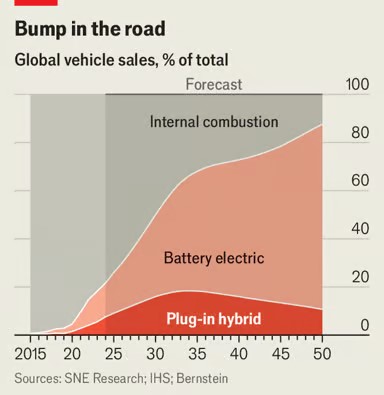
The Joss Whedon script for Serenity, where Wash lives, is Serenity-190pages.pdf at https://www.mediafire.com/two
NOTIFY: Y | REPLY | REPLY WITH QUOTE | PERMALINK | TOP | HOME
An example of crappy alt reporting
Quote:
Context is particularly important when it comes to climate change - as their narrative collapses when looking at a long enough timeline.
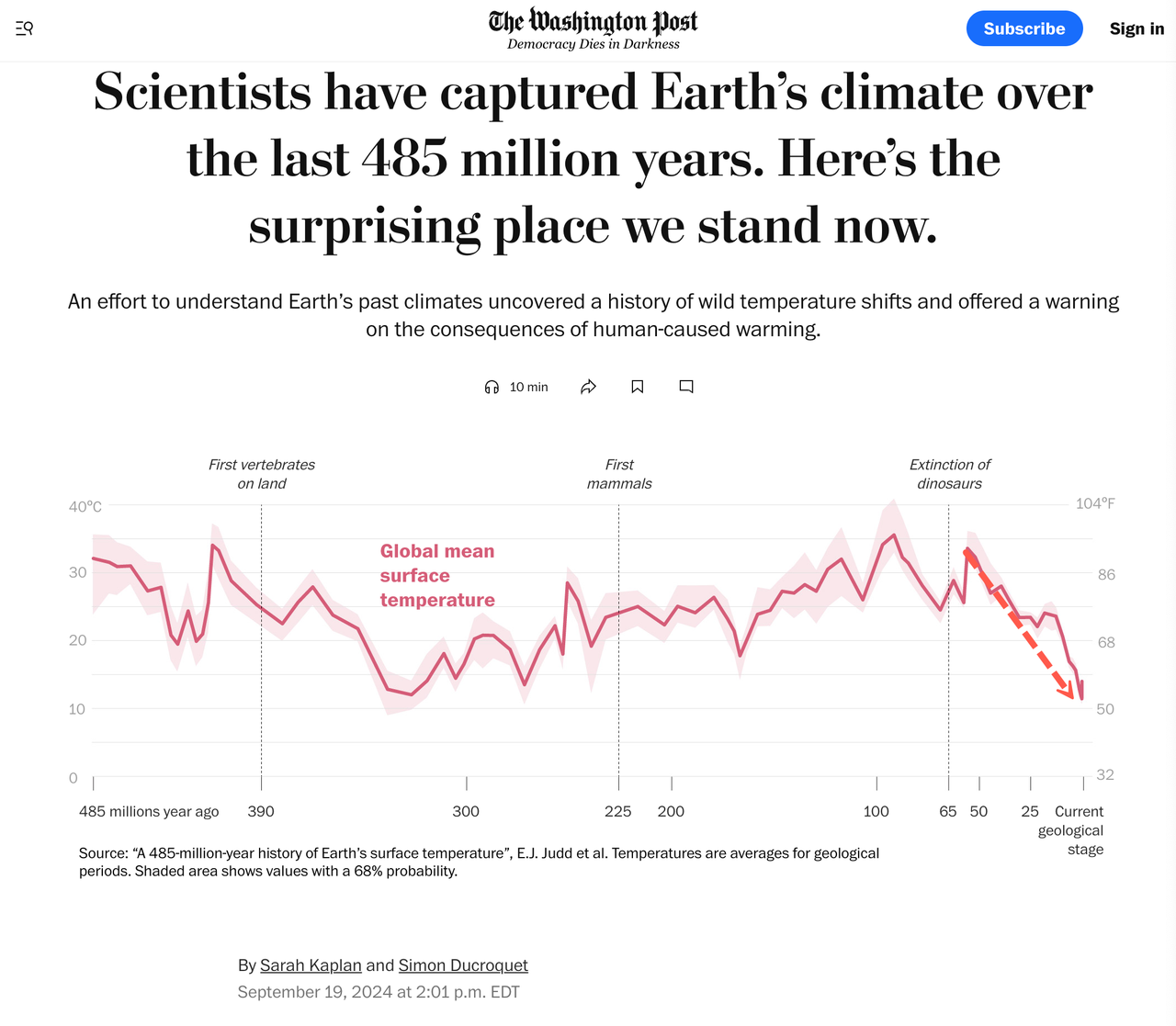
They're attempting to use this to provide "context" about global warming?
Ok, here's the real context: Humans didn't even begin to evolve until 4 million years ago. That 100 million year timeline? Irrelevant.
See where the dinosaurs died out? That's 65 million years ago. 25 million years is conveniently ticked on the x axis. Cut that distance in half. Thats 12. Cut that in half again. That's 6.
No humans yet!
Cut that in half again. That's 3 million years ago. Ape like creatures on two legs in Africa.
Cut that in half again. 1.5 million years ago.
Still no modern humans!
Cut that in half again.
700,000 years ago.
Almost there!
By now, you're almost on top of the line marked "current geological stage" but haven't YET gotten to human civilization.
Humans, and human civilization, evolved during our CURRENT climate regime.
Has the earth been hotter? Yep.
BUT OUR CIVILIZATION WOULDN'T SURVIVE IT.
Note the uptick at the end.
Oxygen concentrations. We can make the same argument: big swings in O2. But we wouldn't survive some of those swings either.
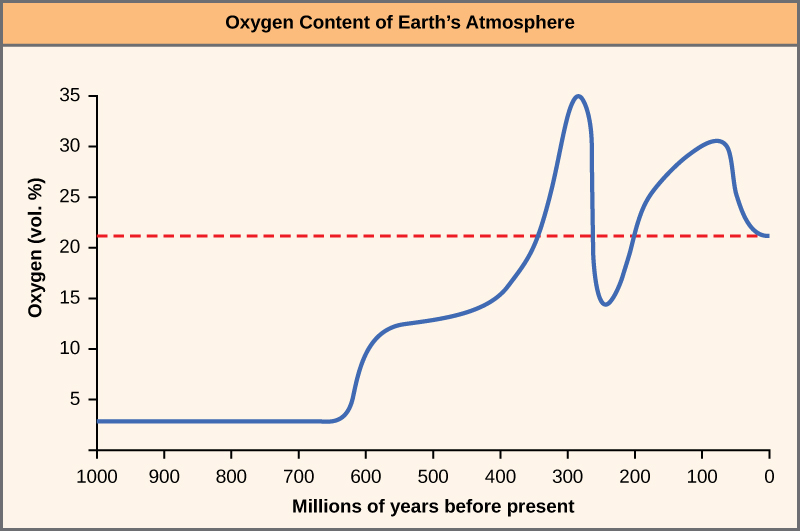
The point of trying to stabilize our environment isn't to "save the planet", it's to save ourselves.
-----------
"It may be dangerous to be America's enemy, but to be America's friend is fatal." - Henry Kissinger
Americans support America

NOTIFY: Y | REPLY | REPLY WITH QUOTE | PERMALINK | TOP | HOME
Researchers say burying wood could be a viable method to prevent carbon from reaching the atmosphere
September 27, 2024
Wood vaulting is an emerging low-cost climate solution. Nonviable wood — like diseased trees and wood scraps — is buried to keep carbon trapped in the ground rather than allowing it to release into the air. The team estimates that wood vaulting could sequester up to ten metric gigatons (10,000,000,000 tonnes) of carbon dioxide a year and cost only about $30 to $100 per metric ton when the process is optimized.
Wood vaulting as a climate solution would work best in conjunction with other climate actions, like reducing greenhouse gas emissions.
https://www.smithsonianmag.com/smart-news/a-3775-year-old-log-of-wood-
may-hold-the-secret-to-an-innovative-and-low-cost-climate-solution-180985161/
37,000,000,000 tonnes of CO2 are released each year.
https://ourworldindata.org/co2-emissions
The Joss Whedon script for Serenity, where Wash lives, is Serenity-190pages.pdf at https://www.mediafire.com/two
NOTIFY: Y | REPLY | REPLY WITH QUOTE | PERMALINK | TOP | HOME
And just look at that huge waste of CO2 in Ukraine!
Not only the fuel being burned, but the energy required to make weapons of war.
All because USA neocons want to play Global Domination!
-----------
"It may be dangerous to be America's enemy, but to be America's friend is fatal." - Henry Kissinger
Americans support America
NOTIFY: Y | REPLY | REPLY WITH QUOTE | PERMALINK | TOP | HOME