

What's the Point of Jobs in China?
POSTED BY: JEWELSTAITEFAN
UPDATED: Wednesday, July 6, 2016 06:24
VIEWED: 9933
PAGE 1 of 1

I thought it was the cheap labor, the significant savings in comparable wages to America, or other countries.
But they are making fully automated production lines - so why cannot these fully automated facilities be here?
https://daringfireball.net/2016/01/why_apple_assembles_in_china
http://www.techrepublic.com/article/chinese-factory-replaces-90-of-hum
ans-with-robots-production-soars/
NOTIFY: Y | REPLY | REPLY WITH QUOTE | PERMALINK | TOP | HOME

Quote:Because the Chinese government does not feel any obligation to provide employment for the American working class? Or maybe American Business does not feel any obligation to hire the American working class?
Originally posted by JEWELSTAITEFAN:
so why cannot these fully automated facilities be here?
NOTIFY: Y | REPLY | REPLY WITH QUOTE | PERMALINK | TOP | HOME
Quote:
Originally posted by second:Quote:Because the Chinese government does not feel any obligation to provide employment for the American working class? Or maybe American Business does not feel any obligation to hire the American working class?
Originally posted by JEWELSTAITEFAN:
so why cannot these fully automated facilities be here?
Or, because Obamanomics has shipped all jobs to China, Business feels no incentive to hire Americans to make Apple products.
NOTIFY: Y | REPLY | REPLY WITH QUOTE | PERMALINK | TOP | HOME
Quote:Do you mean that you want Obama to create new rules for business? Are you demanding that American Business loss its basic freedom and be forced to do as Obama wants it to? You might call the new rules an incentive to hire Americans, but that doesn't sound very Republican! It sounds like Communism!
Originally posted by JEWELSTAITEFAN:
Or, because Obamanomics has shipped all jobs to China, Business feels no incentive to hire Americans to make Apple products.
NOTIFY: Y | REPLY | REPLY WITH QUOTE | PERMALINK | TOP | HOME
Quote:Do you mean that you want Obama to create new rules for business? Are you demanding that American Business loss its basic freedom and be forced to do as Obama wants it to? You might call the new rules an incentive to hire Americans, but that doesn't sound very Republican! It sounds like Communism!
Originally posted by second:Quote:
Originally posted by JEWELSTAITEFAN:
Or, because Obamanomics has shipped all jobs to China, Business feels no incentive to hire Americans to make Apple products.
Are you clueless about Business? There is no need to remove freedoms, as you Democraps and other Libtards constantly strive for. Please review the concepts of tariffs, taxes, taxation of imported goods, and the like. Appropriate tariffs and fees can help balance the incentives provided to business when they are balancing their profit sheets.
NOTIFY: Y | REPLY | REPLY WITH QUOTE | PERMALINK | TOP | HOME
Quote:That is brilliant! A tariff! But are you clueless about tariffs, which are just a tax on either China or Apple's iPhones sold in America?
Originally posted by JEWELSTAITEFAN:
Are you clueless about Business? There is no need to remove freedoms, as you Democraps and other Libtards constantly strive for. Please review the concepts of tariffs, taxes, taxation of imported goods, and the like. Appropriate tariffs and fees can help balance the incentives provided to business when they are balancing their profit sheets.
Because he is very smart, President Trump doesn’t need to force American Business to hire Americans for the assembly lines. Instead, once he is President, Trump can demand that the Chinese government raise the minimum wage in China to $15 per hour. Since Americans’ minimum wage is $7.25 per hour, that would push and shove manufacturing jobs out of China and back into America. Until China does as President Trump demands, he can tax China (what you called a tariff) to make China raise their minimum wage. It is so simple.
See how easily Trump could solve the problem of those automated Chinese factories destroying the jobs of America’s working class on assembly lines? Trump will make the Commies solve the problem and he won’t have to permanently place a heavy and unnecessary burden of new tariffs (taxes) on American Business and American consumers for those imported iPhones. Or imported flat-screen TVs. Or refrigerators. Or microwaves. Or whatever.
www.raisetheminimumwage.com/pages/minimum-wage-state
NOTIFY: Y | REPLY | REPLY WITH QUOTE | PERMALINK | TOP | HOME

Quote:
Originally posted by JEWELSTAITEFAN:Quote:
Originally posted by second:Quote:Because the Chinese government does not feel any obligation to provide employment for the American working class? Or maybe American Business does not feel any obligation to hire the American working class?
Originally posted by JEWELSTAITEFAN:
so why cannot these fully automated facilities be here?
Or, because Obamanomics has shipped all jobs to China, Business feels no incentive to hire Americans to make Apple products.
God dammit, you really are one stupid fucking piece of human shit, aren't you?
Yeah, there was never a job outsourced from the U.S. to China until Obama seized power.
You fucking pathetic halfwit. Go put your gun in your mouth and pull the trigger and do the world a favor.
NOTIFY: Y | REPLY | REPLY WITH QUOTE | PERMALINK | TOP | HOME
Where are Trump's line of shitty clothes made?
He hates America so much he won't even manufacture his own dogshit clothes line here. That should tell you all you need to know about The Donald and his "patriotism." He doesn't give a fuck about you, your country, or anything but his bottom line.
NOTIFY: Y | REPLY | REPLY WITH QUOTE | PERMALINK | TOP | HOME
Quote:I should have noticed that the tariff idea was a Trump idea three months ago.
Originally posted by ElvisChrist:
Where are Trump's line of shitty clothes made?
He hates America so much he won't even manufacture his own dogshit clothes line here. That should tell you all you need to know about The Donald and his "patriotism." He doesn't give a fuck about you, your country, or anything but his bottom line.
www.reuters.com/article/us-usa-election-trump-trade-idUSKCN0WQ0WG
Donald Trump's threats to slap steep tariffs on Chinese and Mexican imports may have won him votes in Republican primaries but they would likely backfire, severely disrupting U.S. manufacturers that increasingly depend on global supply chains.
The Republican presidential front-runner's campaign pledges to impose 45 percent tariffs on all imports from China and 35 percent on many goods from Mexico would spark financial market turmoil and possibly even a recession, former trade negotiators, trade lawyers, economists and business executives told Reuters.
"I don't mind trade wars when we're losing $58 billion a year," Trump said in a Feb. 25 debate, referring to the 2015 U.S. goods trade deficit with Mexico. Economists dispute the idea the United States is "losing" money as the trade deficit is simply the difference between what the United States imports and what it exports to a country.
Among those hardest hit would be the U.S. auto industry, which has fully integrated Mexico into its production network. Some $118 billion worth of vehicles and parts flowed north and south across the border tariff-free last year, according to U.S. Commerce Department data.
A 35 percent tariff would raise costs for Ford Motor Co's U.S.-assembled F-series and medium-duty pickup trucks that use Mexican-made diesel engines, one of its most profitable vehicle lines.
Ford CEO Mark Fields on Wednesday defended the company's investment strategy, which includes $9 billion for U.S. plants over the next four years, saying, "We will do what makes sense for the business." Not what makes sense for Trump.
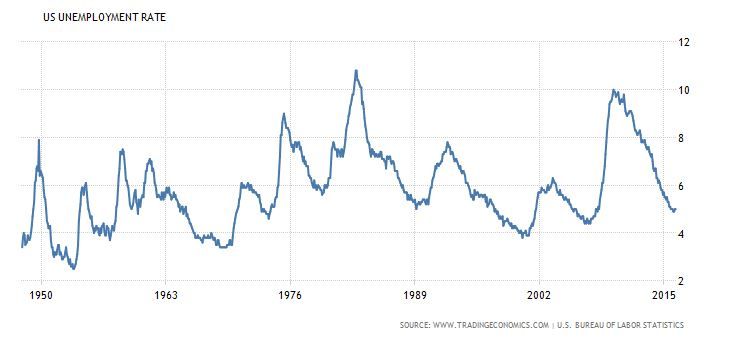
Once President Trump gets started on raising tariffs, he should not stop until the unemployment rate is ZERO for working class Americans. At the moment it is 5%. Just because prices will rise faster than a rocketship with the new Trump tariffs is no reason not to go for ZERO!
www.tradingeconomics.com/united-states/unemployment-rate
http://data.bls.gov/timeseries/LNS14000000
NOTIFY: Y | REPLY | REPLY WITH QUOTE | PERMALINK | TOP | HOME
Quote:I don't think Trump's support by Republicans has any connection to a Trump cult.
Originally posted by G:
BTW Second. You could prove that Trump is a complete pile o' sh*t 100 more times and some of these people still won't believe you. They don't want to. It's a Personality Cult thing - they be hypno-tized. Or Soviet stooges. Their dumb sh*ttery is impenetrable. It's a force of dark nature, like something from the Marvel universe.
Trump is not loved so much as Hillary is hated. Not too long ago, Jayne (Adam Baldwin) https://twitter.com/AdamBaldwin/ hated Trump and equated him with Hillary, even going so far as to post a picture of Trump morphed into Hillary. Now Trump is Jayne’s candidate. If Trump loses the general election, Jayne will pretend he never liked Trump because Trump wasn’t truly a Republican.
I’ve seen the same dynamic with my Texan neighbors. Senator Ted Cruz was their man, Trump was no Republican. He was evil, but once Trump won, all loyalties switched to Trump. There was some bitterness toward Trump and yet Hillary has to be stopped. Nixon, Bush and Bush Jr? My neighbors can’t acknowledge that those Presidents had anything to do with what a Real Republican is. The same will happen to Trump, whether he wins or loses. The average Texas Republican is treacherous, not loyal. Their party is held together by shared hatred of Hillary.

NOTIFY: Y | REPLY | REPLY WITH QUOTE | PERMALINK | TOP | HOME
Apparently this thread about jobs in China for American products and the trade and tariff laws enacted by current and prior administrations has been hijacked because it is all the fault of Trump - who has never held public office.
Denial, much?
Reality impaired?
NOTIFY: Y | REPLY | REPLY WITH QUOTE | PERMALINK | TOP | HOME
Quote:It is Trump selling tariffs as the panacea that will bring more jobs to America. I know for a fact that tariffs will raise prices in America.
Originally posted by JEWELSTAITEFAN:
Apparently this thread about jobs in China for American products and the trade and tariff laws enacted by current and prior administrations has been hijacked because it is all the fault of Trump - who has never held public office.
Denial, much?
Reality impaired?
For example, if Trump puts his 35% tariff on a Ford Flex made in Oakville, Ontario, Canada that is US$10,000 increase in the price. There is 20 hours of Canadian labor in that vehicle. If the Flex was made in America, there would be 20 hours of American labor. If you divide $10,000 by 20 hours of American labor the result is $500 per hour. For every hour more wages paid to an American in a Ford factory, the buyer of a Ford Flex is paying $500. Trump would be screwing every American who bought a Ford.
It was not Obama that ordered Ford to make vehicles in Mexico and Canada. It was Ford. And Trump will bring back American jobs by cheating every American purchaser of a Ford out of $10,000.
There is not enough unemployment in the USA to justify paying in tariffs the equivalent of $500 per hour per assembly line worker for increasing factory employment.
www.tradingeconomics.com/united-states/unemployment-rate
http://data.bls.gov/timeseries/LNS14000000
2016 Ford Flex Limited AWD SUV
Model: 2016 Ford Flex
MSRP: $39,750
How long does it actually take to make a car?
The process of making a car can be roughly divided into stamping, welding, painting, assembly and inspections, which takes about 17-18 hours in total. (It varies according to the number of cars made by a factory.)
NOTIFY: Y | REPLY | REPLY WITH QUOTE | PERMALINK | TOP | HOME

Quote:
It is Trump selling tariffs as the panacea that will bring more jobs to America. I know for a fact that tariffs will raise prices in America.
"That IS generally the point of tarrifs" she said dryly.
If the price of imported goods is raised, it makes internal manufacturing more competitive. That's kind of the point. The idea that we would get "cheaper goods" is what convinced Americans into a Faustian bargain with international businesses. But "who knew" that would boomerang back on US manufacturing jobs? (Who knew, indeed? I think many people did.)
Quote:To the original point of the thread: With the advent of widespread automation, what's the point of jobs ANYWHERE??? Its' not like automation and unemployment stop at the Chinese border.
I thought it was the cheap labor, the significant savings in comparable wages to America, or other countries.
But they are making fully automated production lines - so why cannot these fully automated facilities be here?
Answer your own question. I think you'll be confounded by the result.
--------------
You can't build a nation with bombs. You can't create a society with guns.
NOTIFY: Y | REPLY | REPLY WITH QUOTE | PERMALINK | TOP | HOME
Quote:If the purpose was to solely raise money, you've got a point. But Trump was saying he can move jobs back to America with a 35% tariff on autos. Is it worth what it will cost Americans buying Canadian built cars? You've got to do some arithmetic, which Trump won't do even if he had an accountant to do it for him.
Originally posted by SIGNYM:Quote:
It is Trump selling tariffs as the panacea that will bring more jobs to America. I know for a fact that tariffs will raise prices in America.
"That IS generally the point of tariffs" she said dryly.
If the price of imported goods is raised, it makes internal manufacturing more competitive. That's kind of the point. The idea that we would get "cheaper goods" is what convinced Americans into a Faustian bargain with international businesses. But "who knew" that would boomerang back on US manufacturing jobs? (Who knew, indeed? I think many people did.)
Trump's tariff adds $10,000 to the price of a Ford Flex immediately and the tariff only adds 20 man-hours to American factory workers. It is a very expensive way, at $500 per hour, to increase the earnings of American working class. That's not Trump's problem, because he is not buying a Flex like I did. Why should he care? Why should he ever worry about a trade war with Canada, where it's tariffs that Canada raises on USA built cars, the reverse of the Trump tariffs on Canadian built cars sold in the USA? Trump is not thinking about anything. He is just running his mouth like always, but this time on tariffs.
www.fireflyfans.net/mthread.aspx?bid=18&tid=60561&mid=1011357#
1011357
Trump's next move could be to demand that Ford fire all its Canadian factory workers in Ontario and replace them with factory workers riding a bus or a train from their homes in Detroit.
NOTIFY: Y | REPLY | REPLY WITH QUOTE | PERMALINK | TOP | HOME
The USA has already imposed a 600% tariff on Chinese cold-rolled steel. So??
----
If the goal is to re-industrialize the USA, tariffs are an integral part of that effort, there's no avoiding that concept.
--------------
You can't build a nation with bombs. You can't create a society with guns.
NOTIFY: Y | REPLY | REPLY WITH QUOTE | PERMALINK | TOP | HOME
Quote:The duties are set at 265.79% for Chinese steelmakers. Buying cheap steel from China has a bigger effect than lost wages of American steelmakers. FAR, FAR MORE IMPORTANT IS WHEN CHINA STOPS SELLING STEEL ONCE AMERICA IS DEPENDENT ON CHINA.
Originally posted by SIGNYM:
The USA has already imposed a 600% tariff on Chinese cold-rolled steel. So??
----
If the goal is to re-industrialize the USA, tariffs are an integral part of that effort, there's no avoiding that concept.
Then there is the minor fact that China agreed not to dump steel. The 265.79% duties are a reminder to China that it broke its word.
NOTIFY: Y | REPLY | REPLY WITH QUOTE | PERMALINK | TOP | HOME
Quote:U.S. hikes duties on Chinese steel to more than 500%
The duties are set at 265.79% for Chinese steelmakers.
http://money.cnn.com/2016/05/18/news/us-steel-china-trade/
The increase in prices that you're bitching about is the cost of paying American wages. Are you saying you don't want to increase American wages?
Besides, its inevitable that you'll wind up paying more anyway. When the United States can no longer manufacture anything, your wages will fall relative to the cost of imports.
--------------
You can't build a nation with bombs. You can't create a society with guns.
NOTIFY: Y | REPLY | REPLY WITH QUOTE | PERMALINK | TOP | HOME
Quote:
Originally posted by SIGNYM:Quote:
Originally posted by second:
It is Trump selling tariffs as the panacea that will bring more jobs to America. I know for a fact that tariffs will raise prices in America.
"That IS generally the point of tarrifs" she said dryly.
If the price of imported goods is raised, it makes internal manufacturing more competitive. That's kind of the point. The idea that we would get "cheaper goods" is what convinced Americans into a Faustian bargain with international businesses. But "who knew" that would boomerang back on US manufacturing jobs? (Who knew, indeed? I think many people did.)
Thank you for your attempts to simplify the explanation.
Quote:Quote:To the original point of the thread: With the advent of widespread automation, what's the point of jobs ANYWHERE??? Its' not like automation and unemployment stop at the Chinese border.
Originally posted by JewelStaiteFan:
I thought it was the cheap labor, the significant savings in comparable wages to America, or other countries.
But they are making fully automated production lines - so why cannot these fully automated facilities be here?
Answer your own question. I think you'll be confounded by the result.
The advancement of automation is largely engineered by advanced countries. The nomads and sheiks of Iran and the rice farmers of China are not designing the automation equipment. It could make sense to have these automated systems installed closer to where they are made and designed, and more easily repaired by those who are not farming rice all day.
Give a man a fish, you've fed him a meal. Teach him how to fish, you've fed him for a lifetime. Once he has learned how to fish, should he give away all his fish to people who don't want to fish? Or to the person who taught him how to fish? To the point he has no fish to feed himself or his family, and he has no ability or power to ask for some fish to eat?
NOTIFY: Y | REPLY | REPLY WITH QUOTE | PERMALINK | TOP | HOME
Quote:
Originally posted by SIGNYM:Quote:U.S. hikes duties on Chinese steel to more than 500%
The duties are set at 265.79% for Chinese steelmakers.
http://money.cnn.com/2016/05/18/news/us-steel-china-trade/
The increase in prices that you're bitching about is the cost of paying American wages. Are you saying you don't want to increase American wages?
Besides, its inevitable that you'll wind up paying more anyway. When the United States can no longer manufacture anything, your wages will fall relative to the cost of imports.
What wages? You won't have a job, or wages. You will be begging the chinese owner of every company in America for some work so you can get your 2 rice balls per day.
NOTIFY: Y | REPLY | REPLY WITH QUOTE | PERMALINK | TOP | HOME
Quote:I took a look at the Federal Reserves blog on Manufacturing: Up? Down? Posted on May 26, 2016
Originally posted by JEWELSTAITEFAN:Quote:
Originally posted by SIGNYM:Quote:
Originally posted by second:
It is Trump selling tariffs as the panacea that will bring more jobs to America. I know for a fact that tariffs will raise prices in America.
"That IS generally the point of tarrifs" she said dryly.
If the price of imported goods is raised, it makes internal manufacturing more competitive. That's kind of the point. The idea that we would get "cheaper goods" is what convinced Americans into a Faustian bargain with international businesses. But "who knew" that would boomerang back on US manufacturing jobs? (Who knew, indeed? I think many people did.)
Thank you for your attempts to simplify the explanation.Quote:Quote:To the original point of the thread: With the advent of widespread automation, what's the point of jobs ANYWHERE??? Its' not like automation and unemployment stop at the Chinese border.
Originally posted by JewelStaiteFan:
I thought it was the cheap labor, the significant savings in comparable wages to America, or other countries.
But they are making fully automated production lines - so why cannot these fully automated facilities be here?
Answer your own question. I think you'll be confounded by the result.
The advancement of automation is largely engineered by advanced countries. The nomads and sheiks of Iran and the rice farmers of China are not designing the automation equipment. It could make sense to have these automated systems installed closer to where they are made and designed, and more easily repaired by those who are not farming rice all day.
Give a man a fish, you've fed him a meal. Teach him how to fish, you've fed him for a lifetime. Once he has learned how to fish, should he give away all his fish to people who don't want to fish? Or to the person who taught him how to fish? To the point he has no fish to feed himself or his family, and he has no ability or power to ask for some fish to eat?
https://fredblog.stlouisfed.org/2016/05/manufacturing-up-down/
What did it say? Unemployment rate for manufacturing is lower than the rate for the general population. Production is up. Employment is down, probably because of robots, which means President Trump should’ve forbidden manufacturers from using robots on assembly lines. And while Trump is at it, excavating machinery and bulldozers should be outlawed because moving dirt with shovels will increase employment. Make America Great Again With Backbreaking Work Paying Minimum Wage.
There is nothing about tariffs creating jobs.
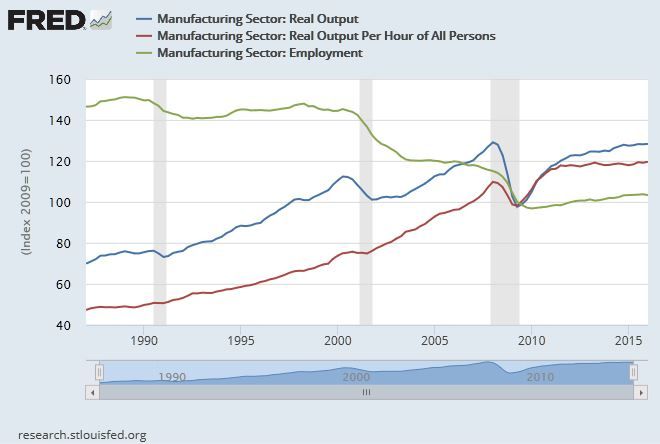
Is manufacturing up or down? As economists like to say, it depends. The graph above shows three indicators of U.S. manufacturing activity, and they point in different directions. Manufacturing output is definitively trending up; that is, the number of things produced in this country has increased over time and is currently increasing. This production is accomplished, however, with fewer and fewer employees. It should be no surprise that an economy becomes increasingly better (quicker, more efficient, etc.) at producing things, thanks to increasing productivity per employee through innovations, for example. Recently, though, manufacturing employment is trending up slightly, while productivity has slowed down (as it has in other sectors).
Is this good or bad? Employing people is clearly important. Yet, when an industry needs fewer people because it is better at doing something, this is viewed as a gain by economists: Workers who aren’t needed any more can move on to produce something else. Of course, there are costs in the process if displaced workers cannot find new employment right away. The U.S. has a relatively flexible labor
NOTIFY: Y | REPLY | REPLY WITH QUOTE | PERMALINK | TOP | HOME
SECOND, first of all, I generally don't look at "unemployment" rates because those are subject to the "discouraged worker" phenomenon. As far as manufacturing jobs, the manufacturing sector has clearly decreased since about 2000, the Fed reading the tea leaves is irrelevant.
The real question is "What's the point of jobs ANYWHERE"? I'd rather engage JSF on this first, if possible.
--------------
You can't build a nation with bombs. You can't create a society with guns.
NOTIFY: Y | REPLY | REPLY WITH QUOTE | PERMALINK | TOP | HOME

I think it's more the latter than the former. People seem to get distracted by bright shiny objects and forget that capitalism rules the day. American Business is totally about making a buck, no matter what. Simple enough - money talks, bullshit walks.
SGG
Quote:
Originally posted by second:Quote:Because the Chinese government does not feel any obligation to provide employment for the American working class? Or maybe American Business does not feel any obligation to hire the American working class?
Originally posted by JEWELSTAITEFAN:
so why cannot these fully automated facilities be here?
NOTIFY: Y | REPLY | REPLY WITH QUOTE | PERMALINK | TOP | HOME
I couldn't have said it better myself. Learn them, ElvisChrist, learn them.
SGG
Quote:
Originally posted by ElvisChrist:
Where are Trump's line of shitty clothes made?
He hates America so much he won't even manufacture his own dogshit clothes line here. That should tell you all you need to know about The Donald and his "patriotism." He doesn't give a fuck about you, your country, or anything but his bottom line.
NOTIFY: Y | REPLY | REPLY WITH QUOTE | PERMALINK | TOP | HOME
Say, isn't that anti-democratic, as well as, anti-capitalist? Say, that's sounds
a lot like Communism. Say, isn't that what JSF hates!
Sometimes, I'm a little slow on the uptake.
SGG
Quote:Do you mean that you want Obama to create new rules for business? Are you demanding that American Business loss its basic freedom and be forced to do as Obama wants it to? You might call the new rules an incentive to hire Americans, but that doesn't sound very Republican! It sounds like Communism!
Originally posted by second:Quote:
Originally posted by JEWELSTAITEFAN:
Or, because Obamanomics has shipped all jobs to China, Business feels no incentive to hire Americans to make Apple products.
NOTIFY: Y | REPLY | REPLY WITH QUOTE | PERMALINK | TOP | HOME

"He doesn't give a fuck about you, your country, or anything but his bottom line."
And you think Hillary cares more? After all she flogged every job-destroying 'free trade' agreement that came along. She didn't just destroy US jobs in one business, she destroyed jobs in entire US industries.
But what the heck! Who cares about shit like that?
Let me just point out that the author left out vital relevant facts in the opinion piece. Doing that is known as cherry-picking. And whether you do that in the news, in discussion, in debate or in opinion, when you distort the facts, you've changed the nature of your communication into propaganda. But WE don't have any of THAT in the US, do we?!
NOTIFY: N | REPLY | REPLY WITH QUOTE | PERMALINK | TOP | HOME
Say, you must own a large corporation or something because you know so much about
running a business overseas. Is it true? Do you own a business here in the U.S.?
You must be filthy rich, especially if you have a business in China.
Are you the owner of Apple?
SGG
Quote:
Originally posted by JEWELSTAITEFAN:Quote:Do you mean that you want Obama to create new rules for business? Are you demanding that American Business loss its basic freedom and be forced to do as Obama wants it to? You might call the new rules an incentive to hire Americans, but that doesn't sound very Republican! It sounds like Communism!
Originally posted by second:Quote:
Originally posted by JEWELSTAITEFAN:
Or, because Obamanomics has shipped all jobs to China, Business feels no incentive to hire Americans to make Apple products.
Are you clueless about Business? There is no need to remove freedoms, as you Democraps and other Libtards constantly strive for. Please review the concepts of tariffs, taxes, taxation of imported goods, and the like. Appropriate tariffs and fees can help balance the incentives provided to business when they are balancing their profit sheets.
NOTIFY: Y | REPLY | REPLY WITH QUOTE | PERMALINK | TOP | HOME
I get the feeling that the businesses that have Chinese connections will be against those tariffs, unless, of course, they can make a profit. Then maybe, not so much.
And since Drumpf has most of his assets here in the good ole USA (say, doesn't he have a golf course or two overseas?) Just saying!
SGG
Quote:
Originally posted by second:Quote:I should have noticed that the tariff idea was a Trump idea three months ago.
Originally posted by ElvisChrist:
Where are Trump's line of shitty clothes made?
He hates America so much he won't even manufacture his own dogshit clothes line here. That should tell you all you need to know about The Donald and his "patriotism." He doesn't give a fuck about you, your country, or anything but his bottom line.
www.reuters.com/article/us-usa-election-trump-trade-idUSKCN0WQ0WG
Donald Trump's threats to slap steep tariffs on Chinese and Mexican imports may have won him votes in Republican primaries but they would likely backfire, severely disrupting U.S. manufacturers that increasingly depend on global supply chains.
The Republican presidential front-runner's campaign pledges to impose 45 percent tariffs on all imports from China and 35 percent on many goods from Mexico would spark financial market turmoil and possibly even a recession, former trade negotiators, trade lawyers, economists and business executives told Reuters.
"I don't mind trade wars when we're losing $58 billion a year," Trump said in a Feb. 25 debate, referring to the 2015 U.S. goods trade deficit with Mexico. Economists dispute the idea the United States is "losing" money as the trade deficit is simply the difference between what the United States imports and what it exports to a country.
Among those hardest hit would be the U.S. auto industry, which has fully integrated Mexico into its production network. Some $118 billion worth of vehicles and parts flowed north and south across the border tariff-free last year, according to U.S. Commerce Department data.
A 35 percent tariff would raise costs for Ford Motor Co's U.S.-assembled F-series and medium-duty pickup trucks that use Mexican-made diesel engines, one of its most profitable vehicle lines.
Ford CEO Mark Fields on Wednesday defended the company's investment strategy, which includes $9 billion for U.S. plants over the next four years, saying, "We will do what makes sense for the business." Not what makes sense for Trump.
Once President Trump gets started on raising tariffs, he should not stop until the unemployment rate is ZERO for working class Americans. At the moment it is 5%. Just because prices will rise faster than a rocketship with the new Trump tariffs is no reason not to go for ZERO!
www.tradingeconomics.com/united-states/unemployment-rate
http://data.bls.gov/timeseries/LNS14000000
NOTIFY: Y | REPLY | REPLY WITH QUOTE | PERMALINK | TOP | HOME
Do you suppose you could actually address a topic - any topic at all - with facts and logic, and avoid the personal attacks, sgg?
Let me just point out that the author left out vital relevant facts in the opinion piece. Doing that is known as cherry-picking. And whether you do that in the news, in discussion, in debate or in opinion, when you distort the facts, you've changed the nature of your communication into propaganda. But WE don't have any of THAT in the US, do we?!
NOTIFY: N | REPLY | REPLY WITH QUOTE | PERMALINK | TOP | HOME
When I look at this pic of Drumpf, a particular song comes to mind:
I Feel Pretty (from West Side Story)
I feel pretty, oh so pretty
I feel pretty and witty and gay
And I pity any girl who isn't me today
SGG
Quote:
Originally posted by second:Quote:I don't think Trump's support by Republicans has any connection to a Trump cult.
Originally posted by G:
BTW Second. You could prove that Trump is a complete pile o' sh*t 100 more times and some of these people still won't believe you. They don't want to. It's a Personality Cult thing - they be hypno-tized. Or Soviet stooges. Their dumb sh*ttery is impenetrable. It's a force of dark nature, like something from the Marvel universe.
Trump is not loved so much as Hillary is hated. Not too long ago, Jayne (Adam Baldwin) https://twitter.com/AdamBaldwin/ hated Trump and equated him with Hillary, even going so far as to post a picture of Trump morphed into Hillary. Now Trump is Jayne’s candidate. If Trump loses the general election, Jayne will pretend he never liked Trump because Trump wasn’t truly a Republican.
I’ve seen the same dynamic with my Texan neighbors. Senator Ted Cruz was their man, Trump was no Republican. He was evil, but once Trump won, all loyalties switched to Trump. There was some bitterness toward Trump and yet Hillary has to be stopped. Nixon, Bush and Bush Jr? My neighbors can’t acknowledge that those Presidents had anything to do with what a Real Republican is. The same will happen to Trump, whether he wins or loses. The average Texas Republican is treacherous, not loyal. Their party is held together by shared hatred of Hillary.
NOTIFY: Y | REPLY | REPLY WITH QUOTE | PERMALINK | TOP | HOME
In a word ------ NO!
SGG
Quote:
Originally posted by 1kiki:
Do you suppose you could actually address a topic - any topic at all - with facts and logic, and avoid the personal attacks, sgg?
Let me just point out that the author left out vital relevant facts in the opinion piece. Doing that is known as cherry-picking. And whether you do that in the news, in discussion, in debate or in opinion, when you distort the facts, you've changed the nature of your communication into propaganda. But WE don't have any of THAT in the US, do we?!
NOTIFY: Y | REPLY | REPLY WITH QUOTE | PERMALINK | TOP | HOME
I saw a report, I think it was on 60 Minutes, where China bought a steel mill here in the U.S.
OMG, I actually came up with a fact! In the words of Mona Lisa Vitti, "OMG, what a fucking nightmare!"
SGG
Quote:
Originally posted by second:Quote:The duties are set at 265.79% for Chinese steelmakers. Buying cheap steel from China has a bigger effect than lost wages of American steelmakers. FAR, FAR MORE IMPORTANT IS WHEN CHINA STOPS SELLING STEEL ONCE AMERICA IS DEPENDENT ON CHINA.
Originally posted by SIGNYM:
The USA has already imposed a 600% tariff on Chinese cold-rolled steel. So??
----
If the goal is to re-industrialize the USA, tariffs are an integral part of that effort, there's no avoiding that concept.
Then there is the minor fact that China agreed not to dump steel. The 265.79% duties are a reminder to China that it broke its word.
NOTIFY: Y | REPLY | REPLY WITH QUOTE | PERMALINK | TOP | HOME
Really!? Bold statement. Exactly which jobs did she destroy. Facts please!
SGG
Quote:
Originally posted by 1kiki:
"He doesn't give a fuck about you, your country, or anything but his bottom line."
And you think Hillary cares more? After all she flogged every job-destroying 'free trade' agreement that came along. She didn't just destroy US jobs in one business, she destroyed jobs in entire US industries.
But what the heck! Who cares about shit like that?
Let me just point out that the author left out vital relevant facts in the opinion piece. Doing that is known as cherry-picking. And whether you do that in the news, in discussion, in debate or in opinion, when you distort the facts, you've changed the nature of your communication into propaganda. But WE don't have any of THAT in the US, do we?!
NOTIFY: Y | REPLY | REPLY WITH QUOTE | PERMALINK | TOP | HOME
Say, what about ElvisChrist? Yell, at him too. This time, I was GOOD!
SGG
Quote:
Originally posted by 1kiki:
Do you suppose you could actually address a topic - any topic at all - with facts and logic, and avoid the personal attacks, sgg?
Let me just point out that the author left out vital relevant facts in the opinion piece. Doing that is known as cherry-picking. And whether you do that in the news, in discussion, in debate or in opinion, when you distort the facts, you've changed the nature of your communication into propaganda. But WE don't have any of THAT in the US, do we?!
NOTIFY: Y | REPLY | REPLY WITH QUOTE | PERMALINK | TOP | HOME
http://www.huffingtonpost.com/lori-wallach/nafta-at-20-one-million-u_b
_4550207.html
Let me just point out that the author left out vital relevant facts in the opinion piece. Doing that is known as cherry-picking. And whether you do that in the news, in discussion, in debate or in opinion, when you distort the facts, you've changed the nature of your communication into propaganda. But WE don't have any of THAT in the US, do we?!
NOTIFY: N | REPLY | REPLY WITH QUOTE | PERMALINK | TOP | HOME
Okay. Then explain to me.....where do tariffs come from? If they are so bad for
the American worker, whom everyone seems to care about, they why oh why are they
in place? Really, can't American workers make American products better than anyone else? Then why are American businesses fleeing the country to do their business overseas? Why aren't businesses and manufacturers rejecting the notion of taking
their companies to foreign lands?
Is the president forcing them to leave and we don't know about it. Wouldn't that
make it an impeachable offense?
Inquiring minds want to know.
SGG
Quote:
Originally posted by JEWELSTAITEFAN:
Apparently this thread about jobs in China for American products and the trade and tariff laws enacted by current and prior administrations has been hijacked because it is all the fault of Trump - who has never held public office.
Denial, much?
Reality impaired?
NOTIFY: Y | REPLY | REPLY WITH QUOTE | PERMALINK | TOP | HOME
Oh, so this is what you mean about posting facts. Good article, yes I actually read. But let me tell you something, I do that all the time. What I don't like is being told what I can post. This is still a free country, if you don't like something I post fine. But don't tell me what to do. You don't know me and I don't know you.
I'm an individual, I think for myself. I speak my mind and try to put my point across. I am more than willing to discuss topics as intelligently as I can, if
I'm not up on a topic, I do not post a haphazard opinion. Generally, I'm a gentleman, except when I feel someone is being a dick towards me. Most times I try to have fun and still get my point across, it's obvious you don't agree. You've
made your point. And now I've made mine.
SGG
Quote:
Originally posted by 1kiki:
http://www.huffingtonpost.com/lori-wallach/nafta-at-20-one-million-u_b
_4550207.html
Let me just point out that the author left out vital relevant facts in the opinion piece. Doing that is known as cherry-picking. And whether you do that in the news, in discussion, in debate or in opinion, when you distort the facts, you've changed the nature of your communication into propaganda. But WE don't have any of THAT in the US, do we?!
NOTIFY: Y | REPLY | REPLY WITH QUOTE | PERMALINK | TOP | HOME
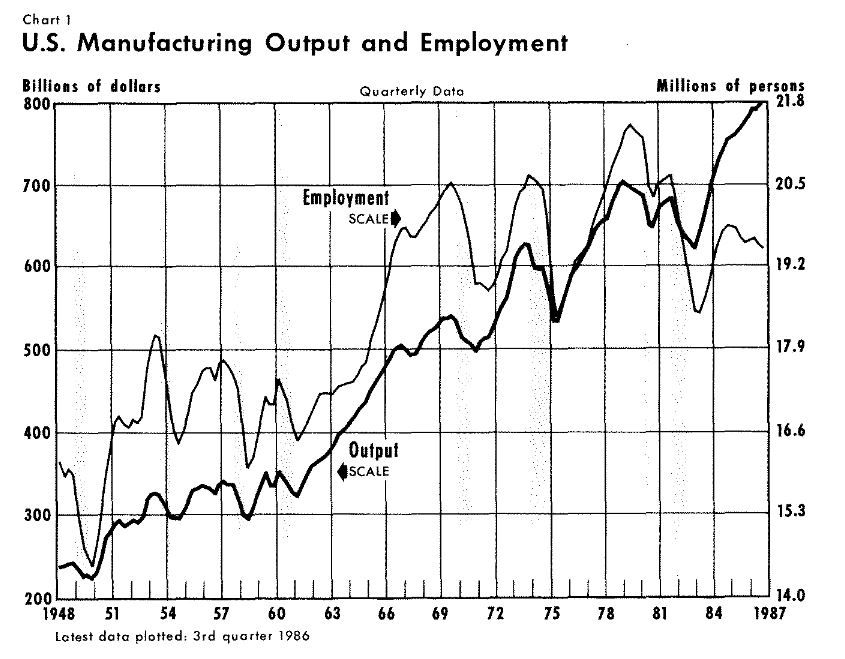
Quote:I saw an article called Why Has Manufacturing Employment Declined? It is from 30 years ago, back when Trump, Hillary and Obama were unimportant. It begins:
Originally posted by SIGNYM:
SECOND, first of all, I generally don't look at "unemployment" rates because those are subject to the "discouraged worker" phenomenon. As far as manufacturing jobs, the manufacturing sector has clearly decreased since about 2000, the Fed reading the tea leaves is irrelevant.
The real question is "What's the point of jobs ANYWHERE"? I'd rather engage JSF on this first, if possible.
“United States manufacturing employment grew little in 1986. Currently at about 19 million workers, it is below the 21 million employed at its peak in 1979. This disappointing performance often is attributed to-” Read it to find out how the sentence ends.
https://research.stlouisfed.org/publications/review/86/12/Manufacturin
g_Dec1986.pdf
I can show you the future story of manufacturing employment with another story that has almost reached its end: farming employment. The USA had 21 million farm workers in 1916, the very same number as 1979’s manufacturing employment. There are now only 1 million farmers and yet we are not starving.
www.ers.usda.gov/topics/farm-economy/farm-labor/background.aspx
Twenty million farmers have tragically lost their jobs. A way of life is gone. How will farmers support their families now that they are unemployed? President Trump says he can increase the number of hardworking farmers back to 21 million with high tariffs on imported food. But, just maybe, Trump should not.
https://research.stlouisfed.org/publications/review/86/12/Manufacturin
g_Dec1986.pdf
NOTIFY: Y | REPLY | REPLY WITH QUOTE | PERMALINK | TOP | HOME
second
Do you believe the data and the factors behind it from your cite are still relevant today - when manufacturing employment and output have undeniably fallen over multiple decades?
Now, I understand there are all sorts of quibbles one can make about any item or metric. Obviously the percent engaged in agriculture has gone down due to the destruction of the family farm and the rise of large-scale mechanized farming. And comparing output by using its monetary value as a metric is deeply influenced by the relative value of the currencies at any one time. And there is the rise of new industries - computing and chip manufacturing (which accounted for the bump circa 2000 which then fell to China afterwards) - and the fall of old ones.
But the fall of US manufacturing can't be explained away, no matter how many quibbles you throw at it.

Let me just point out that the author left out vital relevant facts in the opinion piece. Doing that is known as cherry-picking. And whether you do that in the news, in discussion, in debate or in opinion, when you distort the facts, you've changed the nature of your communication into propaganda. But WE don't have any of THAT in the US, do we?!
NOTIFY: N | REPLY | REPLY WITH QUOTE | PERMALINK | TOP | HOME
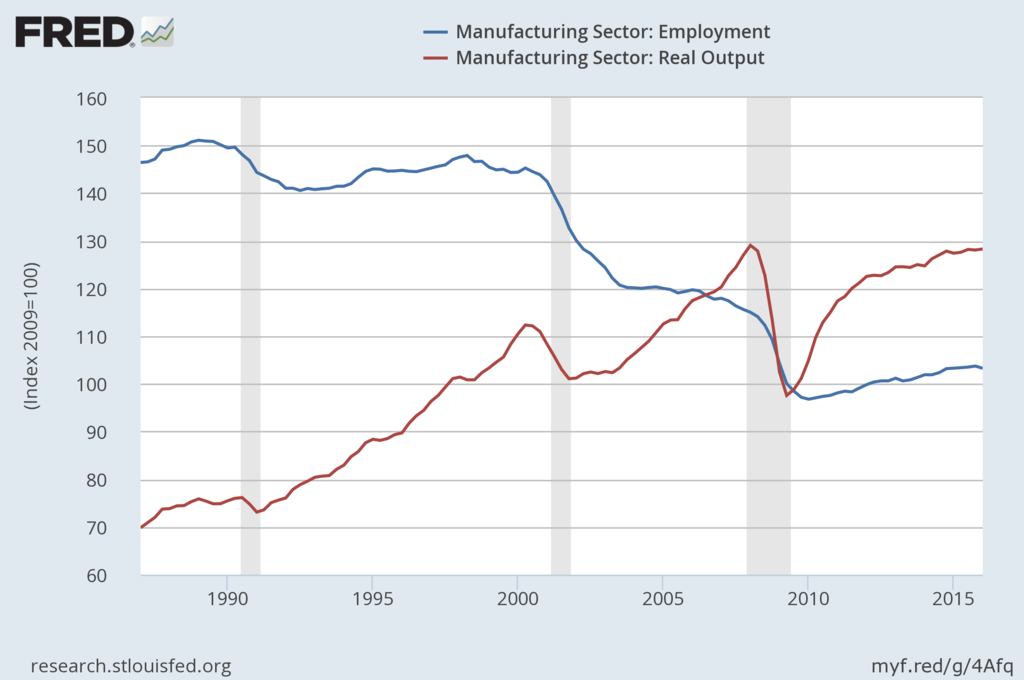
Quote:You're half right. Manufacturing employment has fallen. Manufacturing output? It fell down than rose up. The loss of manufacturing jobs is an on going phenomenon associated with a long trend of technological advance. The advance is more stuff with fewer workers.
Originally posted by 1kiki:
second
Do you believe the data and the factors behind it from your cite are still relevant today - when manufacturing employment and output have undeniably fallen over multiple decades?
But the fall of US manufacturing can't be explained away, no matter how many quibbles you throw at it.
Agriculture had even more technological advance. Farmers went from 21 million in 1916 to 1 million in 2016. Dramatic unemployment for farmers and their plow horses.
http://myf.red/g/4Afq
http://myf.red/g/4AfL
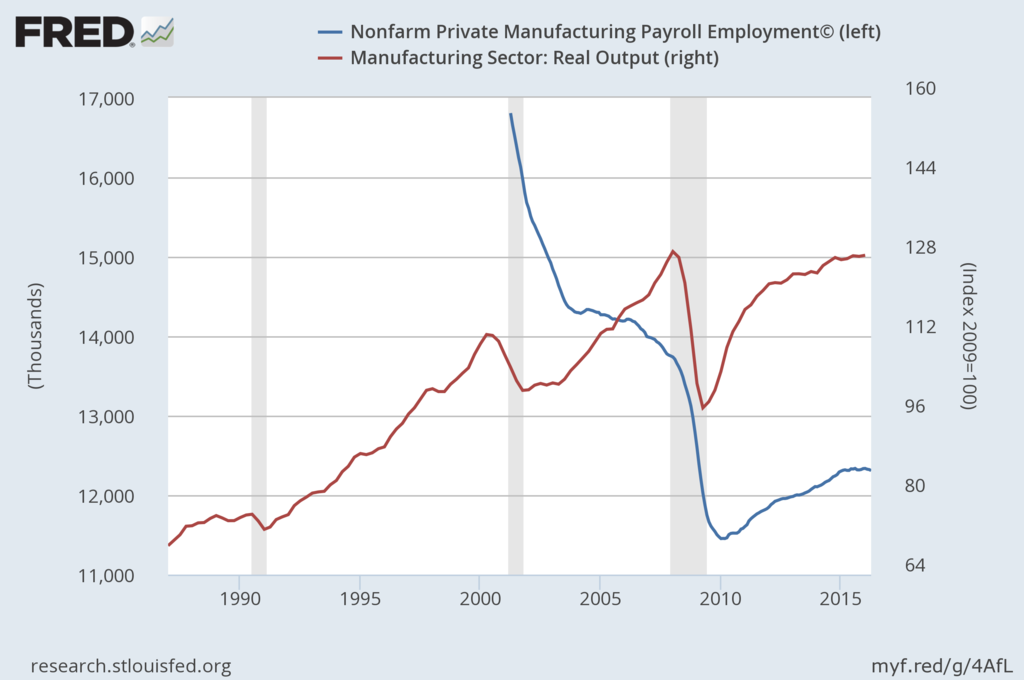
Quote:https://research.stlouisfed.org/publications/es/13/ES_20_2013-07-26.pd
. . . manufacturing jobs as a percentage of private employment has fallen by half—from about 21 percent in 1987 to less than 11 percent today. Yet, manufacturing output as a percentage of private output has followed a steady trend of about 14 percent over the same period. Producing the same share of output with a declining share of the workforce reflects the rising productivity of employees in manufacturing firms who have become more efficient by getting better training and by working with better equipment and software.
f
NOTIFY: Y | REPLY | REPLY WITH QUOTE | PERMALINK | TOP | HOME
http://www.bls.gov/iag/tgs/iag31-33.htm
The manufacturing sector consists of these subsectors:
Food Manufacturing: NAICS 311
Beverage and Tobacco Product Manufacturing: NAICS 312
Textile Mills: NAICS 313
Textile Product Mills: NAICS 314
Apparel Manufacturing: NAICS 315
Leather and Allied Product Manufacturing: NAICS 316
Wood Product Manufacturing: NAICS 321
Paper Manufacturing: NAICS 322
Printing and Related Support Activities: NAICS 323
Petroleum and Coal Products Manufacturing: NAICS 324
Chemical Manufacturing: NAICS 325
Plastics and Rubber Products Manufacturing: NAICS 326
Nonmetallic Mineral Product Manufacturing: NAICS 327
Primary Metal Manufacturing: NAICS 331
Fabricated Metal Product Manufacturing: NAICS 332
Machinery Manufacturing: NAICS 333
Computer and Electronic Product Manufacturing: NAICS 334
Electrical Equipment, Appliance, and Component Manufacturing: NAICS 335
Transportation Equipment Manufacturing: NAICS 336
Furniture and Related Product Manufacturing: NAICS 337
Miscellaneous Manufacturing: NAICS 339
Energy production alone (including fracking, an economically unsustainable activity) accounts for 11% of the rise from 2004 (@110) to 2014 (@127) https://en.wikipedia.org/wiki/Energy_in_the_United_States which drops the supposed rise from 2004 to 2014 (@115). Meanwhile, the population grew from 292.8 in 2004 to 318.9 million in 2014, which accounts for another 9% (and drops the supposed rise @106.)
Accounting for gas and oil production (especially the fracking bubble) and population growth, US manufacturing fell from 110 in 2004 to 106 in 2014.
And according to the BLS
There is no fixed relationship between employment change and labor productivity growth
http://www.bls.gov/spotlight/2013/productivity/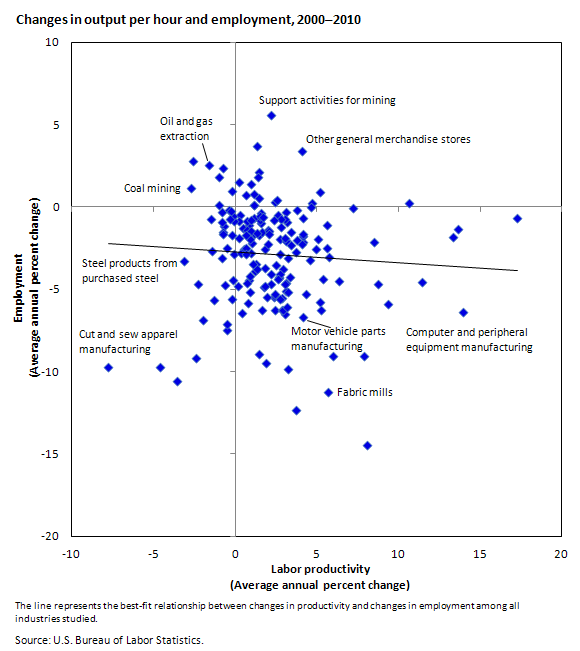
Let me just point out that the author left out vital relevant facts in the opinion piece. Doing that is known as cherry-picking. And whether you do that in the news, in discussion, in debate or in opinion, when you distort the facts, you've changed the nature of your communication into propaganda. But WE don't have any of THAT in the US, do we?!
NOTIFY: N | REPLY | REPLY WITH QUOTE | PERMALINK | TOP | HOME
To 1kiki:
That’s nice that your plot shows average annual % change in labor productivity was negative for oil & gas extraction, coal mining, steel products from purchased steel and cut & sew apparel manufacturing.
But most of those blue diamonds on your plot are in positive territory, not negative. You know happens when productivity is positive or increases? Employment decreases, which is what you should expect with robots working on assembly lines. That is where this all started with China firing assembly line workers because robots could do the work. Or America firing assembly line workers because robots could do the work. The result is the same: fewer assembly line workers, but more production.
I like this slide from your source because it makes clear that manufacturing productivity increased the most while hours decreased the most (except for “Information”, whatever industry that is):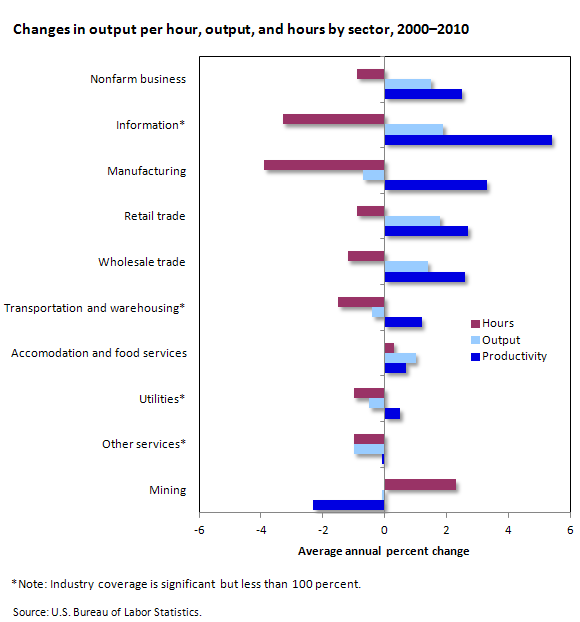
NOTIFY: Y | REPLY | REPLY WITH QUOTE | PERMALINK | TOP | HOME
"But most of those blue diamonds on your plot are in positive territory, not negative."
Apparently you don't know the meaning of linear regression, which means you don't know what correlation means, graphically speaking.
When you look at ALL the data - not cherry picking the stuff that supports your ideas and leaving out the stuff that doesn't - this is how the various correlations look: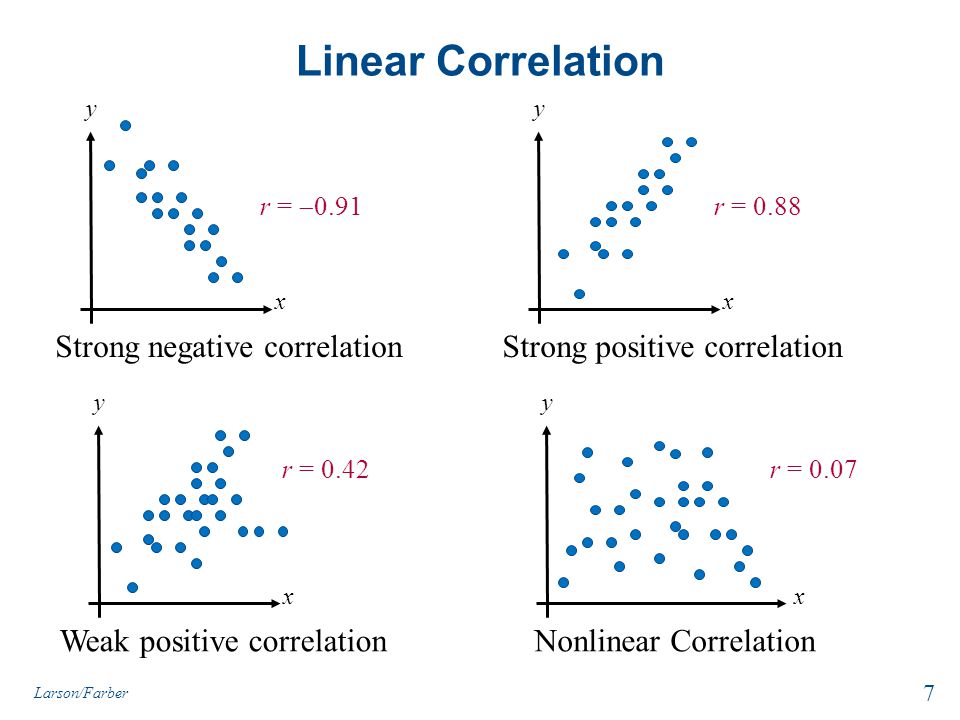
In the case of the BLS graph, the flatness of the regression line indicates lack of correlation. (The placement of the regression line shows bias, not correlation).
Also, fwiw, you completely missed the lesson of the BLS graph you 'like'. I suspect if you understood it, you wouldn't 'like' it so much. Productivity is a function of 2 (two, deux, dos) factors - output AND hours. If you're trying to make a statement about output - you need to look at - the output. Which went down for manufacturing. Which is what I said. "But the fall of US manufacturing can't be explained away, no matter how many quibbles you throw at it."
Let me just point out that the author left out vital relevant facts in the opinion piece. Doing that is known as cherry-picking. And whether you do that in the news, in discussion, in debate or in opinion, when you distort the facts, you've changed the nature of your communication into propaganda. But WE don't have any of THAT in the US, do we?!
NOTIFY: N | REPLY | REPLY WITH QUOTE | PERMALINK | TOP | HOME
Quote:You claim manufacturing employment and output have undeniably fallen over multiple decades. Where did you show that manufacturing output has fallen? You are right about manufacturing employment falling, but, so what? It is doomed to fall just as agricultural employment has fallen by 20 million because of increased productivity per man hour.
Originally posted by 1kiki:
Apparently you don't know the meaning of linear regression, which means you don't know what correlation means, graphically speaking.
Your data stops in 2010. Output has gone up since 2010. Employment has gone up only a little.
http://myf.red/g/4AfL
NOTIFY: Y | REPLY | REPLY WITH QUOTE | PERMALINK | TOP | HOME
As I calculated above, output has gone down accounting for the fracking bubble (which is already popping) and population increase. I suggest you read my post.
Also, btw, you can't account for the lack of MANUFACTURING jobs by pointing to farming. Farming is NOT manufacturing, by definition. The lack of MANUFACTURING jobs is limited to MANUFACTURING. Funny how that works.
Food Manufacturing: NAICS 311
Beverage and Tobacco Product Manufacturing: NAICS 312
Textile Mills: NAICS 313
Textile Product Mills: NAICS 314
Apparel Manufacturing: NAICS 315
Leather and Allied Product Manufacturing: NAICS 316
Wood Product Manufacturing: NAICS 321
Paper Manufacturing: NAICS 322
Printing and Related Support Activities: NAICS 323
Petroleum and Coal Products Manufacturing: NAICS 324
Chemical Manufacturing: NAICS 325
Plastics and Rubber Products Manufacturing: NAICS 326
Nonmetallic Mineral Product Manufacturing: NAICS 327
Primary Metal Manufacturing: NAICS 331
Fabricated Metal Product Manufacturing: NAICS 332
Machinery Manufacturing: NAICS 333
Computer and Electronic Product Manufacturing: NAICS 334
Electrical Equipment, Appliance, and Component Manufacturing: NAICS 335
Transportation Equipment Manufacturing: NAICS 336
Furniture and Related Product Manufacturing: NAICS 337
Miscellaneous Manufacturing: NAICS 339
But if you're not going to bother reading my posts when I go to great lengths to bring facts to the board, then you're no better than THE THREESTOOGES.
In which case - goodbye.
Let me just point out that the author left out vital relevant facts in the opinion piece. Doing that is known as cherry-picking. And whether you do that in the news, in discussion, in debate or in opinion, when you distort the facts, you've changed the nature of your communication into propaganda. But WE don't have any of THAT in the US, do we?!
NOTIFY: N | REPLY | REPLY WITH QUOTE | PERMALINK | TOP | HOME
Quote:Farm employment was only mentioned because farm jobs (but not food production) started being lost 100 years ago when better farm machine became available. The Fordson tractor is an example of this better machinery. https://en.wikipedia.org/wiki/Fordson
Originally posted by 1kiki:
Also, btw, you can't account for the lack of MANUFACTURING jobs by pointing to farming. Farming is NOT manufacturing, by definition. The lack of MANUFACTURING jobs is limited to MANUFACTURING. Funny how that works.
. . .
No matter how many millions of tons of food were imported to the USA, farmers would be losing their jobs. Farmers were angry that any food was imported and they stayed on their land until the bitter end. Some even killed themselves.
Manufacturing employment (but not manufacturing output) started to collapse 40 years ago when better machinery became available. The Honeywell TDC2000 is an example of that better machinery. https://en.wikipedia.org/wiki/Distributed_control_system#History
No matter how many millions of tons of goods were imported to the USA, manufacturing employees would be losing their jobs. They are angry that any goods are imported. Some even kill themselves because they lost their jobs.
Quote:Tomorrow I hope you have a nice Memorial Day.
Originally posted by 1kiki:
. . .
But if you're not going to bother reading my posts when I go to great lengths to bring facts to the board, then you're no better than THE THREESTOOGES.
In which case - goodbye.
NOTIFY: Y | REPLY | REPLY WITH QUOTE | PERMALINK | TOP | HOME
"No matter how many millions of tons of food were imported to the USA, farmers would be losing their jobs. ... No matter how many millions of tons of goods were imported to the USA, manufacturing employees would be losing their jobs."
Yes, that's that idée fixe of yours that the BLS disputes with a decade worth of data across ALL industries; that also doesn't take into account increased demand and new industries that provide more work opportunities; that seems resistant to the idea that when you import cars you're no longer manufacturing them in your country.
Like I said, you and facts don't seem to get along.
Let me just point out that the author left out vital relevant facts in the opinion piece. Doing that is known as cherry-picking. And whether you do that in the news, in discussion, in debate or in opinion, when you distort the facts, you've changed the nature of your communication into propaganda. But WE don't have any of THAT in the US, do we?!
NOTIFY: N | REPLY | REPLY WITH QUOTE | PERMALINK | TOP | HOME
http://www.census.gov/foreign-trade/Press-Release/MITR/2014/2014%20Man
ufacturing%20and%20International%20Trade%20Report.pdf
2014 US figures in millions of dollars
Automobiles exports/ imports
52.1/ 152.6
Light truck and utility vehicles
9.4/ 14.8
Heavy duty trucks
6.5/ 13.4
total
68.0/ 180.8
total jobs lost to imports:
266%
There were 904k auto manufacturing jobs in the US in 2015 http://www.bls.gov/iag/tgs/iagauto.htm#emp_national. Using that as an estimate for 2014, if the US didn't import cars or trucks, there would have been an extra 2404k auto manufacturing jobs instead, in other words, an additional 2.4 million jobs in the automotive industry alone.
Semiconductors and related devices
42.7/ 40.3
jobs lost to imports:
94%
Fiber, yarn, and thread mill products
2.1/ 0.8
jobs lost to imports:
38%
Broadwoven fabric mill products
2.1/ 3.2
jobs lost to imports:
152%
I think it's pretty clear: when goods are imported, those manufacturing jobs are lost from the importing country.
Let me just point out that the author left out vital relevant facts in the opinion piece. Doing that is known as cherry-picking. And whether you do that in the news, in discussion, in debate or in opinion, when you distort the facts, you've changed the nature of your communication into propaganda. But WE don't have any of THAT in the US, do we?!
NOTIFY: N | REPLY | REPLY WITH QUOTE | PERMALINK | TOP | HOME
Quote:There is a missing vital fact. Do you have an estimate of what it will cost, hypothetically, to have all manufacturing of all cars sold in the USA done in the USA? I did one for just the Canadian built Ford Flex and it was $10,000 per Flex. Maybe President Trump's tariff will be lower than his campaign's 35%. Maybe American workers will take many more hours than Canada's 20 man-hours to build a Flex. Maybe it won't cost an extra $500 per hour of work in the USA, but it won't be free.
Originally posted by 1kiki:
. . . if the US didn't import cars or trucks, there would have been an extra 2404k auto manufacturing jobs instead, in other words, an additional 2.4 million jobs in the automotive industry alone.
I think it's pretty clear: when goods are imported, those manufacturing jobs are lost from the importing country.
Let me just point out that the author left out vital relevant facts in the opinion piece. Doing that is known as cherry-picking. And whether you do that in the news, in discussion, in debate or in opinion, when you distort the facts, you've changed the nature of your communication into propaganda. But WE don't have any of THAT in the US, do we?!
What will it cost to create 2,404,000 more jobs in the USA automotive industry?
NOTIFY: Y | REPLY | REPLY WITH QUOTE | PERMALINK | TOP | HOME
Well, I'm glad to see that KIKI disabused you of your argument that automation is the main reason for lost jobs in the USA.
And now you're wondering about the cost of bringing those jobs back to the USA. So, tell me, SECOND, what is the cost of NOT having those jobs?
Welfare, food stamps, broke pension programs (including Social Security), depression, substance abuse, poor health outcomes, suicide? Oversized debt burden at all levels (both public and private) and potential financial collapse? Political instability? The inability of the USA to chart a course independent of banks? Eventually, a worth-less currency and an increase in import costs?
Which brings me back to my question: What's the point of jobs ANYWHERE?
--------------
You can't build a nation with bombs. You can't create a society with guns.
NOTIFY: Y | REPLY | REPLY WITH QUOTE | PERMALINK | TOP | HOME
I just wanted to get back to the topic of automation: the reason why SOME automation happens is specifically to reduce labor costs in order to get a higher profit. It's the same reason why one would 'offshore' jobs to where labor is cheaper. But while reducing labor through automation, and therefore labor costs, is a short-term profit-boosting move for any PARTICULAR business, it's an overall economy- and society-busting paradigm. Because a population that makes less money is ultimately unable to purchase those goods. It's the basic self-destructive internal contradiction of capitalism.
But it's not the only reason to automate. Most, if not all, of our highest-technology goods are impossible to make without automation. Chip manufacturing is an example. So are self-assembled complex chemicals and nano-technology products. Nuclear power is automated. Also, deep mining and large-scale construction have to be done with the aid of machines rather than lots and lots of human labor. And so on. Where environments are too harsh, dimensions too small, precision too exacting, timescales too small - or large, power and force requirements too large; in short, when human labor is incapable, we need our technology, including automation, to accomplish our tasks. It allows us to move beyond human capability to do tasks and make things that would otherwise not be possible.
Let me just point out that the author left out vital relevant facts in the opinion piece. Doing that is known as cherry-picking. And whether you do that in the news, in discussion, in debate or in opinion, when you distort the facts, you've changed the nature of your communication into propaganda. But WE don't have any of THAT in the US, do we?!
NOTIFY: N | REPLY | REPLY WITH QUOTE | PERMALINK | TOP | HOME
So we get back to my question ... what's the point of jobs ANYWHERE?
It's an interesting question. I hope someone tries to answer it besides me.
--------------
You can't build a nation with bombs. You can't create a society with guns.
NOTIFY: Y | REPLY | REPLY WITH QUOTE | PERMALINK | TOP | HOME
Quote:What's the point of jobs ANYWHERE? That's too philosophical for me. Whatever answer I give won't be enough answer.
Originally posted by SIGNYM:
So we get back to my question ... what's the point of jobs ANYWHERE?
It's an interesting question. I hope someone tries to answer it besides me.
--------------
You can't build a nation with bombs. You can't create a society with guns.
The salesmen in the book The Soul of A New Machine said the point is money and what money can buy, but all the people that were interesting in the story had much more complex jobs and larger motives than the salesmen. Salesmen, being who they are, find any purpose other than their purpose to be impractical. I would say salesmen have taken over the world since that book was published in 1981. But complaining about motivation of today will make no more difference than complaining about the Conquistadors' greed for gold and silver 500 years ago.
NOTIFY: Y | REPLY | REPLY WITH QUOTE | PERMALINK | TOP | HOME
If we COULD get machines to do everything for us, and assuming that we could fix the economic system so that people could avail themselves of the products, we'd probably be like the very wealthy of any era: bereft of meaningful problems to solve and accomplishments to be proud of, we'd be swimming in an endless sea of physical gratifications and shallow interactions.
Let me just point out that the author left out vital relevant facts in the opinion piece. Doing that is known as cherry-picking. And whether you do that in the news, in discussion, in debate or in opinion, when you distort the facts, you've changed the nature of your communication into propaganda. But WE don't have any of THAT in the US, do we?!
NOTIFY: N | REPLY | REPLY WITH QUOTE | PERMALINK | TOP | HOME
Quote:
Originally posted by 1kiki:
If we COULD get machines to do everything for us, and assuming that we could fix the economic system so that people could avail themselves of the products, we'd probably be like the very wealthy of any era: bereft of meaningful problems to solve and accomplishments to be proud of, we'd be swimming in an endless sea of physical gratifications and shallow interactions.
Kind of like the Eloi in The Time Machine
SECOND, I can't see the point of answering a question about the point of jobs in any particular place, because in this globalized economy one place can be substituted for another.
Also, it depends on WHOSE purpose you're asking about. Jobs mean different things to financialist (who sees them as a source of profit), to the worker, and to the consumer. And jobs have a greater meaning in general than either of those.
--------------
You can't build a nation with bombs. You can't create a society with guns.
NOTIFY: Y | REPLY | REPLY WITH QUOTE | PERMALINK | TOP | HOME
Quote:Does work have to be Americans’ primary source of status? Should it organize their lives? That is where some of this animosity about "China stealing American jobs" comes from. It is not only about about earning money from factory work.
Originally posted by SIGNYM:Quote:
Originally posted by 1kiki:
If we COULD get machines to do everything for us, and assuming that we could fix the economic system so that people could avail themselves of the products, we'd probably be like the very wealthy of any era: bereft of meaningful problems to solve and accomplishments to be proud of, we'd be swimming in an endless sea of physical gratifications and shallow interactions.
Kind of like the Eloi in The Time Machine
SECOND, I can't see the point of answering a question about the point of jobs in any particular place, because in this globalized economy one place can be substituted for another.
Also, it depends on WHOSE purpose you're asking about. Jobs mean different things to financialist (who sees them as a source of profit), to the worker, and to the consumer. And jobs have a greater meaning in general than either of those.
www.vox.com/2016/6/1/11827024/universal-basic-income
Moving factory production from China to the USA might not mean more permanent, lifetime jobs in the USA. Elon Musk said the world's best automotive factories are still using outmoded and inefficient systems. Tesla’s business is building cars, not increasing employment. “We can make dramatic improvements to the machine that makes the machine. A lot of people will not believe us about this, but I am absolutely convinced this can be accomplished.”
www.latimes.com/business/autos/la-fi-hy-tesla-shareholders-20160531-sn
ap-story.html
But Elon Musk could be mistaken. Maybe auto factories will not become much more efficient at using manpower.
It is not so obvious that the USA needs to bully China into moving factory production to the USA to create new jobs:
Unemployment Claims in 2016 Have Set a New Record Low
The Department of Labor announced today that the 4-week moving average of initial unemployment claims was 276,000 in May. "This marks 65 consecutive weeks of initial claims below 300,000, the longest streak since 1973."
www.motherjones.com/kevin-drum/2016/06/unemployment-claims-2016-have-s
et-new-record-low
NOTIFY: Y | REPLY | REPLY WITH QUOTE | PERMALINK | TOP | HOME
Robots are coming for our jobs. So who is going to lose their job?
Partly because we're better at designing these limited AI systems, some experts predict that high-skilled workers will adapt to the technology as a tool, while lower-skill jobs are the ones that will see the most disruption. When the Obama administration studied the issue, it found that as many as 80 percent of jobs currently paying less than $20 an hour might someday be replaced by AI.
"That's over a long period of time, and it's not like you're going to lose 80 percent of jobs and not reemploy those people," Jason Furman, a senior economic advisor to President Obama, said in an interview. "But [even] if you lose 80 percent of jobs and reemploy 90 percent or 95 percent of those people, it's still a big jump up in the structural number not working. So I think it poses a real distributional challenge."
Policymakers will need to come up with inventive ways to meet this looming jobs problem. But the same estimates also hint at a way out: Higher-earning jobs stand to be less negatively affected by automation. Compared to the low-wage jobs, roughly a third of those who earn between $20 and $40 an hour are expected to fall out of work due to robots, according to Furman. And only a sliver of high-paying jobs, about 5 percent, may be subject to robot replacement.
Those numbers might look very different if researchers were truly on the brink of creating sentient AI that can really do all the same things a human can. In this hypothetical scenario, even high-skilled workers might have more reason to fear. But the fact that so much of our AI research right now appears to favor narrow forms of artificial intelligence at least suggests we could be doing a lot worse.
www.washingtonpost.com/news/the-switch/wp/2016/06/02/everything-you-th
ink-you-know-about-ai-is-wrong/
NOTIFY: Y | REPLY | REPLY WITH QUOTE | PERMALINK | TOP | HOME
Quote:
Does work have to be Americans’ primary source of status? Should it organize their lives?
Does work "have" to be American?
No, of course not.
But only if you change the economic system, because under neo-liberalism (the economic structure which promotes socialism for the wealthy and "free-market" capitalism for everyone else) you either work or die.
As KIKI said, if you could manage to distribute the goods manufactured to people without expecting work from them (1) you wouldn't have capitalism and (2) work wouldn't be required. But I don't see any great benefits coming to the non-worker any time in the near future, do you? And I don't see that happening internationally, either. The USA can't keep importing foreign manufactured goods ... and exchanging them for pieces of paper, or bits in a bank account ... forever. At some point, those holders of American dollars are going to EXPECT something in exchange for that currency, and it's not going to be manis and pedis (the great service economy).
Quote:
...'It is not so obvious that the USA needs to bully China into moving factory production to the USA to create new jobs:
Unemployment Claims in 2016 Have Set a New Record Low
Every time someone points to the unemployment figure, I want to put my head thru a wall. The unemployment figure is so manipulated as to be meaningless, because even gainful employment for ONE HOUR in a month counts you as "employed", and if you've stopped looking for a job you're no longer counted as "unemployed". And while the unemployment figure has been warped this way for a long time, internet connectivity has made ultra-temporary jobs ("the gig economy") more prevalent.
Quote:The push for automation isn't coming about because of a demand for automation from below, it's coming about because of a demand for profit from above. The job of the "job creators" isn't to create jobs, it' to DESTROY them, and they're been working on that for a long, long time.
Partly because we're better at designing these limited AI systems, some experts predict that high-skilled workers will adapt to the technology as a tool, while lower-skill jobs are the ones that will see the most disruption. When the Obama administration studied the issue, it found that as many as 80 percent of jobs currently paying less than $20 an hour might someday be replaced by AI.
Quote:And if establishment policy-makers think that "the answer" is to give everyone a better education so that "everyone" can get one of those higher-paying jobs, what will happen is that there will be a flood of people competing, which will drive wages down.
Policymakers will need to come up with inventive ways to meet this looming jobs problem. But the same estimates also hint at a way out: Higher-earning jobs stand to be less negatively affected by automation. Compared to the low-wage jobs, roughly a third of those who earn between $20 and $40 an hour are expected to fall out of work due to robots, according to Furman. And only a sliver of high-paying jobs, about 5 percent, may be subject to robot replacement.
We will never be able to think about "jobs" - manufacturing or otherwise- logically until we get rid of capitalism as a model. That's because the job destroyers will continue to destroy jobs, and at the same time insist that only those who work will be able to buy the goods so created. Those two demands are logically contradictory and in the long run will destroy each other. The only reason why they're promoted is because they work very well for the 0.01% who can profit from the system (until it implodes, that is, which is does with regularity).
Automation depends not only on technology but also on a source of EXTERNAL, NON-HUMAN POWER. At one time it was water-wheels which drove the looms and mills of mercantile France, England, and the northeast USA. Now it's ele
NOTIFY: Y | REPLY | REPLY WITH QUOTE | PERMALINK | TOP | HOME

Quote:
Originally posted by SIGNYM:
And now you're wondering about the cost of bringing those jobs back to the USA. So, tell me, SECOND, what is the cost of NOT having those jobs?
We have all been talking about this for years, predicted it, but refused to admit it because it was 'scifi'
strange looking flag

http://www.forbiddenplanet.co.uk
Susan Sarandon Fears Hillary Foreign Policy More Than Trump
NOTIFY: N | REPLY | REPLY WITH QUOTE | PERMALINK | TOP | HOME
Quote:
Originally posted by SIGNYM:
SECOND, first of all, I generally don't look at "unemployment" rates because those are subject to the "discouraged worker" phenomenon. As far as manufacturing jobs, the manufacturing sector has clearly decreased since about 2000, the Fed reading the tea leaves is irrelevant.
The real question is "What's the point of jobs ANYWHERE"? I'd rather engage JSF on this first, if possible.
There has been a LOT of traffic in this thread since this post, and I have not been able to catch up until now.
Have I already engaged what you wanted in my reply prior to this one of yours?
NOTIFY: Y | REPLY | REPLY WITH QUOTE | PERMALINK | TOP | HOME
Quote:
Originally posted by 1kiki:
Do you suppose you could actually address a topic - any topic at all - with facts and logic, and avoid the personal attacks, sgg?
He cannot even stay on topic for more than a few words lately, let alone address it.
The last few months have been a trend for him, before that I recall he was more coherent.
NOTIFY: Y | REPLY | REPLY WITH QUOTE | PERMALINK | TOP | HOME
Quote:they come from the mating of the words Tax and Fee.
Originally posted by SHINYGOODGUY:Quote:
Originally posted by JEWELSTAITEFAN:
Apparently this thread about jobs in China for American products and the trade and tariff laws enacted by current and prior administrations has been hijacked because it is all the fault of Trump - who has never held public office.
Denial, much?
Reality impaired?
Okay. Then explain to me.....where do tariffs come from?
Quote:Taxes. It is more reasonable, profitable, practical, business sensible to pay less tazes when allowed to. Paying excessive taxes needlessly when the tax structure favors sending jobs overseas is dumb for bUSiness. Since Obama has made the taxation prohibitively expensive for businesses to keep jobs in America, he has provided incentive and favor to eliminate jobs here and punish the working class, which he hates because he has never known somebody in that class.
If they are so bad for the American worker, whom everyone seems to care about, they why oh why are they in place? Really, can't American workers make American products better than anyone else? Then why are American businesses fleeing the country to do their business overseas?
Quote:Every reasonable person already knew this, and voted against Obamination. Among his many impeachable offenses, this one is not at the top of the list.
Why aren't businesses and manufacturers rejecting the notion of taking
their companies to foreign lands?
Is the president forcing them to leave and we don't know about it. Wouldn't that make it an impeachable offense?
Quote:
Inquiring minds want to know.
SGG
You mean Libtards pretend to want to know. If they had minds or really wanted to know, they would have listened to the reasonable people who already explained this before Obamination was elected.
NOTIFY: Y | REPLY | REPLY WITH QUOTE | PERMALINK | TOP | HOME
Quote:
Originally posted by second:Quote:I saw an article called Why Has Manufacturing Employment Declined? It is from 30 years ago, back when Trump, Hillary and Obama were unimportant. It begins:
Originally posted by SIGNYM:
SECOND, first of all, I generally don't look at "unemployment" rates because those are subject to the "discouraged worker" phenomenon. As far as manufacturing jobs, the manufacturing sector has clearly decreased since about 2000, the Fed reading the tea leaves is irrelevant.
The real question is "What's the point of jobs ANYWHERE"? I'd rather engage JSF on this first, if possible.
“United States manufacturing employment grew little in 1986. Currently at about 19 million workers, it is below the 21 million employed at its peak in 1979. This disappointing performance often is attributed to-” Read it to find out how the sentence ends.
https://research.stlouisfed.org/publications/review/86/12/Manufacturin
g_Dec1986.pdf
I can show you the future story of manufacturing employment with another story that has almost reached its end: farming employment. The USA had 21 million farm workers in 1916, the very same number as 1979’s manufacturing employment. There are now only 1 million farmers and yet we are not starving.
www.ers.usda.gov/topics/farm-economy/farm-labor/background.aspx
Twenty million farmers have tragically lost their jobs. A way of life is gone. How will farmers support their families now that they are unemployed? President Trump says he can increase the number of hardworking farmers back to 21 million with high tariffs on imported food. But, just maybe, Trump should not.
https://research.stlouisfed.org/publications/review/86/12/Manufacturin
g_Dec1986.pdf
20 million farmers from 1916 did not lose their jobs, down to the 1 million jobs today. They are dead or resting in bed today.
You forgot to mention all of the comupter and software jobs from 1916 that have been exported.
NOTIFY: Y | REPLY | REPLY WITH QUOTE | PERMALINK | TOP | HOME
Quote:Fewer farmers every year has been a trend for all your life and farmers' lives, too. Food production is increasing but farm employment is decreasing in the USA. Similarly, factory production is increasing but factory employment is decreasing.
Originally posted by JEWELSTAITEFAN:
20 million farmers from 1916 did not lose their jobs, down to the 1 million jobs today. They are dead or resting in bed today.
You forgot to mention all of the computer and software jobs from 1916 that have been exported.
www.pcmag.com/article2/0,2817,2498688,00.asp
This dehumanizing of manufacturing isn't just a trend in America—or even rich Western nations—it's a global phenomenon. It found its way into China, too, where manufacturing output increased by 70 percent between 1996 and 2008 even as manufacturing employment declined by 25 percent over the same period.
Between 1975 and 2011, manufacturing output in the U.S. more than doubled (and that's despite NAFTA and the rise of globalization), while the number of (human) workers employed in manufacturing positions decreased by 31 percent.
http://mercatus.org/publication/us-manufacturing-output-vs-jobs-1975
http://myf.red/g/4D0x
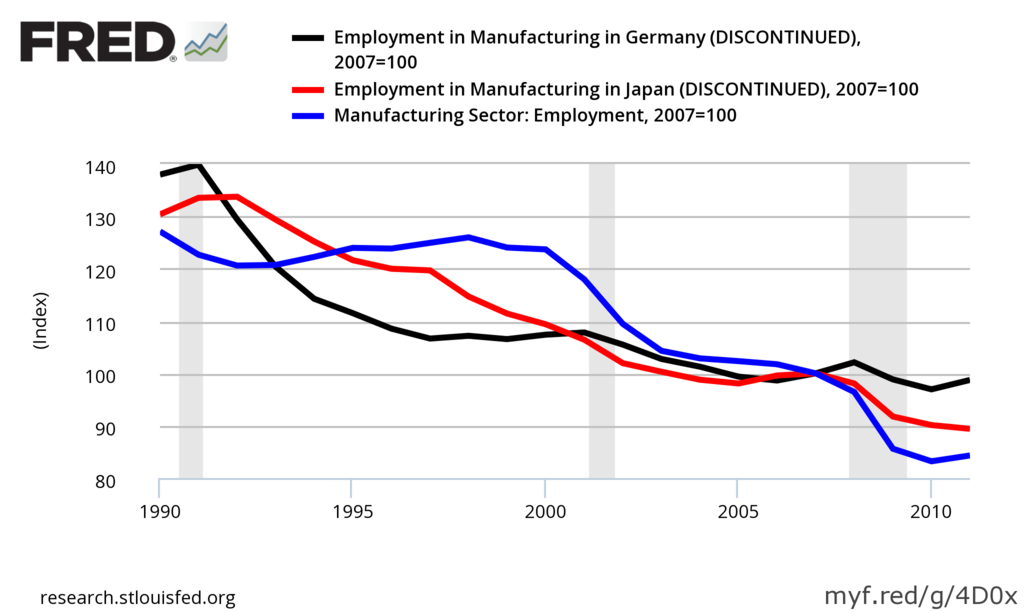
Above is a graph from the St. Louis Fed's excellent data portal which shows manufacturing employment in the US (blue), Germany (black) and Japan (red) from 1990 to 2010 (2011 for the US, note 100 = the series average over 1990 to 2010). The data clearly show that each of these three big manufacturing powerhouses have seen about the same proportional decline in manufacturing employment. Claims that Japan or Germany have not seen the same declines in manufacturing employment as the US are watching wiggles not trends.
The wiggles are important as they can represent the effects of policies aimed at reducing the impacts of recessions. But the trend is important as well, and seeing the same trend in manufacturing employment across three of the world's largest economies is pretty strong evidence that there is a single over-whelming dynamic at play - productivity growth in manufacturing.
NOTIFY: Y | REPLY | REPLY WITH QUOTE | PERMALINK | TOP | HOME
One point that your post fails to make, SECOND, is the number of people IN CHINA engaged in manufacturing. Because during that same period of time, that number has grown immensely, as China shifted from a rural to a manufacturing/ export economy. Injecting somewhere in the realm of a hundred million people into the world's manufacturing labor pool is going to affect manufacturing jobs elsewhere.
As far as automation is concerned, automation has been going on for a long time. It's the high-tech alternative to "cheap labor", but with the same goal: greater and greater profit. (And for the financialists' need to get paid back on the loans that he or she has given to the capitalist.) And as long as the average person lives in a "work or die" economy, and as long as TPTB can't figure out how to disburse the results of (automated/ cheap labor) production to people who have no money because they don't have a reasonably-paid "job", "jobs" will still be an ever-shrinking dire necessity for billions of people on the globe.
It's nice to think of a future when a person's ego and self-identification isn't "job" dependent, but currently the focus for most people is survival, not ego gratification.
The question from here is: How do we manage "jobs" in the global economy in a way that isn't self-destructive to the system, destructive to the environment, or destructive to people?
--------------
You can't build a nation with bombs. You can't create a society with guns.
NOTIFY: Y | REPLY | REPLY WITH QUOTE | PERMALINK | TOP | HOME
Second
I wanted to point out that Germany VERY SPECIFICALLY and with intent has focused its jobs creation in three different directions: cutting edge technology, skilled trades, and crafts; and has very specifically outsourced its standard bulk manufacturing to China; both directions by policy and specific intention.
I suspect that Japan fell into the doldrums because - as an island nation without significant natural resources - Japan configured itself as an export manufacturing economy, exporting primarily to the US. But after US trade shifted away from Japan to - again - China, Japan's manufacturing decreased.
Let me just point out that the author left out vital relevant facts in the opinion piece. Doing that is known as cherry-picking. And whether you do that in the news, in discussion, in debate or in opinion, when you distort the facts, you've changed the nature of your communication into propaganda. But WE don't have any of THAT in the US, do we?!
NOTIFY: N | REPLY | REPLY WITH QUOTE | PERMALINK | TOP | HOME
But to get back to the question of jobs -
If you look at certain pets, or animals confined in small cages in a zoo, when they're deprived of their 'jobs' - roaming, foraging, hunting, establishing territories, etc - they become pathological and exhibit all sorts of self-destructive and/or repetitive behaviors.
If you look at highly social animals - parrots, elephants, orcas, etc - when they're deprived of their normal societies they also become pathological and exhibit all sorts of self-destructive and/or repetitive behaviors.
I don't believe humans are any different from animals, and so, deprived of meaningful survival tasks and social inputs, we become pathological. Unfortunately our society is filled with 'junk food' work, 'junk food' interactions, and junk food.
In your post your link posited a society that wasn't based on the meaning of 'jobholder' status, and it then failed to realize or even posit what that society could be.
I suggest you read U K Le Guin's 'The Dispossessed' for one imagining of a world where the basics are met by common effort while your 'job' - your calling, that task you are drawn to do - is something discovered individually.
Let me just point out that the author left out vital relevant facts in the opinion piece. Doing that is known as cherry-picking. And whether you do that in the news, in discussion, in debate or in opinion, when you distort the facts, you've changed the nature of your communication into propaganda. But WE don't have any of THAT in the US, do we?!
NOTIFY: N | REPLY | REPLY WITH QUOTE | PERMALINK | TOP | HOME
The fracking bubble?
Fracking can return in force whenever the price of oil increases.
The costs of fracking are fairly low, and become profitable as soon as oil prices rise again. Otherwise the oil prices can stay at current rates until oil dries up.
NOTIFY: Y | REPLY | REPLY WITH QUOTE | PERMALINK | TOP | HOME
Quote:I found (and maybe you would, too) more about American factory workers and their dissatisfactions from Ten Thousand Working Days [1978] by Robert Schrank than from The Dispossessed: An Ambiguous Utopia [1974] by Ursula K. Le Guin. www.amazon.com/Ten-Thousand-Working-Days-Press/dp/0262690640/
Originally posted by 1kiki:
But to get back to the question of jobs -
I suggest you read U K Le Guin's 'The Dispossessed' for one imagining of a world where the basics are met by common effort while your 'job' - your calling, that task you are drawn to do - is something discovered individually.
I forgot to mention that the real Schrank was raised by anarchists, as was the fictional Shevek from Dispossessed.
The Joss Whedon script for Serenity, where Wash lives, is Serenity-190pages.pdf at www.mediafire.com/folder/1uwh75oa407q8/Firefly
NOTIFY: Y | REPLY | REPLY WITH QUOTE | PERMALINK | TOP | HOME
SECOND, what's your point?
It seems to be that automation is inevitable and good, and that the economy (and people) will adjust to the level of automation in their lifetime.
Is that your point?
--------------
You can't build a nation with bombs. You can't create a society with guns.
NOTIFY: Y | REPLY | REPLY WITH QUOTE | PERMALINK | TOP | HOME
The dratted double!
NOTIFY: Y | REPLY | REPLY WITH QUOTE | PERMALINK | TOP | HOME
So, anyway, getting back to the point I was making about a society without 'jobs' as we know them, neither second's link nor second's recommended book envision what that possibility would look like. One explores the concept of a guaranteed minimal stipend and explores the difference between retirement and unemployment; however they are all in the context of a society based on 'jobs'. The other explores the positives and negatives of working a 'job'.
To explore what a society without 'jobs' as we know them could be, I mentioned three things: confined wild animals deprived of their instinctual 'jobs'; the wealthy class of any age (because their survival was provided for and a 'job' was never at any time expected); and The Dispossessed by U K Le Guin, as thought experiment of a society without 'jobs'.
I'd be happy to continue this line of thinking.
Let me just point out that the author left out vital relevant facts in the opinion piece. Doing that is known as cherry-picking. And whether you do that in the news, in discussion, in debate or in opinion, when you distort the facts, you've changed the nature of your communication into propaganda. But WE don't have any of THAT in the US, do we?!
NOTIFY: N | REPLY | REPLY WITH QUOTE | PERMALINK | TOP | HOME
Today, Switzerland voted against ending poverty and against a world without work:
www.bbc.com/news/world-europe-36454060
Swiss voters have overwhelmingly rejected a proposal to introduce a guaranteed basic income for all.
Final results from Sunday's referendum showed that nearly 77% opposed the plan, with only 23% backing it.
The proposal had called for adults to be paid an unconditional monthly income, whether they worked or not.
The supporters camp had suggested a monthly income of 2,500 Swiss francs (£1,755; $2,555) for adults and also SFr625 for each child.
The amounts reflected the high cost of living in Switzerland. It is not clear how the plan would have affected people on higher salaries.
The supporters had also argued that since work was increasingly automated, fewer jobs were available for workers.
Switzerland is the first country to hold such a vote.
NOTIFY: Y | REPLY | REPLY WITH QUOTE | PERMALINK | TOP | HOME
The global economy is still jobs-based. As a member of the global economy, Switzerland still exists in competition with that economy, which demands maximizing profits. Also, Switzerland has a long-standing Protestant work-ethic of industriousness, even tho only about 25% of their GDP is due to manufacturing. (An astounding 11% of their GDP is due just to banking, which doesn't require work per se.) If the vote were to take place in some other culture with less of that mindset, I wonder how it would turn out.
Let me just point out that the author left out vital relevant facts in the opinion piece. Doing that is known as cherry-picking. And whether you do that in the news, in discussion, in debate or in opinion, when you distort the facts, you've changed the nature of your communication into propaganda. But WE don't have any of THAT in the US, do we?!
NOTIFY: N | REPLY | REPLY WITH QUOTE | PERMALINK | TOP | HOME
Quote:You can draw your own conclusions. I think nothing is inevitable and nothing ever happens until somebody makes it happen. Here is a story about a seamless steel pipe factory opening in 2017 in Texas that would typically employ 1,200, but this factory will only need 600. What made that happen? $1,800,000,000 and tariffs and Italians.
Originally posted by SIGNYM:
SECOND, what's your point?
It seems to be that automation is inevitable and good, and that the economy (and people) will adjust to the level of automation in their lifetime.
Is that your point?
While the new pipe mill will add 600 jobs next year, Tenaris has already cut 540 elsewhere in the Houston area. Tenaris mothballed its Texas Arai facility in northwestern Houston this year after cutting about 300 jobs. Last year, Tenaris did the same at its Conroe plant while eliminating 240 positions.
So the net gain in jobs will be 600 – 540 = 60 after expending $1,800,000,000. This only applies to steel pipe, but, once again, you can draw whatever conclusions please you about how many American jobs will be created by building factories in the USA for products that can be imported.
www.houstonchronicle.com/business/article/Tenaris-spending-1-8-billion
-on-pipe-plant-amid-7963028.php
Tenaris spending $1.8 billion on pipe plant amid oil slump
By Jordan Blum
A corporation with roots in three foreign countries is making a $1.8 billion bet on building a steel pipe mill at a time when the oil patch is littered with idle equipment.
Tenaris' mill 70 miles southwest of Houston plans to produce seamless pipe, tubing and casing for oil and gas wells in the U.S., where the rig count has dropped to 404 from 1,930 at its peak in October 2014.
The Bay City mill will employ 600 when it opens next summer.
"It will be the latest and most advanced manufacturing facility in our industry in the world," said Germán Curá, the North American president of Tenaris. "When and if the activity rebounds, and we believe that it will, we'll be ready."
Tenaris announced the project in 2013 when oil prices were booming. Analysts who follow the company, however, do not believe it suffers from bad timing.
"It's actually incredibly well timed," said Michael LaMotte, an oil field services analyst in Dallas for Guggenheim Securities.
A look at the mill
$1.8 billion Total project cost
600,000 tons The annual steel pipe production capacity
1.2 million Square footage of the mill, not counting ancillary facilities
44 millionSquare footage of Tenaris' Bay City property
600Tenaris' anticipated Bay City employee count when the mill opens next year
1,400The average number of workers during construction, including 160 permanent Tenaris workers
$6 million: Project grant approved by former Gov. Rick Perry from the state's Texas Enterprise Fund
$1.3 million The amount invested locally by Tenaris in education, including more than $400,000 in scholarships since 2013
$10 million The amount spent by Tenaris with Matagorda County vendors and contractors
95% The percentage of waste materials at the site that Tenaris says it will recycle
Oil producers will need to drill a lot more wells beginning as soon as 2017 just to keep U.S. oil production going at current levels, LaMotte said. Tenaris' mill will skip the bust and open right when the industry likely is returning, he said.
A different world
Drive just past the outskirts of small Bay City, and the seemingly otherworldly bright purple, green and blue hues of the massive pipe mill spring out of nowhere.
Tenaris' vivid logo colors painted on the sides of the mill make it stand out from a typical manufacturing plant.
But that's kind of the point for a Luxembourg-based global company with Argentinian and Italian roots that's trying to revolutionize the industry, Curá said. After all, during the height of the shale oil boom, 50 percent of all well piping was imported from Asia and other p
NOTIFY: Y | REPLY | REPLY WITH QUOTE | PERMALINK | TOP | HOME
Quote:I think the vote for an Unconditional Basic Income would fail everywhere on Earth. But eventually it will become reality. We just have to wait for the robot revolution to evolve to the point where lots of middle-class white people are permanently put out of work. Then it swiftly will go from pet unicorn to "duh."
Originally posted by 1kiki:
The global economy is still jobs-based. As a member of the global economy, Switzerland still exists in competition with that economy, which demands maximizing profits. Also, Switzerland has a long-standing Protestant work-ethic of industriousness, even tho only about 25% of their GDP is due to manufacturing. (An astounding 11% of their GDP is due just to banking, which doesn't require work per se.) If the vote were to take place in some other culture with less of that mindset, I wonder how it would turn out.
NOTIFY: Y | REPLY | REPLY WITH QUOTE | PERMALINK | TOP | HOME
It'll be harder than you think. The entire economy is based on the transfer of money in return for work performed. Unless that money is transferred in some other way, there'll be no money moved away from the corporations that own the means of production back to the people (or the government that might act as an intermediary). Hence, they'll be no money to pay the stipend.
Let me just point out that the author left out vital relevant facts in the opinion piece. Doing that is known as cherry-picking. And whether you do that in the news, in discussion, in debate or in opinion, when you distort the facts, you've changed the nature of your communication into propaganda. But WE don't have any of THAT in the US, do we?!
NOTIFY: N | REPLY | REPLY WITH QUOTE | PERMALINK | TOP | HOME
Quote:No money, you say?
Originally posted by 1kiki:
It'll be harder than you think. The entire economy is based on the transfer of money in return for work performed. Unless that money is transferred in some other way, there'll be no money moved away from the corporations that own the means of production back to the people (or the government that might act as an intermediary). Hence, they'll be no money to pay the stipend.
The money could come from a progressive annual tax on capital as suggested seriously by Thomas Piketty in Capital in the Twenty-First Century (2014). The capital tax schedule would be 1 percent on fortunes between 1 and 5 million euros, 2 percent between 5 and 10 million euros, and as high as 5 or 10 percent for fortunes of several hundred million or several billion euros.
But Thomas Piketty has even loftier goals. He wrote:
Quote:
I see economics as a subdiscipline of the social sciences, alongside history, sociology, anthropology, and political science. I hope that this book has given the reader an idea of what I mean by that. I dislike the expression “economic science,” which strikes me as terribly arrogant because it suggests that economics has attained a higher scientific status than the other social sciences. I much prefer the expression “political economy,” which may seem rather old-fashioned but to my mind conveys the only thing that sets economics apart from the other social sciences: its political, normative, and moral purpose.
From the outset, political economy sought to study scientifically, or at any rate rationally, systematically, and methodically, the ideal role of the state in the economic and social organization of a country. The question it asked was: What public policies and institutions bring us closer to an ideal society? This unabashed aspiration to study good and evil, about which every citizen is an expert, may make some readers smile. To be sure, it is an aspiration that often goes unfulfilled. But it is also a necessary, indeed indispensable, goal, because it is all too easy for social scientists to remove themselves from public debate and political confrontation and content themselves with the role of commentators on or demolishers of the views and data of others. Social scientists, like all intellectuals and all citizens, ought to participate in public debate. They cannot be content to invoke grand but abstract principles such as justice, democracy, and world peace. They must make choices and take stands in regard to specific institutions and policies, whether it be the social state, the tax system, or the public debt. Everyone is political in his or her own way. The world is not divided between a political elite on one side and, on the other, an army of commentators and spectators whose only responsibility is to drop a ballot in a ballot box once every four or five years.
NOTIFY: Y | REPLY | REPLY WITH QUOTE | PERMALINK | TOP | HOME
As I posted further up, you have to reinvent the economy when production is no longer the conduit by which resources are redistributed to people for their survival. So Piketty proposes a tax not based on transfer of money as income or sales, but on existing static wealth, just because. It's interesting that he believes the entire planetful of people can survive on 5 -10% redistribution of accumulated wealth. Did he provide calculations for that? And, if (roughly) true - man what a raw deal us idiots scratch that suckers scratch that people have been willingly duped into.
"They cannot be content to invoke grand but abstract principles such as justice, democracy, and world peace."
Useless words used to beguile people into a bad deal, along with 'market principles', 'freedom' and other religious tenets. If someone has to resort to those words in the absence of a concrete demonstration of how the effect they claim is generated from the cause they're shilling, you'd better watch your wallet ... and your back.
Let me just point out that the author left out vital relevant facts in the opinion piece. Doing that is known as cherry-picking. And whether you do that in the news, in discussion, in debate or in opinion, when you distort the facts, you've changed the nature of your communication into propaganda. But WE don't have any of THAT in the US, do we?!
NOTIFY: N | REPLY | REPLY WITH QUOTE | PERMALINK | TOP | HOME
Quote:
Originally posted by SIGNYM:
So we get back to my question ... what's the point of jobs ANYWHERE?
It's an interesting question. I hope someone tries to answer it besides me.
Not all jobs are readily automated.
Would you rather be greeted and served by a person when you order your meal, or have the recycler on Star Trek provide you with sustenance? Sure, that is a service job, not a technical job.
But jobs anywhere are for people to perform a task for a cheaper rate than whatever a machine would cost to do the same task.
Once labor rates become overblown, then the installation of a machine to replace the greedy worker makes it automatically more efficient for the company or owner to continue using the machine - the great expense is the changeover, the initial outlay.
The U. S. Postal Service has several unions, one of them the largest in the world. 3 are NALC, APWU, NMU. There is great savings derived from automation and processing equipment. But contract agreements require that before purchasing new equipment or converting an operation from manual labor to automation, the Postal Service prove that the automation will have a total expense (cost of equipment, parts, maintenance, mechanics, operators, programmers, computers and peripherals, etc) of less than 80% of the cost of keeping the operation manual. One might think of this as incentive for the machine makers to make their units more efficient, and the union workers to also work somewhat efficient ("work smarter, not harder") to keep their jobs. But the unions oppose the installation of the machines, and support this by directing their workers to work SLOWER, more OBTRUSIVE, LESS efficient - which then makes the argument and equation for replacing them with machines even stronger.
I did not intend that to be too long-winded, but hope it provides one example of how the balance between jobs and automation, producing pay vs. paying for goods, can be attempted.
When the labor expenses became too onerous, jobs were moved outside the country of unionists. But the savings in manual labor rates becomes minimal when both sides of the border are using automation, not using cheap labor on one side of the border and automation on the other.
NOTIFY: Y | REPLY | REPLY WITH QUOTE | PERMALINK | TOP | HOME
When the profit demands became too onerous
iPhone 6s Plus costs Apple an estimated $236 to make and assemble, roughly a third of the $749 retail price it asks for the new smartphone.
How much does Nike actually spend on a pair of sneakers that retails for $100? About $28.50.
The under a dollar pair (of jeans) will hit retail stores for $20.00 and up and will be sold en masse meaning high profits.
Let me just point out that the author left out vital relevant facts in the opinion piece. Doing that is known as cherry-picking. And whether you do that in the news, in discussion, in debate or in opinion, when you distort the facts, you've changed the nature of your communication into propaganda. But WE don't have any of THAT in the US, do we?!
NOTIFY: N | REPLY | REPLY WITH QUOTE | PERMALINK | TOP | HOME
Not as glamorous as the iPhone, but I saw an article this morning about the long political battle to manufacture shoes in America. To me, the article suggests how difficult it is to pass legislation forcing Made In America.
www.bloomberg.com/politics/articles/2016-06-06/new-balance-close-to-wi
n-in-buy-america-foot-race-for-military
New Balance Athletic Shoe Inc. is close to winning an almost decade-long marathon: A buy-American provision in the massive defense policy bill the Senate will debate this week could force the Pentagon to purchase the company’s sneakers for new military recruits.
Currently, the Pentagon issues about $15 million in vouchers a year, covering 225,000 to 250,000 pairs of athletic shoes, New Balance estimates. If the provision survives in the final version of the fiscal 2017 defense authorization bill and recruits are required to wear American-made apparel, the vouchers could no longer be used for shoes made overseas by Nike Inc. and other companies.
Boston-based New Balance long has lobbied the government to follow the letter of a 1941 law that it perceives as requiring made-in-the-U.S.A. attire for soldiers. That means providing U.S.-made athletic footwear instead of giving recruits allowances to shop for the shoes they prefer.
The Pentagon and the White House oppose the new provision, contending that costs could rise and new recruits could be injured if they are wearing shoes that don’t fit them well.
See the article for the details of who in Congress is for Made In America New Balance shoes and what they say to justify their votes.
NOTIFY: Y | REPLY | REPLY WITH QUOTE | PERMALINK | TOP | HOME
As you say, SECOND, nothing happens until somebody MAKES it happen.
Given the huge profit incentive to manufacture abroad, in cheap-labor locations, manufacturing in the USA won't happen unless somebody MAKES it happen.
The only difficulty in the way of manufacturing at home is the one that you keep pointing out... corporations which are used to making huge profits don't want to give that up. But where is it in the national interest that we should do what corporations desire?
--------------
You can't build a nation with bombs. You can't create a society with guns.
NOTIFY: Y | REPLY | REPLY WITH QUOTE | PERMALINK | TOP | HOME
Quote:The US Constitution, which set a Congress in place, doesn't look after the national interest. Congress looks after the interests of whichever of the 50 states that have banded together to look after their states' interests. And for every gorram issue it could be a different group of states banded together. Agricultural states controlling wherever possible agricultural issues and manufacturing states controlling manufacturing and banking or oil controlled by whichever states are on top of banking or oil. The US Constitution deliberately created a big mess with congressmen looking after me-me-me and my state, never the national interest.
Originally posted by SIGNYM:
As you say, SECOND, nothing happens until somebody MAKES it happen.
But where is it in the national interest that we should do what corporations desire?
www.washingtonpost.com/blogs/the-fix/wp/2014/04/14/how-congress-became
-more-partisan-over-time-in-four-charts
NOTIFY: Y | REPLY | REPLY WITH QUOTE | PERMALINK | TOP | HOME
Quote:Not quite true.
Congress looks after the interests of whichever of the 50 states that have banded together to look after their states' interests.
The President, as Commander in Chief, can order troops into combat without Congress declaring war.
The President also has significant authority in matters of foreign policy and trade relations. It's the President (and his staff) who negotiate alliance, partnerships, and trade deals, and while Congress ultimately has to vote on them they have almost never voted against a deal that the President has made.
Unfortunately, the Presidency has been bought and paid for by the 0.01%. So the President looks after the interests of the 0.01%.
Congress SHOULD be looking after the interests of its various member states, but Congress has ALSO been bought and paid for by the 0.01% so it's really looking after the interests of the wealthy.
So ... aside from the President and Congress looking after the interests of the USA (which isn't about to happen any time soon) ... who IS looking after the interests of the USA?
And what are those interests anyway?
--------------
You can't build a nation with bombs. You can't create a society with guns.
NOTIFY: Y | REPLY | REPLY WITH QUOTE | PERMALINK | TOP | HOME
Quote:Here is an excellent example about how the "National Interest" is decided by government from today's Houston Chronicle article about rocket engines manufactured in Russia. It is a very unstable decision making process. SpaceX (actually Elon Musk, multi-billionaire ) says he can build those engines in the USA. NASA says let's not get hasty about destroying our relationship with Russia just to please Musk and move a few jobs to Musk's factory.
Originally posted by SIGNYM:
Unfortunately, the Presidency has been bought and paid for by the 0.01%. So the President looks after the interests of the 0.01%.
Congress SHOULD be looking after the interests of its various member states, but Congress has ALSO been bought and paid for by the 0.01% so it's really looking after the interests of the wealthy.
So which side is looking after the "national interest"? Is the multi-billionaire looking after the best interests of America by banning import of the RD-180? Or is NASA and the Pentagon looking after the best interests by continuing to buy the RD-180?
www.houstonchronicle.com/news/politics/us/article/Shots-over-Russian-r
ocket-engine-could-hit-NASA-7974043.php
Rocket battle could hit NASA
Proposed curbs on Russian-made engines debated
By Kevin Diaz
WASHINGTON — A fight over the use of Russian rocket engines to launch U.S. military satellites has ignited a lobbying battle in Congress among a handful of commercial space industry giants, sparking concerns in Houston about the potential fallout for NASA’s Johnson Space Center.
The controversy, involving hundreds of millions of dollars in government contracts, rose Thursday as lawmakers scrambled to put the finishing touches on a sweeping $602 billion defense bill.
President Barack Obama, citing national security concerns over restricting the Russian engines, has threatened to veto the entire bill, which includes other controversial provisions for registering women for the draft and closing the military prison in Guantanamo Bay, Cuba.
Fueling a debate over American dependence on the popular RD-180 engine are rising geopolitical tensions over the Ukraine. At the same time, a group of Houston business leaders has joined some aerospace industry officials in warning about the potential costs of banning the Russian-made rockets too quickly.
Among them is Bob Mitchell, president of the Bay Area Houston Economic Partnership, who has warned of “far-reaching, negative effects” of efforts in Congress to cut the number of Russian rockets the Pentagon can use to fly satellites to space.
“We urge you to strongly consider the consequences of blocking access to the RD-180 for political reasons before a reliable and affordable domestic alternative is available years from now,” Mitchell wrote to Texas U.S. Sens. John Cornyn and Ted Cruz. “Prematurely ending the use of the RD-180 would also have far-reaching negative impact to the space industry, which employs 14,000 highly technical skilled people in the Houston area.”
Although the proposed restrictions apply only to the military, some officials worry that they could increase costs for NASA’s commercial crew and cargo shipments for the International Space Station, which rely on Atlas V rockets powered by RD-180 engines.
“With the military out of the picture, a sharp drop in Atlas V launches overall may make overhead costs for NASA use prohibitive,” Mitchell said. “This could undermine NASA planning for the next decade.”
Opponents of the RD-180, led by Arizona Sen. John McCain, chairman of the Senate Armed Services Committee, say there would be no impact on NASA, thanks to new rockets being developed by SpaceX and United Launch Alliance (ULA), a joint venture of Boeing Co. and Lockheed Martin Corp. that has served as the Pentagon’s main launch provider.
However, questions remain about how quickly those new rocket engines can be made available, and the increased costs of currently available U.S. heavy-launch alternatives to the
NOTIFY: Y | REPLY | REPLY WITH QUOTE | PERMALINK | TOP | HOME
Quote:
Here is an excellent example about how the "National Interest" is decided by government from today's Houston Chronicle article about rocket engines manufactured in Russia. It is a very unstable decision making process. SpaceX (actually Elon Musk, multi-billionaire ) says he can build those engines in the USA. NASA says let's not get hasty about destroying our relationship with Russia just to please Musk and move a few jobs to Musk's factory.
So which side is looking after the "national interest"? Is the multi-billionaire looking after the best interests of America by banning import of the RD-180? Or is NASA and the Pentagon looking after the best interests by continuing to buy the RD-180?
NEITHER
The REAL interests of the USA would have us capable of manufacturing everything of military, scientific, and infrastructural significance here, at home. And there's more I would add, but that properly belongs in the "What's YOUR platform" thread.
Elon Musk, for all of his money and brains, is an idiot outside of his specific money-making niche. He's not a "technology" expert any more than a physicist is a "biology" expert. His car-making venture wouldn't be making money except for government subsidies, and his rocket-launching venture is energetically ridiculous- you have to loft more than twice the amount of fuel than with a one-way launch. The only purpose that his space vehicle is good for is space tourism. It's not meant for heavy-duty satellite, space station, or exploration launches.
And I think the fault goes back to wealthy Republicans who, after Roosevelt, and stinging from the 90% tax rates that were imposed on the wealthy in the 1940s and 1950s, sought to dismember "government" by portraying it as "evil".
Now, between the twin onslaughts of destroying the parts of government which looked after the common good, and buying off the rest, there are NO agents who are looking after "American interests".
The conundrum that you presented (and there was just an article in the WSJ about chip-making and the Pentagon, which was exactly the same) is the result of decades of wealthy businessmen successfully representing THEIR interests at the expense of the general (and long-term) good, and the success of this money-fueled plan coming home to roost.
--------------
You can't build a nation with bombs. You can't create a society with guns.
NOTIFY: Y | REPLY | REPLY WITH QUOTE | PERMALINK | TOP | HOME
Quote:I'd say that it has always been this way, from the very beginning. There was never a golden age of high-minded Congressmen, even back when Alexander Hamilton was Secretary of the Treasury. It has always been people with oversized personalities making decisions based on anything but "National Interest".
Originally posted by SIGNYM:
The conundrum that you presented (and there was just an article in the WSJ about chip-making and the Pentagon, which was exactly the same) is the result of decades of wealthy businessmen successfully representing THEIR interests, and this policy coming home to roost.
I could be wrong, but you will have to prove it. Give many names and many decisions where Congressmen did NOT vote for what was their own self-interest. You have over two hundred years of American history to choose from for your very numerous examples of high-minded decision-making by Congress and the President. I don't think you will find two hundred examples in two hundred years out of all the millions of decisions made.
NOTIFY: Y | REPLY | REPLY WITH QUOTE | PERMALINK | TOP | HOME
Quote:
Originally posted by SIGNYM:
As you say, SECOND, nothing happens until somebody MAKES it happen.
Given the huge profit incentive to manufacture abroad, in cheap-labor locations, manufacturing in the USA won't happen unless somebody MAKES it happen.
The only difficulty in the way of manufacturing at home is the one that you keep pointing out... corporations which are used to making huge profits don't want to give that up. But where is it in the national interest that we should do what corporations desire?
Not strictly in the way you are stating it, but in general terms supporting Free Enterprise and a Free Economy allows the economy to strengthen, thereby producing economic power for the nation's leaders to wield (or pretend to).
NOTIFY: Y | REPLY | REPLY WITH QUOTE | PERMALINK | TOP | HOME
Quote:
Not strictly in the way you are stating it, but in general terms supporting Free Enterprise and a Free Economy allows the economy to strengthen, thereby producing economic power for the nation's leaders to wield (or pretend to).
What is "Free Enterprise"?
What is a "Free Economy"?
How do they produce economic power?
... and while we're at it ....
What is economic power?
--------------
I'll tell you what I DON'T like about Trump: I think that he has never confronted either the international banking cartel, nor the CIA-State Dept multi-headed hydra, nor the military-industrial complex. The last person to confront them was JFK (BTW, ALL immigration was illegal under JFK) and look what happened to him.
NOTIFY: Y | REPLY | REPLY WITH QUOTE | PERMALINK | TOP | HOME
Quote:
Not strictly in the way you are stating it, but in general terms supporting Free Enterprise and a Free Economy allows the economy to strengthen, thereby producing economic power for the nation's leaders to wield (or pretend to). - JSF
What is "Free Enterprise"?
What is a "Free Economy"?
How do they produce economic power?
... and while we're at it ....
What is economic power?- SIGNY
Ok, let me sharpen the question. Some people believe that "free enterprise" means that ONLY MONEY should determine policy, since "markets" achieve the best outcomes. In other words, people with money, making strictly financial decisions, should do whatever they want.
Is that what you mean by "free": Free of all constraint?
--------------
I'll tell you what I DON'T like about Trump: I think that he has never confronted either the international banking cartel, nor the CIA-State Dept multi-headed hydra, nor the military-industrial complex. The last person to confront them was JFK (BTW, ALL immigration was illegal under JFK) and look what happened to him.
NOTIFY: Y | REPLY | REPLY WITH QUOTE | PERMALINK | TOP | HOME
Quote:
Not strictly in the way you are stating it, but in general terms supporting Free Enterprise and a Free Economy allows the economy to strengthen, thereby producing economic power for the nation's leaders to wield (or pretend to). - JSF
What is "Free Enterprise"?
What is a "Free Economy"?
How do they produce economic power?
... and while we're at it ....
What is economic power?- SIGNY
Ok, let me sharpen the question. Some people believe that "free enterprise" means that ONLY MONEY should determine policy, since "markets" achieve the best outcomes. In other words, people with money, making strictly financial decisions, should do whatever they want. Is that what you mean by "free": Free of all constraint?- SIGNY
Or, if not free of ALL constraint, what constraints would you keep?
--------------
I'll tell you what I DON'T like about Trump: I think that he has never confronted either the international banking cartel, nor the CIA-State Dept multi-headed hydra, nor the military-industrial complex. The last person to confront them was JFK (BTW, ALL immigration was illegal under JFK) and look what happened to him.
NOTIFY: Y | REPLY | REPLY WITH QUOTE | PERMALINK | TOP | HOME
Quote:
Originally posted by SIGNYM:Quote:
Not strictly in the way you are stating it, but in general terms supporting Free Enterprise and a Free Economy allows the economy to strengthen, thereby producing economic power for the nation's leaders to wield (or pretend to). - JSF
What is "Free Enterprise"?
What is a "Free Economy"?
How do they produce economic power?
... and while we're at it ....
What is economic power?- SIGNY
Ok, let me sharpen the question. Some people believe that "free enterprise" means that ONLY MONEY should determine policy, since "markets" achieve the best outcomes. In other words, people with money, making strictly financial decisions, should do whatever they want. Is that what you mean by "free": Free of all constraint?- SIGNY
Or, if not free of ALL constraint, what constraints would you keep?
I gotta visit the board more. And this thread another time.
NOTIFY: Y | REPLY | REPLY WITH QUOTE | PERMALINK | TOP | HOME