

Conservatives have no ideas what to do about recessions
POSTED BY: kpo
UPDATED: Monday, March 9, 2026 17:30
VIEWED: 29022
PAGE 12 of 25

Meanwhile, Wall Street ended 2013 on record highs and huge profits.
So that must mean that the economy is "on fire", as AuRaptor would say.
NOTIFY: Y | REPLY | REPLY WITH QUOTE | PERMALINK | TOP | HOME

Quote:
Originally posted by SIGNYM:
"The country" was sold, it was Congress that wasn't. AFA "necessary corrections"... enlighten us: What WERE those corrections that were supposed to happen?
...
Our government has consistently represented the will of the wealthy few over the non-wealthy many. Consider it a flaw in the practice of democracy, that politics is so often dominated by money.
So the people aren't smart enough to elect representatives who will look out after their interests. No doubt that's why we need you to tell us what to do.
Quote:
Unions and pension funds don't generally invest in hedge funds and speculation because they're too risky.
Quote:
The primary investors are wealthy individuals and institutions.
http://useconomy.about.com/od/themarkets/f/Hedge_Investors.htm
Quote:
And the point is that there is a lot of money NOT being "invested", and therefore not being recycled into production and consumption. You failed to address that point, which is a major one.
But hedge funds invest into production, as below:
Quote:
Coatue Management, a hedge fund run by brothers Phillipe and Thomas Laffont, has invested $50 million in a Series C equity financing in Snapchat, the white-hot photo-messaging company run by 23 year-old Evan Spiegel and his cofounder, 25 year-old Bobby Murphy. Thomas Laffont, who runs private company investments for the firm, declined to comment on Snapchat’s valuation in the round, but recently released incorporation documents suggest up to $2 billion.
http://www.forbes.com/sites/jjcolao/2013/12/11/hedge-fund-invests-50-m
illion-into-snapchat/
Quote:Quote:How does it not? Your question makes no sense, please rephrase.
Then you have an issue of pretty much forcing folks to pay higher prices for domestic goods, but for several years don't have the domestic goods on the shelves yet. So how does money get spent to stay in circulation?
The minimum wage, and wages in general, have gone up. I have more money in my pocket. I want to buy a new laptop (or clothes, or a TV, or pretty much anything not currently manufactured in the U.S.). Due to tariffs, the price of any of this stuff has gone up, and no one in the U.S. has ramped up production to make it yet. Even when they do, their costs are going to be a lot higher than manufacturing overseas (due to much higher minimum wage, costs of environmental and safety regulation, etc.), so my increased income won't be able to buy any more than before. Possibly less.
Quote:
So what? Why do we need to "compete" in the world market on every single commodity and product, if all we wind up doing is wrecking our environment and our economy?
So you're calling for economic isolationism?
Quote:Hmmm... Take your mind off Mises or Keynes or Marx or Hayek or Bernanke. Think about economies and how they work without resorting to (inaccurate) name-calling, if you can. Address the point, if at all possible.
Guten tag, Herr Marx. - Geezer


When your criticism of capitalism is pretty much word for word Marx, it's hard not to draw a comparison.
Quote:
It costs $50 or less to manufacture an iPhone, which sells for $500. I think we can manage to raise wages and still keep prices reasonably low. The only part of this equation which will take a hit is that companies will not take MAXIMUM profit. Again- so what?
It costs $50(or up to $200 depending on who you ask and what you consider is involved in "make") to make an iPhone because the folks doing a lot of the work are paid less than $2.00 an hour with no benefits, the factories don't have to meet any environmental or worker safety standards, and the energy is provided by cheap but dirty coal-fired plants. That's sure not gonna fly here.
Quote:Quote:
Could you specify against what foreign industries you would
NOTIFY: Y | REPLY | REPLY WITH QUOTE | PERMALINK | TOP | HOME
Quote:
Originally posted by kpo:Quote:
Actually it was debt/GNP, and, as noted, it went from 18% in 1929 to 45% in 1939.
Ok, let's post the graph again.
Do you or don't you see a flat line from about the middle of 1933 onwards?
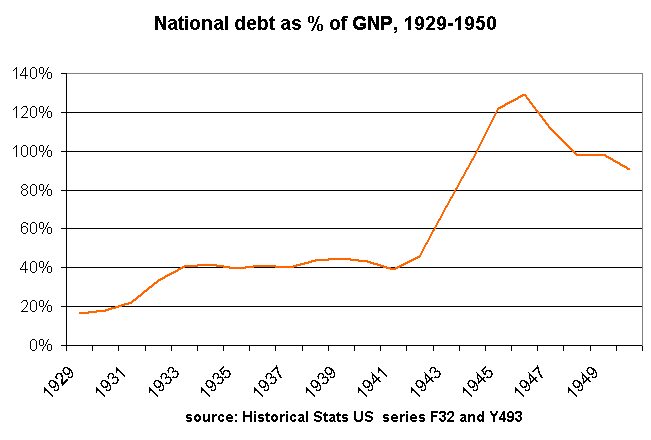
Yep.
Interesting in that per the graph on the cite below, federal spending, as a percent of GDP, pretty much tripled between 1929(<4%) and 1936(11%).
http://www.usgovernmentdebt.us/spending_chart_1920_1940USp_15s1li011mc
n_F0f_US_Federal_Spending
If you use the controls on this site to look at Gross Public Debt for the 1920-1940 period as a percent of GDP, it goes from about 18% in 1929 to 44% in 1938.
Or you can pick the Federal Deficit as a percent of GDP and see it went from a 1% surplus in 1930 to a 4.5% deficit in 1936.
Not sure how these reconcile with your "flat line".
Quote:
What it comes down to is you have no case for there having been wild, unrestrained spending throughout the Great Depression. That didn't come until WWII, and when it did come the economy recovered.
So we're back to only a war, or spending at a rate that you can't sell to the country, can end a depression.
Dryer's buzzing, I'll get to the rest after clothesfolding.
NOTIFY: Y | REPLY | REPLY WITH QUOTE | PERMALINK | TOP | HOME

Quote:Fixed that for you.
or spending ON SOCIAL AND JOBS PROGRAMS at a rate that you can't sell to the WEALTHY

NOTIFY: Y | REPLY | REPLY WITH QUOTE | PERMALINK | TOP | HOME
I note that a couple of folks here have used phrases like "Its not hard" or "it's not rocket science" in relation to economic theory.
Would that it were rocket science.
Rocket science is just math and physics.
If you apply a given force to an object of given mass for a given time in a given gravity field, all rocket scientists will agree on how fast it ends up going.
Economics is not only math, but judgments as to what individuals, groups of individuals, governments, businesses, political parties, markets, exchanges, etc. will do in a particular situation, or in a whole series of constantly changing situations.
Unlike, rocket science, where everyone agrees about the rules of math and laws of physics as they apply to rockets, in economics there are many conflicting schools, each of which believes it has the answers and that the other schools are fools (Hey. I'm a poet (or alliterator) and don't know it). This applies even more when you get into macroeconomics.
When I read stuff like this:
Quote:
A 2002 International Monetary Fund study looked at "consensus forecasts" (the forecasts of large groups of economists) that were made in advance of 60 different national recessions in the 1990s: in 97% of the cases the economists did not predict the contraction a year in advance. On those rare occasions when economists did successfully predict recessions, they significantly underestimated their severity.
http://en.wikipedia.org/wiki/Economics
It does not encourage faith in any particular economic school. Guess I'm as agnostic about economic theories as religion, since I can see as little proof for one as the other.
Given that I have little faith in any economic school, if I'm forced to choose, I'd choose the one that offers the least chance of harm if it doesn't work, and reject the one that offers the most harm if it doesn't work. Keynesian economics, particularly its response to recession/depression, seems to offer the most harm if it fails, what with high taxes, high spending, massive deficits, unresolved problems of the original recession, and the cries from its proponents that it'll eventually work if we just spend a lot more.
Guess I just don't have the faith to be a Keynesian.
"When your heart breaks, you choose what to fill the cracks with. Love or hate. But hate won't ever heal. Only love can do that."
NOTIFY: Y | REPLY | REPLY WITH QUOTE | PERMALINK | TOP | HOME
Quote:
Originally posted by Magonsdaughter:
I'm not.
No answer on what to do about recessions, just lots of attack on Keynesian economics.
I never claimed to have an answer.
Just asking if anyone had examples where recessions during conservative administrations took longer to end than those during liberal administrations.
And you can see my problem with Keynes in the post above.
"When your heart breaks, you choose what to fill the cracks with. Love or hate. But hate won't ever heal. Only love can do that."
NOTIFY: Y | REPLY | REPLY WITH QUOTE | PERMALINK | TOP | HOME
Quote:
Originally posted by m52nickerson:
It's a flaw in the way government is run, not my reasoning.
But we live with the way the government is run, not your reasoning. If you propose solutions that will never be implemented, they do what good?
"When your heart breaks, you choose what to fill the cracks with. Love or hate. But hate won't ever heal. Only love can do that."
NOTIFY: Y | REPLY | REPLY WITH QUOTE | PERMALINK | TOP | HOME
Quote:
Originally posted by SIGNYM:Quote:Fixed that for you.
or spending ON SOCIAL AND JOBS PROGRAMS at a rate that you can't sell to the WEALTHY
No. You fixed it for you.
I understand why you like Keynes. He gives you permission to go out and take from every class and group you hate.
"When your heart breaks, you choose what to fill the cracks with. Love or hate. But hate won't ever heal. Only love can do that."
NOTIFY: Y | REPLY | REPLY WITH QUOTE | PERMALINK | TOP | HOME

Quote:
Originally posted by Geezer:
But we live with the way the government is run, not your reasoning. If you propose solutions that will never be implemented, they do what good?
The way government runs can be changed, it is not a static thing. You turning this in to "well the government doesn't do this" is a massive cop out because conservatives and libertarians have no idea how to deal with recessions or how to prevent them.
I do not fear God, I fear the ignorance of man.
NOTIFY: Y | REPLY | REPLY WITH QUOTE | PERMALINK | TOP | HOME
Quote:
Originally posted by Geezer:
Keynesian economics, particularly its response to recession/depression, seems to offer the most harm if it fails, what with high taxes, high spending, massive deficits, unresolved problems of the original recession, and the cries from its proponents that it'll eventually work if we just spend a lot more.
Guess I just don't have the faith to be a Keynesian.
You just ignore that larger picture and only focus on the parts you don't like. You also ignore the much greater harm recessions and depressions do to everyday people than government deficits ever do.
I do not fear God, I fear the ignorance of man.
NOTIFY: Y | REPLY | REPLY WITH QUOTE | PERMALINK | TOP | HOME