

Photos of Apollo debris still on Moon.
POSTED BY: oldenglanddry
UPDATED: Monday, May 8, 2023 03:14
VIEWED: 22921
PAGE 1 of 5

http://uk.news.yahoo.com/photos-show-astronauts-moon-tracks-181919946.
html
NOTIFY: Y | REPLY | REPLY WITH QUOTE | PERMALINK | TOP | HOME

Humans...
Leaving trash, where ever they go.
That's pretty cool, actually.
" I do not love the bright sword for its sharpness, nor the arrow for its swiftness, nor the warrior for his glory. I love only that which they defend. "
NOTIFY: N | REPLY | REPLY WITH QUOTE | PERMALINK | TOP | HOME

Where's PN to tell us how fake all those photos are?
NOTIFY: Y | REPLY | REPLY WITH QUOTE | PERMALINK | TOP | HOME


Funny how NASA still hasn't discovered how to take color photos like Google Earth
http://www.nasa.gov/mission_pages/LRO/news/apollo-sites.html
http://blogs.discovermagazine.com/badastronomy/2009/07/17/apollo-landi
ng-sites-imaged-by-lro/comment-page-19/
Funny how the loony rover left almost invisible (or invisible) tire tracks, but the astronots left giant troughs carves into the loony surface like snowplows... Guess the fakers forget human being take individual STEPS.
Look Ma...no tire tracks!
http://apolloanomalies.com/rover_tracks_rebuttal.htm
Funny how the new orbiter satellite photoshops show a giant crater carved out by the loony lander, but all the photos and video from Apollo show no such crater.
No crater under rocket motor
Giant crater under rocket motor
No crater under rocket motor
Apollo 17 no crater under rocket motor, no dust blown away by rocket motor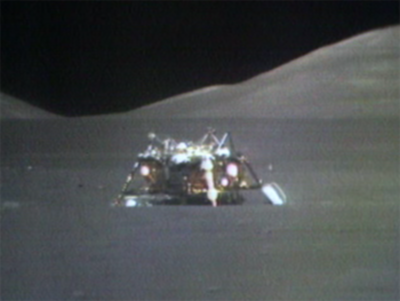
Apollo 17 no footsteps or tire tracks on the moon
Apollo 17 no footsteps or tire tracks on the moon, but lots of mountains invisible from orbit
Look Ma...no rocket exhaust on the loon!
NOTIFY: N | REPLY | REPLY WITH QUOTE | PERMALINK | TOP | HOME

Look Ma...no tire tracks on the loon!
Look Ma...no tire tracks on the loon!
Look Ma...no tire tracks on the loon!
Look Ma...no tire tracks on the indoor loon!
Look Ma...cardboard and cellophane tape on the loon!
Look Ma...cardboard and cellophane tape on the loon!
Look Ma...cardboard and cellophane tape on the loon!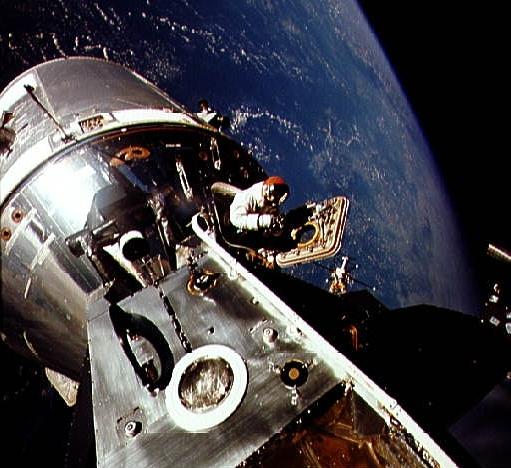
Look Ma...Earth has two suns! (Earth globe lighted on opposite side of LEM lighting)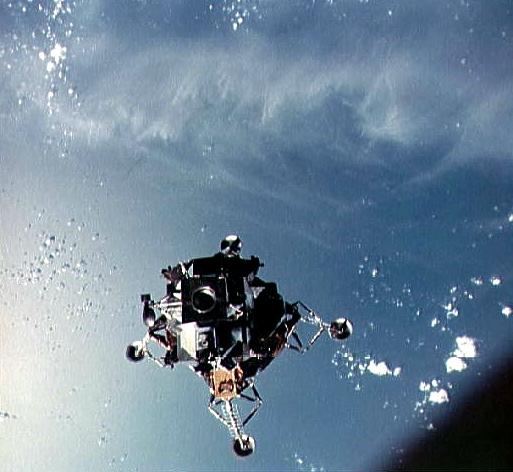
Look Ma...LEM landing on Earth!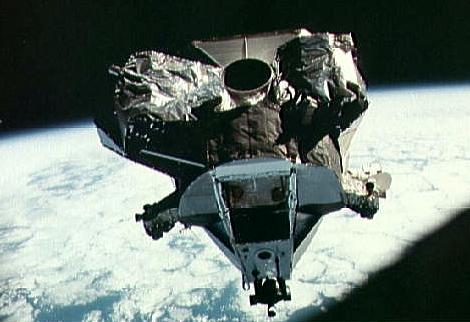
Look Ma...LEM flies back to Earth!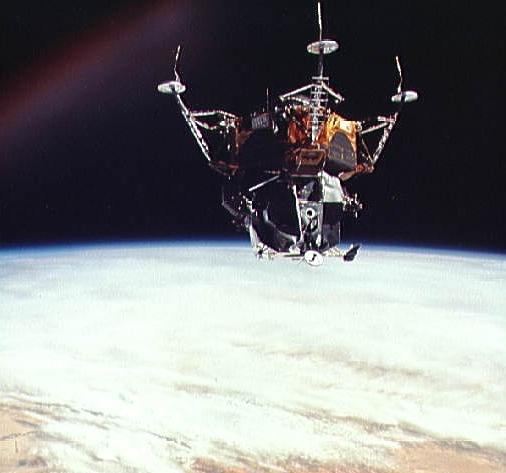
Look Ma...LEM landing on Earth!
Good thing NASA sealed its Apollo files until 2024 (or permanently like the Warren Commission and 9/11 Commission)!
NOTIFY: N | REPLY | REPLY WITH QUOTE | PERMALINK | TOP | HOME

"Look Ma...no tire tracks on the loon!"
Hello,
You must have *some* tire tracks on you.
But anyway, I suppose your belief is that in order to fake these photographs, they delivered the buggy into the middle of their carefully prepared Hollywood-style set via a crane. A difficult procedure, and a procedure you'd only perform if you didn't want to leave tracks.
--Anthony
_______________________________________________
“If you are not free to choose wrongly and irresponsibly, you are not free at all”
Jacob Hornberger
“Freedom is not worth having if it does not connote freedom to err. It passes my comprehension how human beings, be they ever so experienced and able, can delight in depriving other human beings of that precious right.”
Mahatma Gandhi
NOTIFY: Y | REPLY | REPLY WITH QUOTE | PERMALINK | TOP | HOME
"Look ma, LEM landing on earth."
Look fool, Apollo 9:
Apollo 9, the third manned mission in the American Apollo space program, was the first flight of the Command/Service Module (CSM) with the Lunar Module (LM). Its three-person crew, consisting of Commander Jim McDivitt, Command Module Pilot David Scott, and Lunar Module Pilot Rusty Schweickart, tested several aspects critical to landing on the Moon, including the LM engines, backpack life support systems, navigation systems, and docking maneuvers. The mission was the second manned launch of a Saturn V rocket.
After launching on March 3, 1969, the crewmen spent ten days in low Earth orbit. They performed the first manned flight of a LM, the first docking and extraction of a LM, two spacewalks, and the first docking of two manned spacecraft. The mission proved the LM worthy of manned spaceflight. Further tests on the Apollo 10 mission would prepare the LM for its ultimate goal, landing on the Moon.
NOTIFY: N | REPLY | REPLY WITH QUOTE | PERMALINK | TOP | HOME

All I know is that seeing the footage and the broadcasts by the astronauts on documentaries etc. was an incredibly profound experience for me, where we've been, where we're going, who we were back then and who we are now and the good and bad of each. Its one of the most amazing things I've ever seen on TV. Moving and powerful, evoked tears of wonder and awe. You can call that whatever you want but I don't care. that was my experience.
"A completely coherant River means writers don't deliver" KatTaya
NOTIFY: N | REPLY | REPLY WITH QUOTE | PERMALINK | TOP | HOME

Dammit Mike, you had to go and encourage him, didn't you??

Hippie Operative Nikovich Nikita Nicovna Talibani,
Contracted Agent of Veritas Oilspillus, code name “Nike”,
signing off 
NOTIFY: Y | REPLY | REPLY WITH QUOTE | PERMALINK | TOP | HOME

Gamma ray map of the Moon, Apollo landing sites on left
http://www.sciencephoto.com/media/325400/view
Quote:
"Surprisingly, the Moon is a moderately bright gamma-ray source. The only part of the electromagnetic spectrum where the Moon is brighter than the Sun is gamma rays. The surface of the Moon is baldly exposed to cosmic rays and solar flares. When cosmic rays hit the ground, they produce a dangerous spray of secondary particles right at your feet, and trigger little nuclear reactions that release yet more radiation in the form of neutrons. The lunar surface itself is radioactive!"
-Dr Robert Naeye PhD, NASA GLAST Fermi Gamma Ray Space Telescope, Solar System: Sun, Moon, and Earth, 23 August 2007
http://www.nasa.gov/mission_pages/GLAST/science/solar_system.html
"Ordinary stars are simply not energetic enough to generate detectable levels of gamma rays. The one exception is the Sun, but only because of its close proximity to Earth. Surprisingly, the Moon is a moderately bright gamma-ray source. The only part of the electromagnetic spectrum where the Moon is brighter than the Sun is gamma rays. Being a cold, mostly inert object, the Moon is utterly incapable of producing gamma rays on its own. But cosmic-ray particles slamming into the lunar surface produce secondary gamma rays. Being a cold, mostly inert object, the Moon is utterly incapable of producing gamma rays on its own. But cosmic-ray particles slamming into the lunar surface produce secondary gamma rays. Earth itself is also a bright gamma-ray source. Fortunately for us, our planet's magnetic field and atmosphere prevent gamma rays from hitting the surface. But cosmic-ray interactions produce a steady and significant flux of gamma rays in the upper atmosphere. "
-Dr Robert Naeye PhD, NASA GLAST, FERMI GAMMA RAY SPACE TELESCOPE, "Solar System: Sun, Moon, and Earth", 23 August 2007
http://www.nasa.gov/mission_pages/GLAST/science/solar_system.html
"On the Moon, many of the things that can kill you are invisible: breathtaking vacuum, extreme temperatures and space radiation top the list. Vacuum and temperature NASA can handle; spacesuits and habitats provide plenty of air and insulation. Radiation, though, is trickier. The surface of the Moon is baldly exposed to cosmic rays and solar flares, and some of that radiation is very hard to stop with shielding. Furthermore, when cosmic rays hit the ground, they produce a dangerous spray of secondary particles right at your feet. All this radiation penetrating human flesh can damage DNA, boosting the risk of cancer and other maladies. For people to live and work on the Moon safely, the radiation problem must be solved. Out in deep space, radiation comes from all directions. On the Moon, you might expect the ground, at least, to provide some relief, with the solid body of the Moon blocking radiation from below. Not so. When galactic cosmic rays collide with particles in the lunar surface, they trigger little nuclear reactions that release yet more radiation in the form of neutrons. The lunar surface itself is radioactive! So which is worse for astronauts: cosmic rays from above or neutrons from below? Igor Mitrofanov, a scientist at the Institute for Space Research and the Russian Federal Space Agency, Moscow, offers a grim answer: "Both are worse." The first global mapping of neutron radiation from the Moon was performed by NASA's Lunar Prospector probe in 1998-99. Photo: The distribution of ground-level neutron radiation around the Moon's south pole. "Hot spots" are red; cool spots, blue. Credit: Lunar Prospector. With such knowledge in hand, scientists can begin designing spacesuits, lunar habitats, Moon vehicles, and other equipment for NASA's return to the Moon knowing exactly how much radiation shielding this equipment must have to keep humans safe." [PS: Dictator Hussein Obama Soetoro cancelled the Constellation Moon landing program.]
-Patrick L. Barry, Editor: Dr. Tony PhillipsNOTIFY: N | REPLY | REPLY WITH QUOTE | PERMALINK | TOP | HOME