

this is all we have - Search for Advanced Civilizations beyond Earth Finds Nothing Obvious in 100,000 Galaxies
POSTED BY: 1kiki
UPDATED: Tuesday, August 4, 2026 22:26
VIEWED: 5073
PAGE 1 of 3

http://www.labmanager.com/news/2015/04/search-for-advanced-civilizatio
ns-beyond-earth-finds-nothing-obvious-in-100-000-galaxies?fw1pk=2#.VS8b83ZXais
Search for Advanced Civilizations beyond Earth Finds Nothing Obvious in 100,000 Galaxies
Lack of alien-filled galaxies is an interesting and new scientific result
After searching 100,000 galaxies for signs of highly advanced extraterrestrial life, a team of scientists using observations from NASA's WISE orbiting observatory has found no evidence of advanced civilizations in them. "The idea behind our research is that, if an entire galaxy had been colonized by an advanced spacefaring civilization, the energy produced by that civilization's technologies would be detectable in mid-infrared wavelengths -- exactly the radiation that the WISE satellite was designed to detect for other astronomical purposes," said Jason T. Wright, an assistant professor of astronomy and astrophysics at the Center for Exoplanets and Habitable Worlds at Penn State University, who conceived of and initiated the research.
The research team's first paper about its Glimpsing Heat from Alien Technologies Survey (G-HAT), will be published in the Astrophysical Journal Supplement Series on April 15, 2015. Also among the team's discoveries are some mysterious new phenomena in our own Milky Way galaxy.
"Whether an advanced spacefaring civilization uses the large amounts of energy from its galaxy's stars to power computers, space flight, communication, or something we can't yet imagine, fundamental thermodynamics tells us that this energy must be radiated away as heat in the mid-infrared wavelengths," Wright said. "This same basic physics causes your computer to radiate heat while it is turned on."
Theoretical physicist Freeman Dyson proposed in the 1960s that advanced alien civilizations beyond Earth could be detected by the telltale evidence of their mid-infrared emissions. It was not until space-based telescopes like the WISE satellite that it became possible to make sensitive measurements of this radiation emitted by objects in space.
Roger Griffith, a postbaccalaureate researcher at Penn State and the lead author of the paper, scoured almost the entire catalog of the WISE satellite's detections -- nearly 100 million entries -- for objects consistent with galaxies emitting too much mid-infrared radiation. He then individually examined and categorized around 100,000 of the most promising galaxy images. Wright reports, "We found about 50 galaxies that have unusually high levels of mid-infrared radiation. Our follow-up studies of those galaxies may reveal if the origin of their radiation results from natural astronomical processes, or if it could indicate the presence of a highly advanced civilization."
In any case, Wright said, the team's non-detection of any obvious alien-filled galaxies is an interesting and new scientific result. "Our results mean that, out of the 100,000 galaxies that WISE could see in sufficient detail, none of them is widely populated by an alien civilization using most of the starlight in its galaxy for its own purposes. That's interesting because these galaxies are billions of years old, which should have been plenty of time for them to have been filled with alien civilizations, if they exist. Either they don't exist, or they don't yet use enough energy for us to recognize them," Wright said.
"This research is a significant expansion of earlier work in this area," said Brendan Mullan, director of the Buhl Planetarium at the Carnegie Science Center in Pittsburgh and a member of the G-HAT team. "The only previous study of civilizations in other galaxies looked at only 100 or so galaxies, and wasn't looking for the heat they emit. This is new ground."
Matthew Povich, an assistant professor of astronomy at Cal Poly Pomona, and a co-investigator on the project, said "Once we had identified the best candidates for alien-filled galaxies, we
NOTIFY: Y | REPLY | REPLY WITH QUOTE | PERMALINK | TOP | HOME

1. What is the definition of an advanced civilization? Do humans with barely a space program qualify?
2. How does an advanced civilization emit the proper amount of mid-infrared radiation? Do humans produce this radiation? How?
3. If so, what is the farthest from earth we have been able to detect it of ourselves?
Find here the Serenity you seek. -Tara Maclay
NOTIFY: Y | REPLY | REPLY WITH QUOTE | PERMALINK | TOP | HOME

Seems we'd need to look close to home before declaring nothing there in 100,000 galaxies. We're finding not just h2o but the liquid stuff on Mars. Who saw that comin?
Fathom the hypocrisy of a government that requires every citizen to prove they are insured... but not everyone must prove they are a citizen
I'm just a red pill guy in a room full of blue pill addicts.
" AU, that was great, LOL!! " - Chrisisall
NOTIFY: Y | REPLY | REPLY WITH QUOTE | PERMALINK | TOP | HOME

Absence of evidence is not evidence of absence!!! The fact that no evidence has been found does not mean there is none to be found! We've only been looking for a few decades, gorrammit!
Besides, has anyone taken into account the minor consideration that other than the Magellanic Clouds, the nearest galaxy is 2.2 million light-years away?! We're seeing the galaxies as they were millions of years ago - suppose there weren't any advanced civilisations extant back then, or any comparable to ours? What if several have arisen since? How the gorram hell would we know?!
Also, they've said there's no 'obvious' evidence. What about not-so-obvious? Isn't that an obvious point? :)
I am very disappointed by this failure of both imagination and faith on science's part. The 'Fermi Paradox' is nothing of the kind - it isn't even a paradox.
Consider the Principle of Mediocrity - this is a principle which states that since the laws of physics are (so far as we know, but it seems reasonable) the same everywhere in the Universe, then everywhere should be pretty much the same as everywhere else.
Our sun is a very common type, a G2. It seems reasonable to suppose that other G2-type stars have solar systems similar to ours, formed by the same processes which in turn are governed by the same laws of physics.
Therefore there should be many planets similar to this one. Therefore there should be sentient life similar to us in terms of intelligence and civilisation. The fact that we haven't found them is, I repeat, not proof - or even evidence - that there aren't any.
We simply haven't found them yet, that's all. Be patient already.
NOTIFY: Y | REPLY | REPLY WITH QUOTE | PERMALINK | TOP | HOME
They were clear about what they were looking for, and why. In fact, the important words are in the title. They define an 'advanced civilization' as one that has interstellar travel, and enough interstellar travel to spread across a galaxy. At that capacity, the waste energy signature would be obvious, even from a distance.
They didn't say there was no life, or no intelligent life, just that they didn't find an 'advanced civilization' - one that we might communicate with and that might bridge the distance between us. Because we aren't even off our little planet, let alone to another star in our galaxy ... and so, 'they' - if they exist - are going to have to come to us, and not the other way around if there's to be a meeting.
SAGAN: We are releasing vast quantities of carbon dioxide, increasing the greenhouse effect. It may not take much to destabilize the Earth's climate, to convert this heaven, our only home in the cosmos, into a kind of hell.
NOTIFY: N | REPLY | REPLY WITH QUOTE | PERMALINK | TOP | HOME
Not all headlines tell the full story. From the article...
Quote:
"We found about 50 galaxies that have unusually high levels of mid-infrared radiation. Our follow-up studies of those galaxies may reveal if the origin of their radiation results from natural astronomical processes, or if it could indicate the presence of a highly advanced civilization."
NOTIFY: N | REPLY | REPLY WITH QUOTE | PERMALINK | TOP | HOME
Maybe if they were so advanced, they wouldn't waste so much energy?
Anyway, on a completely cynical note, I don't find that we're so hot stuff ourselves. So far, we've been following the same growth/ waste curve as bacteria in a petri dish. When we learn to live within the means of our space ship ...er, I mean planet .... THEN I feel we will have taken the first steps towards civilization.
THIS IS OUR SPACESHIP.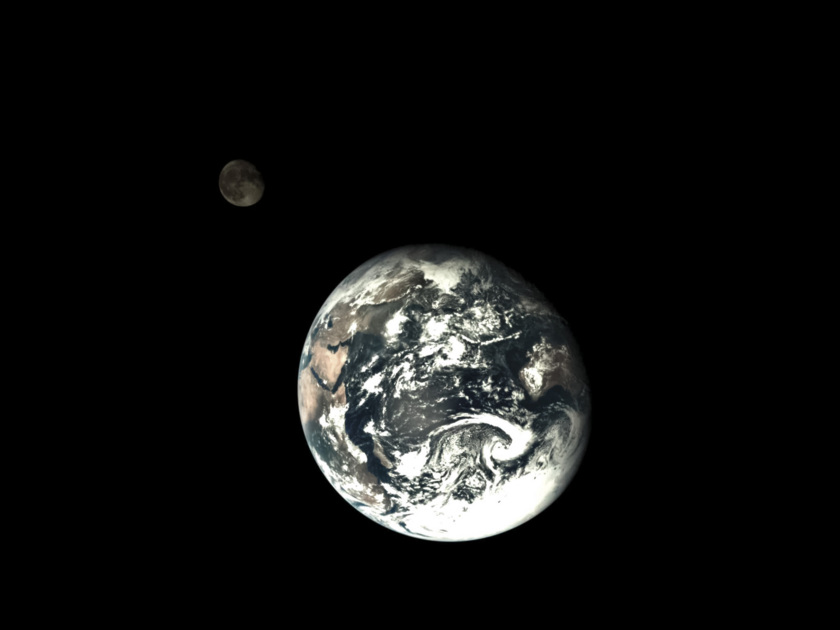
We had better learn to live with it, and with each other, or we're going to kill ourselves off. It's not like we have some place else to go.
--------------
You can't build a nation with bombs. You can't create a society with guns.
NOTIFY: Y | REPLY | REPLY WITH QUOTE | PERMALINK | TOP | HOME
We have Mars. I think more and more I'd like to go there, but I know it'll never happen.
But as for advanced civilizations, they too would have gone through an adolescent stage of wasteful and foolish energy usage. Those are the signs which I suspect the scientist would be looking for. Even if some species is 500, 5000 or 1 million years more advanced, the echo of their youth, so to speak, should be picked up by our sensors and radio telescopes.
We'r still new to the game, so who knows... maybe we'll find something that allows us to see what's been staring at us all along, and just didn't know it.
NOTIFY: N | REPLY | REPLY WITH QUOTE | PERMALINK | TOP | HOME
I'm just a tad dumb about all this..but if someone were looking our way from another planet..say 2 million light years away...we'd look a bit unoccuppied as well..just a few dinosuars roaming around right?...
NOTIFY: Y | REPLY | REPLY WITH QUOTE | PERMALINK | TOP | HOME
Quote:
Originally posted by AURaptor:
We have Mars. I think more and more I'd like to go there, but I know it'll never happen.
No we don't.
I've thought about what it would take to set up a living space that would be self-sustaining for the foreseeable future, and it's not just "not easy" I think it's impossible. All organisms, us included, evolved under conditions that we don't even think about but which we depend on to survive.
Gravity, for example. The space-station astronauts come back bone-wasted due to lack of gravity, despite the fact they they exercise like crazy to keep their bone mass up. Various biological experiments show that a lot of living organisms ... plants, ants, etc ... require gravity to survive and reproduce. Yes, Mars has gravity, but it's weak compared to earth's. I think there'll be negative effects due to that, and "gravity" is one thing you can't manufacture.
Radiation. We need enough of the right kind (like UV, to make vitamin D), and less of the wrong kind (like cosmic rays). The earth has a magnetosphere which protects us, for the most part, from a lot of stray radiation. Mars doesn't have one. So EVERYTHING ... the greenhouses and living quarters and barns ... will have to be heavily shielded, a real problem. Being so far from the sun, and having to be shielded from hard radiation means ALL light will have to be artificial. That takes a lot of energy- where will it come from? It's a difficulty.
Trace minerals. There are some minerals that we absolutely need- like magnesium and chromium, and some that seem to have no beneficial effects at all, like lead and cadmium. When you live in an environment where mineral profile is "off" from what your species evolved in, it's easy to suffer from subtle deficiencies - or worse- subtle and cumulative poisoning.
So even if we solve the problem of not enough oxygen or too much carbon dioxide (and the experiment where people lived in an enclosed presumably self-sustaining environment ON EARTH, which was a failure due to carbon dioxide buildup) there will be some challenges which I think are simply unfixable.
MOST IMPORTANTLY, aside from the technical challenges, what makes you think "there" will be any better than "here"? We're at the technological level where we're past the most common existential threats that nature has dished out*. We've conquered diseases that could have wiped out the human species, we could conquer famine if we wanted to, and we can learn to roll with the weather. At this moment, the largest existential threats to us COME FROM US. Unless we learn how to live in one place like we have to LIVE IN ONE PLACE FOREVER ... not constantly seeking some new place ... we will fuck up every place we go.
We will become that "rapacious, locust-like alien" that scifi movies love to paint as the villain.
*except earth-killing meteorites, supervolcanoes, and the sun going supernova ... but, really, we got the common ones licked, if only we would chose to do so
--------------
You can't build a nation with bombs. You can't create a society with guns.
NOTIFY: Y | REPLY | REPLY WITH QUOTE | PERMALINK | TOP | HOME