

9.0 in Japan
POSTED BY: canttakesky
UPDATED: Monday, August 24, 2026 01:23
VIEWED: 8475
PAGE 6 of 10

I'd have to look up the citation, but I thought the San Andreas was actually a torsional plate that is rotating clockwise as the Pacific plate subducts under the North American plate?
I also recall that the Mammoth Lake area of California had been "humping" under geological pressure. Something there wants out. I sure hope Chile, New Zealand and now Japan are not precursors of something else big going on the ring of fire.
The more I get to know people the more I like my dogs.
...and he that has no sword, let him sell his garment, and buy one. Luke 22:36
NOTIFY: Y | REPLY | REPLY WITH QUOTE | PERMALINK | TOP | HOME


Dr Brian Baptie, also from the BGS, explained that the earthquake occurred on the subduction zone along two different tectonic plates, the Pacific plate to the east and another plate to the west, which many geologists regard as a continuation of the North American plate.
NOTIFY: N | REPLY | REPLY WITH QUOTE | PERMALINK | TOP | HOME
The pacific plate is a tough one, it seems to be moving north or northeast. Torsion may have been suggested to explain the many directions it seems to be moving (judging by the subduction zones) The San Andreas is not a plate in of itself.
Subduction along north america and south america actually only occurs in a few locations, such as along the kodiak islands in Alaska, under the micro-plate in the vicinity of Seattle, and around the chilean mountains, where there's another plate between it and the pacific plate.
In any case, the San Andreas Fault is distinctly a strike-slip fault.
Illustration:
EDIT: Heh, Kiki posted one too. Anyway, hope that all helps people.
NOTIFY: Y | REPLY | REPLY WITH QUOTE | PERMALINK | TOP | HOME

The release of hydrogen gas from the nuclear reactors means that the "cladding" of the fuel rods is oxidizing (steam + zirconium alloy + heat = zirconium oxide powder + hydrogen). That process actually ADDS heat to the reactor core, and drives up the temperature even further.
What that means is the fuel rods are swelling and possibly splitting. If the fuel rods swell and split, it will be physically impossible to remove them because they will be jammed in to their holders.
Very close to the oxidation temperature of Zircalloy is the runaway temperature, where the "moderator" materials melt and run down into a puddle in the bottom of the containment vessel, leaving the fuel rods naked to each other.
The operators HAVE to keep the core cool by ANY means possible, or there will be a Chernobyl-style meltdown.
NOTIFY: Y | REPLY | REPLY WITH QUOTE | PERMALINK | TOP | HOME

The Super Moon will be increasing its gravitational force upon planet Earth for the rest of this week...
NOTIFY: N | REPLY | REPLY WITH QUOTE | PERMALINK | TOP | HOME
Here's a thought: why do we even have nuclear power plants above ground, anyway?
When they test nuclear weapons, they drill into a solid granite stock and the bury it before they set it off. When people are doing experiments with particle accelerators, they do them below ground.
If you absolutely have to have nuclear power plants, and your public doesn't want to individualize their power supply with something more manageable, why in HELL do you build them above ground?
NOTIFY: Y | REPLY | REPLY WITH QUOTE | PERMALINK | TOP | HOME

Actually it's Yellowstone which has me wincing...
http://news.nationalgeographic.com/news/2011/01/110119-yellowstone-par
k-supervolcano-eruption-magma-science/
If that sucker ever goes, it'd make what happened in Japan look like a wet firecracker by comparison.
-Frem
I do not serve the Blind God.
NOTIFY: N | REPLY | REPLY WITH QUOTE | PERMALINK | TOP | HOME

Quote:
Originally posted by Bytemite:
Here's a thought: why do we even have nuclear power plants above ground, anyway?
When they test nuclear weapons, they drill into a solid granite stock and the bury it before they set it off. When people are doing experiments with particle accelerators, they do them below ground.
If you absolutely have to have nuclear power plants, and your public doesn't want to individualize their power supply with something more manageable, why in HELL do you build them above ground?
Because a bomb is an uncontrolled reaction and no one is trying to harness its power.
A nuclear generator is a controlled reaction that generates heat and runs a steam engine, which requires water and the release of steam.
Underground it would just melt and poison the earth and be difficult to control. A nuclear meltdown is nothing like a nuclear bomb.
That's what a ship is, you know - it's not just a keel and a hull and a deck and sails, that's what a ship needs.
NOTIFY: Y | REPLY | REPLY WITH QUOTE | PERMALINK | TOP | HOME
None of those things suggest to me that a reactor has to be above ground. It seems like you could control temperatures above ground just as well as below ground. Water is EVERYWHERE below ground, far more than is at the surface. You just have to pump it out of the ground/walls.
You could have steam vents that go to the surface.
NOTIFY: Y | REPLY | REPLY WITH QUOTE | PERMALINK | TOP | HOME

Quote:
Yes, she is, and I hope she always will be...
And yes, we are a strange little species. Capable of screwing things up for us, to some degree, but nature is always there to bitch slap mankind, and remind us all how insignificant and puny we are on the grand scale.
Ahhh, thank you Byte. Yes, that’s it. There are places in Marin where you can SEE where the last big San Andreas was, tho’ by now the grass has overgrown it in most places...it’s eerie to see.
As to build-up, who knows? We’ve supposedly been “overdue” for “the big one” for decades on the San Andreas---but the Loma Prieta 7.9 was the HAYWARD Faul (an offshoot of the S.A.)t, so we’re still “overdue”. I don’t think Nature keeps to man’s timetable, if you know what I mean...  It kinda comes down to “seismologists say the guess...” rather than “seismologists say...” in the end, really, y’know?
Mmmm, Mammoth. Yes...Jim’s son lives there, and actually they’ve decided now it’s not a fault after all:Quote:
It IS certainly, however, a volcanic area, with hot springs; Mammoth Mountain itself being the central volcano, which has been dormant for 50,000-some years. They get lots of little shakers all the time...and of course it’s near Yosemite and it’s glacier-cut geology, too, and Yosemite gets shakers and has nearby hot springs. Mammoth is part of the Long Valley Caldera, which includes the famous, weird-looking Mono Lake, an inland salt “sea” which was cut off ages ago, creating all those weird “sculptures”, still an active volcanic area.
this sizable fissure is not an earthquake fault caused by a single quake, as the name implies. Geologists now believe it is a system of fractures formed during a series of strong quakes when the Inyo Craters and Inyo Domes erupted centuries ago.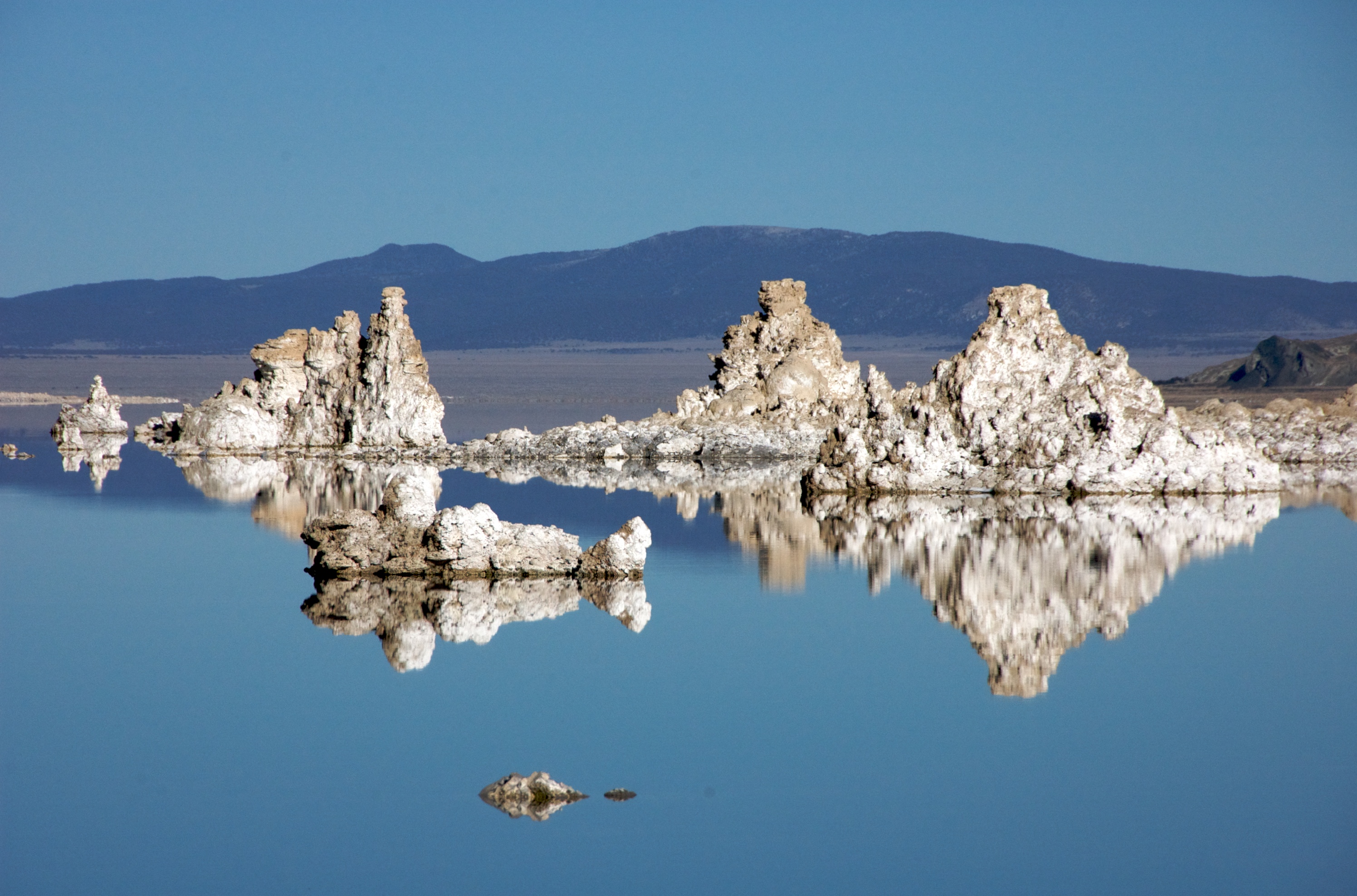
Jeff sends us lots of stuff on Mammoth, he adores it up there. Tough to make a living, tho’, as its economy is based on tourism...mostly Winter. But he’s taken all kinds of jobs, just to stay there...it IS gorgeous, less populous, and is covered with hiking trails and great skiing. Just look up “Mammoth Lakes Pictures” and you’ll wanna move there, too!
I don’t remember enough of the details about the San Andreas, some of it sticks in my head but of course the old memory ain’t what it was in college...but yes, it’s a strike-slip. As a child I lived in the hills of San Mateo over Crystal Springs Reservoir, which is a filled-in remnant of the fault line: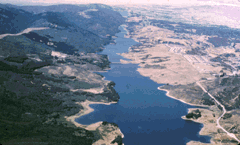
Quote:
http://pubs.usgs.gov/gip/dynamic/tectonics.html
Like all transform plate boundaries, the San Andreas is a strike-slip fault, movement along which is dominantly horizontal. Specifically, the San Andreas fault zone separates the Pacific and North American Plates, which are slowly grinding past each other in a roughly north-south direction. The Pacific Plate (western side of the fault) is moving horizontally in a northerly direction relative to the North American Plate (eastern side of the fault). Evidence of the sideways shift of these two landmasses can be found all along the fault zone, as seen from the differences in topography, geologic structures, and, sometimes, vegetation of the terrain from one side of the fault to the other. For example, the San Andreas runs directly along Crystal Springs Reservoir on the San Francisco Peninsula. Topographically, this reservoir fills a long, straight, narrow valley that was formed by erosion of the easily erodible rocks mashed within the fault zone.
That stuff about the differences is really true up on the Pt. Reyes Peninsula. It’s part of the Pacific plate, and the terrain out there is VERY different from the rest of the North American Plate...it’s actually kinda eerie.
Now, L.A.’s more recent Northridge earthquake did not directly involve movement along one of the strands of the San Andreas Fault system. It was on the San
NOTIFY: Y | REPLY | REPLY WITH QUOTE | PERMALINK | TOP | HOME