
Fukushima Nuclear Reactor Status
POSTED BY: HAKEN
UPDATED: Monday, December 22, 2025 19:24
VIEWED: 51428
PAGE 1 of 14

The fallout map below is false.
You can read the Snopes Info regarding it.
http://www.snopes.com/photos/technology/fallout.asp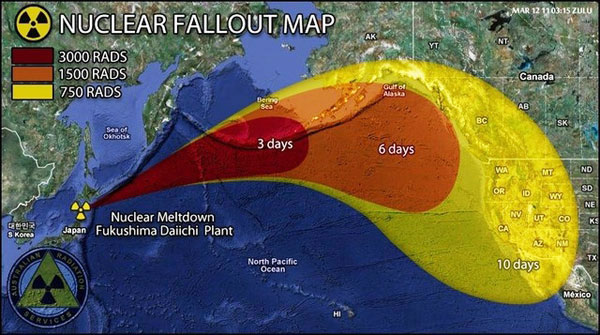
As a result, I renamed this thread so that we can track the status of the Fukushima reactors.
NOTIFY: Y | REPLY | REPLY WITH QUOTE | PERMALINK | TOP | HOME

Oh that is not good.
I got some interesting phone calls recently asking if any of my surplus-disposal or other former military contacts might know where aircraft with heavy lift capacity might be found in a hurry - fortunately there is an american subdivision of Sikorsky which has at least some heavy lift S&R choppers which might be useful, so I put them in touch...
Apparently they're shorthanded on carrier based heavy lift Search and Rescue, choppers are ideal for that, especially given the situation, and the Navy diverted one craft to Korea to collect up "everything they had", and cleaned them out completely - those were CH/MH-53's I think, which ought to be on site now and I hope they're useful.
How you doin in the islands, Haken ?
I hear it wasn't as bad as feared, and I winced at the thought of you getting swamped.
-Frem
NOTIFY: N | REPLY | REPLY WITH QUOTE | PERMALINK | TOP | HOME

Sheesh - That's the kind of graphic that can start mass hysteria. It would be nice to know the source so we could have a sense of who is saying that. AND it would be nice to know how flipping dangerous that really is. Answers.com - a very questionable source - says: "About 500 to 1000 RADS is enough to kill a human. it takes between 1-5 days for the radiation to kill all the cells in a human body."
Scifi movie music + Firefly dialogue clips, 24 hours a day - http://www.scifiradio.com
NOTIFY: Y | REPLY | REPLY WITH QUOTE | PERMALINK | TOP | HOME

Found an identical map where the logo had changed and all the numbers in the legend had been divided down by about 150. I also found a lot of websites calling the map a hoax, but none were reputable news sources themselves.
I wouldn't lose any sleep over this one yet.
-----------------------------
I pray for one last landing,
on the globe that gave me birth.
Let me rest my eyes on the fleecy skies
and the cool, green hills of Earth.
NOTIFY: Y | REPLY | REPLY WITH QUOTE | PERMALINK | TOP | HOME
Quote:
Originally posted by beatupplenty:
You are using common sense to ruin everyone's drinking and fornicating before they get vaporized. In nine months there are gonna be a lot of newborns named Fukushima.
I think I name mine Fuk U. Shima


I hope the 'U' stands for Uhura.
-----------------------------
I pray for one last landing,
on the globe that gave me birth.
Let me rest my eyes on the fleecy skies
and the cool, green hills of Earth.
NOTIFY: Y | REPLY | REPLY WITH QUOTE | PERMALINK | TOP | HOME

It's a hypothetical, as far as I know they've only measured high radiation levels within certain buildings, not outside in the environment for widespread dispersal.
But wind patterns would absolutely carry the fallout across the ocean and hit the US.
NOTIFY: Y | REPLY | REPLY WITH QUOTE | PERMALINK | TOP | HOME

Have you bought your potassium iodate today?
NOTIFY: N | REPLY | REPLY WITH QUOTE | PERMALINK | TOP | HOME
fwiw from the Nuclear Energy Institute
UPDATE AS OF 12:30 P.M. EDT, SUNDAY, MARCH 13:
NEI has created a new fact sheet, "Radiation and the Japanese Nuclear Reactors," which describes the events at the Fukushima Daiichi and Daini nuclear plants in Japan following the earthquake and tsunami nearby. Also a description of radiation dose limits and exposures to workers and the public in the United States, with a placeholder for radiation doses at the affected reactors in Japan.
http://www.nei.org/resourcesandstats/documentlibrary/safetyandsecurity
/factsheet/radiation-and-the-japanese-nuclear-reactors
UPDATE AS OF 8:30 A.M. EDT, SUNDAY, MARCH 13:
Tokyo Electric Power Co. continues to implement emergency cooling and pressure relief operations at Fukushima Daiichi nuclear power station. In addition, at Fukushima Daini, three reactors remain shut down. They have electrical power available at Daini, but the suppression water pools used for reactor cooling are saturated at both sites.
Fukushima Daiichi: There is a state of emergency declared at Fukushima Daiichi 1, 2 and 3. The company is venting containment structures at reactors 1 and 3. Reactor 3 uses mixed-oxide fuel. Electrical power is not available at any of the reactors at this site and there is not backup power available at Units 1, 2 and 3. TEPCO has been pumping seawater into reactors 1 and 3 to maintain cooling and there is some uranium fuel rod damage suspected at both reactors. Public evacuation has been ordered and executed in a 12-mile radius and there have been low levels of radiation released into the environment as a result of venting and the explosion at Unit 1 secondary containment. The maximum reported dose at the site is 128 millirem per hour, which is less than the annual average dose for commercial airline flight crews and far less than the radiation the average American is exposed to per year from all sources (see the the U.S. Environmental Protection Agency's Web page on radiation protection). One worker at the site has received a radiation dose of 10.6 rem.
Fukushima Daini: There is a state of emergency at Units 1, 2 and 4 and evacuation has been ordered and executed for 2.5 miles around the plant. There has been no radioactive release reported at the site. There is electric power available at all four reactors at the site, but there is limited use of cooling water pumps at Units 1, 2 and 4 due to damage from the tsunami. The suppression pools are saturated at all three reactors.
Comments from Japanese officials:
The company is providing seawater and boron for core cooling at Fukushima Daiichi units 1 and 3 and is venting containment at the reactors, Japan's Chief Cabinet Secretary, Yukio Edano, said on Sunday. Officials are acting on the assumption that a meltdown could be underway at Fukushima Daiichi Unit 3. "Unlike the No.1 reactor, we ventilated and injected water at an early stage," Edano said.
Authorities are preparing to distribute iodine to protect people from radioactive exposure.
NEI has created a new fact sheet, "Radiation and the Japanese Nuclear Reactors," which describes the events at the Fukushima Daiichi and Daini nuclear plants in Japan following the earthquake and tsunami nearby. Also a description of radiation dose limits and exposures to workers and the public in the United States, with a placeholder for radiation doses at the affected reactors in Japan.
http://www.nei.org/resourcesandstats/documentlibrary/safetyandsecurity
/factsheet/radiation-and-the-japanese-nuclear-reactors
Radiation and the Japanese Nuclear Reactors
March 2011
Key Facts
An earthquake measuring 9.0 on the Richter scale struck off the northeastern coast of Japan on March 11, triggering a tsunami. Along with the loss of life and damage, Japan also faces the challenge of stabilizing nuclear power plants in the hardest-hit region.
After the earthquake, all the operating reactors at the Fukushima Daiichi and Fukushima Daini nuclear plants shut down automatically, as they are designed to do. However, due to the loss o
NOTIFY: Y | REPLY | REPLY WITH QUOTE | PERMALINK | TOP | HOME
Quote:
http://www.cnn.com/2011/WORLD/asiapcf/03/12/japan.quake/index.html?hpt
=T1&iref=BN1
Quote:
Tokyo Electric, battling to avoid a meltdown at its Fukushima nuclear plant, faces “severe” rebuilding costs and Toshiba’s nuclear business may see increased scrutiny, said Minoru Matsuno, president of Value Search Asset Management Co. in Tokyo.
Radiation levels near the Fukushima plant, located 135 miles (217 kilometers) north of Tokyo, rose above Japanese limits after an explosion yesterday destroyed the walls of the reactor building. Nippon Steel Corp., Suzuki Motor Corp. and Canon Inc. today joined the growing number of companies saying their operations were hurt following the 8.9-magnitude earthquake on March 11 that rocked Japan and triggered tsunamis.
“For Tokyo Electric and anything nuclear-related, it’s going to be pretty bad,” said Makoto Kikuchi, chief executive officer at Myojo Asset Management Japan Co., a Tokyo-based hedge fund advisory firm. “The biggest fear I have is what will happen at the nuclear power plant as it would be a real disaster if the situation deteriorates into another Chernobyl.”
Disruptions at Shin-Etsu and Sumco Corp. account for about 60 percent of the world’s electronic wafers, will undermine global supply, which may benefit the No. 3 producer, Wacker Chemie AG’s Sitronic, according to Klaus Ringel, an analyst at Credit Agricole Cheuvreux.
Dennis Chan, an analyst at Yuanta Financial Holding Co., wrote March 11 that Sony, which has factories in Fukushima-ken and Tochigi-ken in northern of Japan, may be affected. The company makes about 10 percent of the world’s laptop batteries, according to Chan. The company said today that it’s halting production at eight factories that make products ranging from Blu-ray discs, magnetic heads and batteries.
Toyota, Nissan Motor Co. and Honda Motor Co. said thousands of new vehicles were damaged. Toyota will suspend production at its dozen factories in Japan and its body makers on March 14, while Honda said it will stop production at factories in Sayama, Mouka, Hamamatsu and Suzuka.
http://www.bloomberg.com/news/2011-03-13/tokyo-electric-toshiba-east-j
apan-rail-may-be-among-most-hurt-by-quake.html
Quote:
Japan battles to stop nuclear catastrophe
Prime minister Naoto Kan said Japan faced its “worst crisis” since the second world war as the nation grapples with the aftermath of Friday’s earthquake and tsunami and the increasingly serious situation at two nuclear reactors reports the Financial Times.
His warning came as fears grew that the death toll from the devastating tsunami would ultimately be measured in the tens of thousands.
I believe that by coming together as a nation we can overcome this crisis,” Mr Kan said in a televised news conference.
While rescue workers worked around the clock to find survivors of the tsunami along Japan’s north-east coastline, nuclear experts were trying to prevent a nuclear meltdown at an atomic plant in Fukushima, some 240km north of Tokyo.
Earlier on Sunday, Yukio Edano, the chief government spokesman, said there was a “significant chance” that radioactive fuel rods had partially melted in two reactors [Number One and Number Three] at the Fukushima Daiichi nuclear power facility.
More than 24 hours after engineers began pumping seawater into the Number One reactor, the water level inside its containment vessel and that of the Number Two reactor, remained significantly below levels needed to cool their uranium fuel and prevent a full nuclear meltdown.
Seawater injection at the second reactor began early on Sunday morning, but nuclear safety officials said the water level was not rising as intended. Olli Heinonen, former deputy head of the International Atomic Energy Agency, said the Japanese authorities were “having tremendous trouble”.
“As they long as they can maintain a reasonable level of cooling at the affected reactors, they can avoid partial or full meltdown,” said Mr Heinonen. “But if they fail tNOTIFY: N | REPLY | REPLY WITH QUOTE | PERMALINK | TOP | HOME