

Interstellar or Interplanetary?
POSTED BY: Galfridus
UPDATED: Saturday, February 22, 2003 11:02
VIEWED: 19917
PAGE 1 of 6

Is there faster-than-light travel in Firefly, or (as some people have inferred from the intro) are there somehow a whole ton of planets in one system? Does the pilot get into this?
NOTIFY: Y | REPLY | REPLY WITH QUOTE | PERMALINK | TOP | HOME

Nope, the pilot doesn't have any additional info on this topic. There's been a lot of informal buzz from Whedon and Minear -- mainly through interviews in various media -- that, yes, the Firefly stories all take place in a single solar system with a suprisingly large number of inhabitable worlds, and no, there's no FTL travel. Some fans have speculated on things like wormholes or multiple solar systems that are closer together than those in our current neighborhood. But there's no mention of anything like this on the show or from W&M.
There's a mention in The Train Job (replayed tomorrow if the playoffs end early) that the farthest habitable worlds are about 90 million miles apart. Our own solar system is only 10 million miles across, and only a small fraction of it is neither too hot nor too cold to support a habitable world. So obviously this system is very different from our own.
JOSS, WHERE'S MY CHECK???!!!
NOTIFY: Y | REPLY | REPLY WITH QUOTE | PERMALINK | TOP | HOME
Quote:Whoa there partner. <<< note Westernism :)
Originally posted by Zicsoft:
There's a mention in The Train Job (replayed tomorrow if the playoffs end early) that the farthest habitable worlds are about 90 million miles apart. Our own solar system is only 10 million miles across, and only a small fraction of it is neither too hot nor too cold to support a habitable world. So obviously this system is very different from our own.
Our Solar System (measured as the distance across the orbit of the most distant planet, Pluto) is some 8 billion miles across. The sun alone is almost a million miles in diameter, and the earth is 93 million miles from the sun. So the Earth's orbit alone is almost 200 million miles in diameter.
Now on to Firefly: If we assume that the sun in question in the Firefly system is larger then our own sun, then there could concievably be dozens of worlds (possibly even hundreds) within an orbital region to allow for earth-like conditions. And if we further assume that the system in question is a binary star system, then that number of habitable planets could very well reach in the hundreds.
Given the size of certain stars in possible binary or trinary systems, and assuming that terraforming technology is vastly more superior 500 years in the future, it is not impossible to imagine a system of literally thousands of habitable planets.
-----------
In the Dark Ages, Romano-Celtic Britannia was over-run by Viking-like cultures collectively called the Anglo-Saxons. They were led by warlords called Drytinns, and the greatest warriors among them were the Thegns.
NOTIFY: Y | REPLY | REPLY WITH QUOTE | PERMALINK | TOP | HOME
It seems to me that hundreds, or even dozens, of worlds orbiting the same body at about the same distance would be gravitically unstable. Perhaps this is a hint that the system is artificial in origin?
Also, how would the notion of a "core" and a "periphery" work into such a system. All of the planets would have to be orbiting at about the same distance, and unless they were all orbiting at precisely the same speeds, the distances between them would be constantly changing.
Guess I have something to ask Mr. Whedon if I ever meet him. :)
NOTIFY: N | REPLY | REPLY WITH QUOTE | PERMALINK | TOP | HOME
Quote:Hmm, you're right. I seem to have dropped some decimal points. Oh well!
Originally posted by Thegn:
Our Solar System (measured as the distance across the orbit of the most distant planet, Pluto) is some 8 billion miles across.
I can imagine a bigger star with a bigger life zone able to support a dozen or so habitable planets. But hundreds? And forget about binary and trinary systems -- any planets in such a system would have very eratic orbits.
More plausible (to my math-challenged mind, anyway) is that a lot of the Firefly worlds orbit gas giants in the outer system. Like the Firefly sun, they're a lot bigger than the our local gas giants. Big enough, in fact, to become "brown dwarfs"
http://www.space.com/scienceastronomy/astronomy/brown_dwarfs_011025.ht
ml
and thus emit heat of their own, enough to make some of their moons habitable. And indeed, we seem to see a lot of gas giants on Firefly, including this one:
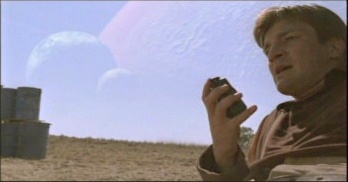
Notice that Mal seems to be on a world orbiting that big planet, and that one of the worlds in sky also seems to be a terraformed satellite.
JOSS, WHERE'S MY CHECK???!!!
NOTIFY: Y | REPLY | REPLY WITH QUOTE | PERMALINK | TOP | HOME
Quote:No. All of the planets would not have to be orbiting at the same distance. That's a myth brought on by egocentric thinking. The orbit of the earth is not the only orbit that a planet could have earth-like conditions. There is a range of orbits, from the orbit of venus to out beyond the orbit of Mars. Both Venus and Mars could have had earth-like environments on them at one time. So concievably the sun could have as many as three earth-like planets, possibly four. Just because we see only one today is more because we don't live long enough to see the full history of our solar system.
Originally posted by Galfridus:
Also, how would the notion of a "core" and a "periphery" work into such a system. All of the planets would have to be orbiting at about the same distance, and unless they were all orbiting at precisely the same speeds, the distances between them would be constantly changing.
Guess I have something to ask Mr. Whedon if I ever meet him. :)
A larger sun could have a larger range of orbits. In fact, a blue giant could have a range billions of miles wide, supporting dozens or possibly hundreds of earth-like planets. the furthest planets would be on the other side of the star, as many as 10 - 20 billion (or more) miles away, hence the "core" and the "periphery." Because the orbits would be so large, their positions relative to one another might change slowly, so that within a human life time, these core and periphery planets would be constant.
And yeah, the gas giant thing adds a whole other dimension. You could have 4 or 5 or possibly 16 or 20 "planets" orbiting a single gas giant. In essence, you have all these planets sharing the same earth-like orbit. Which (once again) concievably increases the number of possible earth-like planets a system like that could support.
And binary star systems could support habitable planets. The orbits don't have to be erratic. There are stable binary systems.
-----------
In the Dark Ages, Romano-Celtic Britannia was over-run by Viking-like cultures collectively called the Anglo-Saxons. They were led by warlords called Drytinns, and the greatest warriors among them were the Thegns.
NOTIFY: Y | REPLY | REPLY WITH QUOTE | PERMALINK | TOP | HOME

Quote "every man there, go back inside, or we will blow a new crater in this little moon" wash, the train job.
NOTIFY: N | REPLY | REPLY WITH QUOTE | PERMALINK | TOP | HOME
I know a star's life zone can have more than one planet in it. Our sun has three. Maybe a big sun could have 20 or so. But hundreds? I don't buy it. And, as that photo indicates, many worlds on Firefly would seem to be satellites of gas giants or brown dwarfs.
JOSS, WHERE'S MY CHECK???!!!
NOTIFY: Y | REPLY | REPLY WITH QUOTE | PERMALINK | TOP | HOME
Habitable planets would have a very difficult time forming naturally around any O or M class star such as blue giant. However, if they could be helped along by some form of terraforming there certainly could be a huge number of habitable planets orbiting a star that size, based on geometry alone. I don't know where you came up with this number 20 and why you think it's a limiting factor, but there's no law of physics that says there can't be more.
As for your gas giant theory, I'm not disagreeing with you. That sounds perfectly reasonable to me.
One question I have: why do we never see the gas giants in space?
These kinds of planets are not easy to hide. Jupiter is 11 times the diameter of the Earth, and there's no reason that a gas giant couldn't be larger, but Jupiter itself is hard to miss. In NASA photos of Jupiters moons, Jupiter often dominates the background scenery, sometimes Jupiter is the background scenery.
If these planets really are gas giant moons, I would like to see these gas giants in the background when the Serenity enters and leaves a world.
-----------
In the Dark Ages, Romano-Celtic Britannia was over-run by Viking-like cultures collectively called the Anglo-Saxons. They were led by warlords called Drytinns, and the greatest warriors among them were the Thegns.
NOTIFY: Y | REPLY | REPLY WITH QUOTE | PERMALINK | TOP | HOME
Quote:
Zicsoft wrote:
I know a star's life zone can have more than one planet in it. Our sun has three. Maybe a big sun could have 20 or so. But hundreds? I don't buy it. And, as that photo indicates, many worlds on Firefly would seem to be satellites of gas giants or brown dwarfs.
"The universe is not only stranger than we imagine, it is stranger than we can imagine."
Now, if the refugees from the dying earth suddenly discovered a system with such vast potential, what would they do?
Remember, Earth is a major unlikely event and we evolved (or were created) to fit it.
Jeff
Who figures a poly star system with other advantages as well.
NOTIFY: Y | REPLY | REPLY WITH QUOTE | PERMALINK | TOP | HOME