

The Firefly/Serenity Solar System
POSTED BY: FraserBW
UPDATED: Tuesday, March 7, 2006 10:55
VIEWED: 27197
PAGE 2 of 11

The important words in my sentence were Tau and Relative. The relative i.e. subjective time could be quite low when traveling at near lightspeeds because of the low Tau.
If I can get mathematical:
t = t0/(1-v²/c²)½
where: t = time of external observer
t0 = time on board ship
v = the speed of the moving object
c = the speed of light in a vacuum
So given a trip to Alpha Centauri at 0.5c:
t0 = t * (1 - v²/c²)½
t0 = 8.6 * (1 - 0.5²)½
t0 = 8.6 * 0.866
t0 = 7.4
Given that I think they'd use bussard ram scoops capable of constant acceleration they'd have no maximum speed below lightspeed.
Given higher velocities subjective time onboard ship is significantly less than the 'real' time.
Edit:
Assuming a constant acceleration of 1g with a Bussard Ram scoop (and assuming the maths right) a trip of 200,000,000 lightyears would take ~36yrs of subjective ship time.
More insane ramblings by the people who brought you beeeer milkshakes!
Remember, the ice caps aren't melting, the water is being liberated.

NOTIFY: Y | REPLY | REPLY WITH QUOTE | PERMALINK | TOP | HOME

There is no faster than light travel in firefly, we can debate that later if you like. Right now I just want to point somehting out:
There is such a thing as relative time and the only indications of time we are given are by the ones who made the journey not some stationary observer. That means that saying, "Such and such is X light years away so it must take more than X years to get there," is bullshit. I mean we can make measurable differences in the passage of time on this planet with the use of things as slow as planes.
Someone here once did the calculations for us on how long it would take to get to some star or other if one accelerated half way and decelerated the other half, it’s not all that long considering.
-
If you want to know how right or wrong Joss could be take into account that the average lifespan was somewhere between what it is now and 120 years, remember that one generation never saw the outside of a space ship. Figure out a reasonable amount of acceleration and calculate how far someone could get with more than one but less than three generations worth of time passing on ship.
Then take that distance, use it to draw a sphere around our planet, tell us how many stars are within that sphere, how many could conceivably house multiple planets, and how many of those could have a large habitability zone after atmospheric meddling.
Then and only then will you in a position to criticize the travel time. Relative time gives me a headache so I have no plans to do it.
I'm not saying what we are told is reasonable, I'm not saying that at all. I am saying that I have yet to see someone who is claiming it is unreasonable back up their claim, and until they at least try to back it up I think they shouldn’t be so adamant about what they clearly do not know.
NOTIFY: Y | REPLY | REPLY WITH QUOTE | PERMALINK | TOP | HOME

I don't want to seem like a complete idiot, but would it be possible for planets to orbit in different directions? For example, could one planet orbit around the sun's "equator" and another along a "meridian"? Also could planets orbit at different levels or do they all orbit around the widest part of the sun?
"Pain is scary." -Jayne
NOTIFY: N | REPLY | REPLY WITH QUOTE | PERMALINK | TOP | HOME

recently another planetary body was discovered beyond Pluto in our solar system. It has yet to be named and only made it on the news briefly.
It could be some planets share the same orbital distance but at opposite sides of the "sun" in the new system. If memory serves me that's called a Trojan point. The problem I have with all the planets in the same system (which I know they are based on the Visual Companion) is that our solar system only has a narrow habitable zone from Venus to Mars. Mars atmosphere is too thin to hold in enough heat to keep it warm and habitable, Venus is too much of a runaway greenhouse environment to shed enough heat to be habitable. Earth is the baby bear bed and porridge for us humans. Pity we crap where we eat and act like there's another Earth ready to go when this one's used up but hey, most humans are just a tiny bit more evolved from apes not alot more. I think to be close to accurate the star that the Firefly verse is centered on has to be just a tad bigger and just a bit hotter than our sun to create a larger habitable zone. A blue giant star would be too hot and the lighting wouldn't look right in any of the scenes on any of the planets in the system.
Jaytee
NOTIFY: Y | REPLY | REPLY WITH QUOTE | PERMALINK | TOP | HOME
Quote:Well, it’s not difficult to figure with a first order Newtonian approximation. The gravitation field around the sun is an inverse square law, so it goes as the inverse of the square of the distance.
Originally posted by TenthCrewMember:
And yes, the pull extends well beyond pluto, all the comets for example that orbit the sun...to what degree the strength of this is? I dunno, but it does exist, I agree.
Given the value for the gravitation constant, the mass of the sun and a distance from the sun, in this case maybe twice distance of Pluto. (Thee field F = GM/r^2) I get ~9.5E-7 N/kg.
Not a very precise calculation, because the gravitational constant isn’t known to enough significant figures. Astrophysics would normally use a measured body specific value which takes the place of GM in the equation.
-------------
Qui desiderat pacem praeparet bellum.
NOTIFY: Y | REPLY | REPLY WITH QUOTE | PERMALINK | TOP | HOME
Planets that form in a solar system tend to stay on the plane because they are formed in an Accretian disc. If some of the planets are captured bodies they could be in any orbit.
More insane ramblings by the people who brought you beeeer milkshakes!
Remember, the ice caps aren't melting, the water is being liberated.
NOTIFY: Y | REPLY | REPLY WITH QUOTE | PERMALINK | TOP | HOME
Quote:Yes, they have to orbit around the widest part of the sun. To orbit above and parallel to the ecliptic would require an expenditure of energy by planet, since it would basically be orbiting at a high potential. It’s sort of the same idea as floating above the earth’s surface.
Originally posted by FeatherontheWind:
I don't want to seem like a complete idiot, but would it be possible for planets to orbit in different directions? For example, could one planet orbit around the sun's "equator" and another along a "meridian"? Also could planets orbit at different levels or do they all orbit around the widest part of the sun?
"Pain is scary." -Jayne
-------------
Qui desiderat pacem praeparet bellum.
NOTIFY: Y | REPLY | REPLY WITH QUOTE | PERMALINK | TOP | HOME
The stylized map of the solar system in the movie only shows the planetary orbits around one of the stars of the 'verse. It has been shown in the movie as well as the official visual companion that the entire "system" includes other stars and their planets as well as the "core" system shown in the opening of Serenity.
Later, River looks at this map, showing other stars and orbits. A similar map was printed in the visual companion.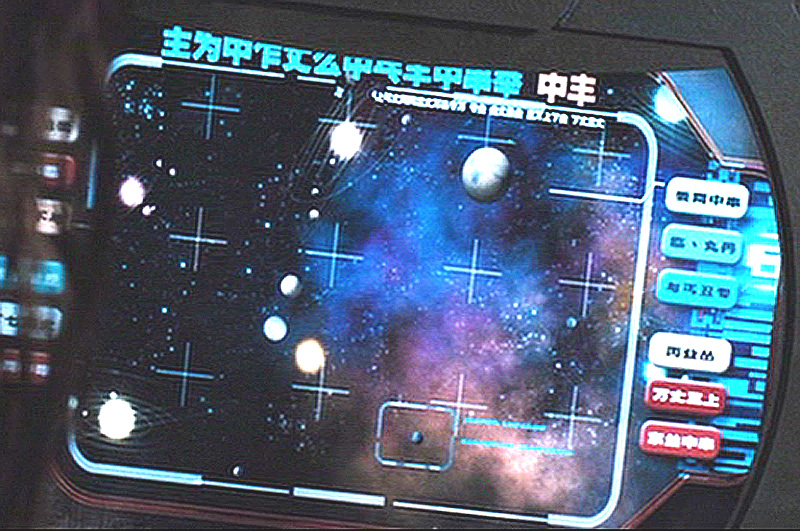
The visual companion also has Joss's shooting script, which includes a scene where River is looking at a map of the "solar system of stars, planets and moons" connected by colored lines. This is evidence enough to me that Joss has it in his head that the 'verse has several star systems that comprise of the "solar system". Very unscientific, but very Joss.
NOTIFY: Y | REPLY | REPLY WITH QUOTE | PERMALINK | TOP | HOME

Quote:
Originally posted by citizen:
The important words in my sentence were Tau and Relative. The relative i.e. subjective time could be quite low when traveling at near lightspeeds because of the low Tau.
If I can get mathematical:
t = t0/(1-v²/c²)½
where: t = time of external observer
t0 = time on board ship
v = the speed of the moving object
c = the speed of light in a vacuum
So given a trip to Alpha Centauri at 0.5c:
t0 = t * (1 - v²/c²)½
t0 = 8.6 * (1 - 0.5²)½
t0 = 8.6 * 0.866
t0 = 7.4
Given that I think they'd use bussard ram scoops capable of constant acceleration they'd have no maximum speed below lightspeed.
Given higher velocities subjective time onboard ship is significantly less than the 'real' time.
Edit:
Assuming a constant acceleration of 1g with a Bussard Ram scoop (and assuming the maths right) a trip of 200,000,000 lightyears would take ~36yrs of subjective ship time.
Oh my god! (Or something that effect in Chinese.) My post has generated a ton of responses in a short period of time, I can't keep up with them.
OK, this is the response I was looking for. The MATH. It is said somewhere on this site (I'm taking this on faith from a previous poster, I haven't read it yet) that Joss said that the colonizers of the Firefly system left Earth and their grandchildren benefited from their heroic journey. So I concluded Grandpa and Grandma left Earth and died on the way. Mom and Dad may have children upon leaving Earth or born on the way, and probably got to the system but were much older on arrival. The Grandkids were born on board and basically the new generation for this new terraformed system that "benefited." So given a 70 to 120 year lifespan for people (I think Joss is conservative on lifespan extension in his canon, but this is something we should probably ask him) the trip should be at least 100 years shiptime to maybe 200 years. So 200,000,000 light years of travel in 36 years of shiptime is too short for that speed. Now the wiggle room could be that it is stated in the canon that Firefly is 500 years in the future. Now is that Earth years or relative years of the shiptime plus 400 or less planet (Earth) time? I assume non-sciencey Joss mean 500 years of Earth time, but it could be reasonable to wiggle out of that if necessary by counting ship time, and therefore allowing more Earth time to go by for trip purposes. Again, what does Joss say on this already?
NOTIFY: Y | REPLY | REPLY WITH QUOTE | PERMALINK | TOP | HOME
Quote:
Originally posted by FraserBW:
I assume non-sciencey Joss mean 500 years of Earth time
I have to disagree with you on that, Joss may be non-sciencey but he isn't an idiot.
(almost) No one is going to hop on a ship, have five years pass, and then hop back off of the ship and say, "No, five years didn't really pass, more years passed because from the point of view of some observer we'll never meet in some place we'll never go more than five years passed."
The same holds true for ten years, and for twenty, and for one hundred and for any other number you choose.
People simply don't operate that way and Joss is smart enough to know that.
If the people in the Firefly verse say it is 2507 that means that it is 502 years of relative time from now.
NOTIFY: Y | REPLY | REPLY WITH QUOTE | PERMALINK | TOP | HOME