

A thread for Democrats Only
POSTED BY: THGRRI
UPDATED: Sunday, September 6, 2026 15:36
VIEWED: 755368
PAGE 722 of 725

Quote:Trumptards are Confederates. They don't want Lincoln telling them that slavery is wrong, and they know that slaves deserve to work for free so that Confederates don't have to.
Originally posted by 6ixStringJack:
SPOILER ALERT: You ARE the bad guys.
The Joss Whedon script for Serenity, where Wash lives, is Serenity-190pages.pdf at https://www.mediafire.com/two
NOTIFY: Y | REPLY | REPLY WITH QUOTE | PERMALINK | TOP | HOME
The Voters Who Believe That Trump Defends Their Values
Why Calls to ‘Save Democracy’ Don’t Work
Katy Osborn, Scott Warren | June 13, 2026
https://www.theatlantic.com/ideas/2026/06/democracy-government-trump-m
aga/687535/
Given President Trump’s disregard for long-standing political norms and his efforts to overturn the 2020 election, many Americans fear that he is hostile to democracy. According to this view, the 49.8 percent of voters who supported him in 2024 must simply be unaware of the existential threat he poses to our republic. The logic, to Trump’s critics, is therefore simple: Once voters fully grasp that democracy is under threat from creeping authoritarianism, then surely they will turn against Trump.
Yet this strategy has largely fallen flat. Why? The consulting and pro-democracy organizations where we work have spent the past few months with conservative Trump voters across three counties in Wyoming, Michigan, and South Carolina. We learned that many do indeed revere America’s founding design, including the Constitution, free and fair elections, the Electoral College, and the rule of law. But these voters feel that government institutions have drifted from their founding values and priorities, which they classify as faith, or the belief that moral authority precedes political authority; family, the primary unit of social life and obligation; freedom, mainly from government overreach; and place, or the importance of local community over national abstraction. The people we spoke with explained that by forsaking these values, the country’s political institutions have lost touch with the moral ethos that they believe should guide public life, and that these institutions were designed to protect.
Our research involved conducting in-depth interviews with and observing the daily lives of dozens of people along with their friends, families, and neighbors to better understand how they think about American democracy right now. Our goal was not to persuade or judge, but to figure out why public trust in national institutions has plummeted to historic lows and what might be done to build it back up.
We learned that the central question for the conservatives we met is not “Should America be a democracy?” Instead it is: “Has American democracy remained faithful to what makes it legitimate?” Democratic institutions are legitimate, in the view of conservatives, when they honor and protect the faith, freedom, families, and communities of their constituents. When institutions and the politicians who inhabit them fail to appreciate the centrality of these core values, they become illegitimate.
One participant, Sarah, a 30-something mother of three in rural Wyoming, grew up poor, the daughter of a single teen mom. From the time she was 10, her local church fed her family, cared for her when her mother couldn’t be around, and surrounded her with people who treated her with dignity. In 2008, at age 18, she strongly considered voting for Barack Obama for president. She appreciated his care for struggling Americans and believed his promises of change. The parents of her boyfriend at the time didn’t argue with her. Instead, her future in-laws listened and then asked: Who brought you out of poverty? The answer, Sarah realized, was not the federal government, but her church community—a view that she believed put her closer to the priorities and policies of conservatives rather than Democrats.
Nearly 20 years later, Sarah told us that virtually every major institution she has encountered in her life, including public schools, hospitals, and various federal agencies, has squandered her trust and fallen short of what her church gave her. Having witnessed the shortcomings of the public-school system firsthand as a teacher, Sarah now home-schools her children. When neurologists dismissed her young son's recurring seizures, she turned to networks of mothers online to crowdsource a diagnosis and treatment plan, which largely entailed avoiding certain government-sanctioned products and chemicals. (When we met h
NOTIFY: Y | REPLY | REPLY WITH QUOTE | PERMALINK | TOP | HOME
Boomers actually do hold most of the wealth and power. So why do they call it ‘whiny’ to point that out?
By Nick Lichtenberg
June 14, 2026, 7:00 AM ET
https://fortune.com/2026/06/14/why-are-boomers-millennials-angry-at-ea
ch-other-wealth-inequality-psychology/
Over 2,000 years ago, Aristotle had some bars about the kids these days: “Young men have strong passions, and tend to gratify them indiscriminately,” the great philosopher wrote in Rhetoric. “They are changeable and fickle in their desires, which are violent while they last, but quickly over… They have exalted notions, because they have not yet been humbled by life or learnt its necessary limitations.”
Later in the same chapter, he had some words for their elders: “They are small-minded, because they have been humbled by life: their desires are set upon nothing more exalted or unusual than what will help them to keep alive.”
He could have been reading my email.
A striking number of my readers—older, almost uniformly—skipped past the data entirely and went straight to character: younger generations complain too much. They spend recklessly. They don’t sacrifice. They whine.
What was notable wasn’t the anger. It was the precision of the deflection. No one challenged the Federal Reserve data showing that Baby Boomers control roughly 52% of U.S. household wealth while representing about 20% of the population. No one argued that Millennials are, in fact, thriving. The response to a structural argument about wealth and power was, almost invariably, a moral argument about character.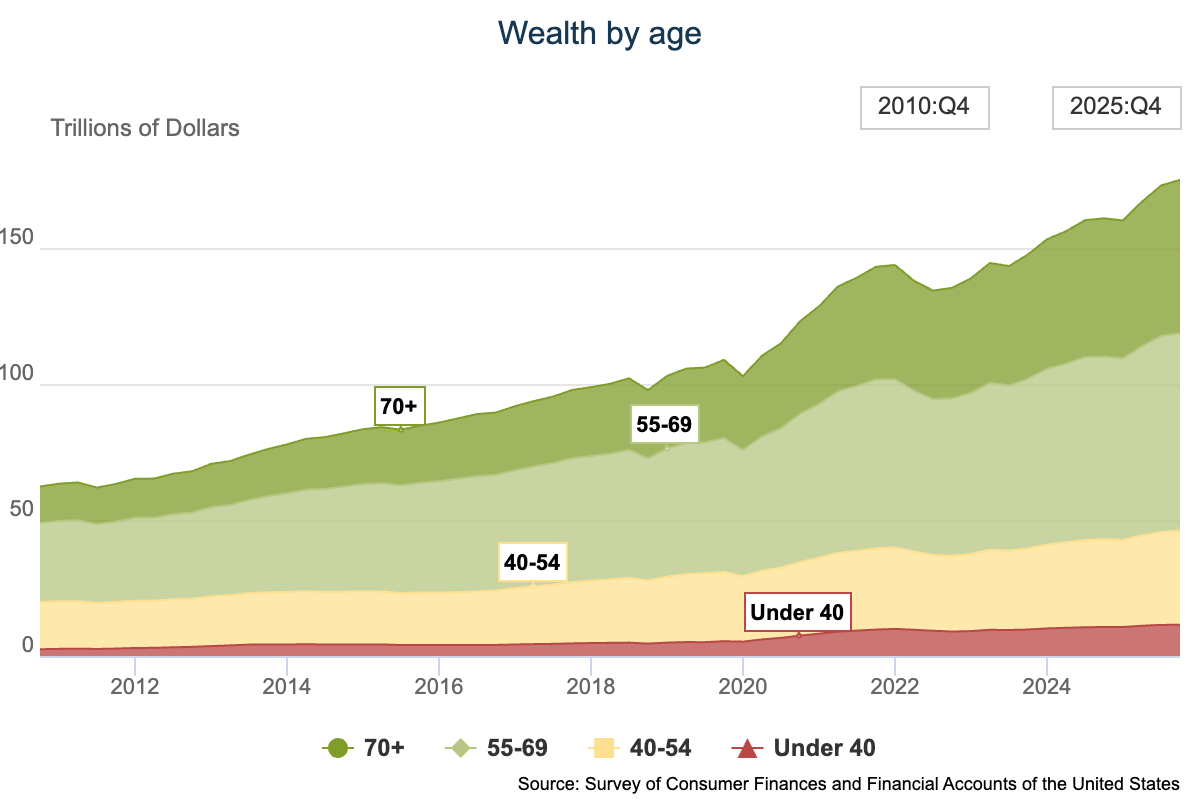
That pattern has a name in psychology. And understanding it—alongside what actually makes Boomers different from every dominant class that preceded them—tells you more about where America is stuck than any balance sheet. Is it whiny to try to understand this psychology, or is it a form of self-knowledge?
Two kinds of threats—and why they’re not symmetrical
In 2023, researchers Stéphane Francioli, Felix Danbold, and Michael North published a peer-reviewed study in Personality and Social Psychology Bulletin examining precisely what makes Boomers and Millennials hostile toward each other. The findings map almost perfectly onto the reader mail in this reporter’s inbox. https://pmc.ncbi.nlm.nih.gov/articles/PMC11490062/
Both generations express genuine animosity toward the other. But the nature of that animosity is fundamentally different, and the difference is not incidental.
Millennials’ hostility toward Boomers is driven primarily by what intergroup threat theorists call realistic threat—specifically, the fear that Boomers’ delayed transmission of power hampers their life prospects. The Federal Reserve data on housing, wealth, and debt give that fear its material texture. Millennials aren’t upset about Boomer values. They’re upset about Boomer advantages, and the structural conditions that have made those advantages self-perpetuating.
Boomers’ hostility toward Millennials runs in the opposite direction. Their animosity is driven primarily by symbolic threat—perceived conflict over culture, values, and worldview. Not economics or data. The feeling that a generation coming up behind them is challenging something essential about what America is, what hard work means, what success is supposed to look like.
This asymmetry is a predictable feature of dominant-group psychology, older even than Aristotle. When you hold the material advantages, you don’t feel materially threatened — because you aren’t. What you feel threatened by is the narrative that your advantages might not be entirely earned. That is a different kind of threat that produces a different kind of defense.
The meritocracy is the message
One word I used in a previous headline was particularly triggering: “hoarding,” as in, hoarding wealth, hoarding real estate, hoarding political power and opportunity. Seen through the lens of psychology, this verb begs the question of what Boomers a
NOTIFY: Y | REPLY | REPLY WITH QUOTE | PERMALINK | TOP | HOME

Quote:
Originally posted by second:Quote:Trumptards are Confederates. They don't want Lincoln telling them that slavery is wrong, and they know that slaves deserve to work for free so that Confederates don't have to.
Originally posted by 6ixStringJack:
SPOILER ALERT: You ARE the bad guys.
Confederates were Democrats.
And it's the Democrats today that want to let in millions every year to work for slave wages and keep the quality of life down for everyone who isn't rich.
YOU are the bad guys. You were always the bad guys.
--------------------------------------------------
Those who dance always seem crazy to those who can't hear the music.
NOTIFY: Y | REPLY | REPLY WITH QUOTE | PERMALINK | TOP | HOME
Quote:So, the Democrats of today's USA are the Democrats of the Confederacy in 1860? Then the Democrats of North Korea must be the Democrats of today's USA, too. The same name must mean they are the same.
Originally posted by 6ixStringJack:Quote:
Originally posted by second:Quote:Trumptards are Confederates. They don't want Lincoln telling them that slavery is wrong, and they know that slaves deserve to work for free so that Confederates don't have to.
Originally posted by 6ixStringJack:
SPOILER ALERT: You ARE the bad guys.
Confederates were Democrats.
And it's the Democrats today that want to let in millions every year to work for slave wages and keep the quality of life down for everyone who isn't rich.
YOU are the bad guys. You were always the bad guys.
--------------------------------------------------
Those who dance always seem crazy to those who can't hear the music.
• People's Democratic Republic of Algeria
• Democratic Republic of the Congo
• Democratic Republic of Timor-Leste
• Federal Democratic Republic of Ethiopia
• Lao People's Democratic Republic
• Democratic People's Republic of Korea
• Federal Democratic Republic of Nepal
• Democratic Socialist Republic of Sri Lanka
The Joss Whedon script for Serenity, where Wash lives, is Serenity-190pages.pdf at https://www.mediafire.com/two
NOTIFY: Y | REPLY | REPLY WITH QUOTE | PERMALINK | TOP | HOME
The End of Neoliberalism
The virtues it extolled—cosmopolitanism and competition—led to its demise.
June 15, 2026, 12:13 AM
By Branko Milanovic, a research professor at the CUNY Graduate Center.
https://foreignpolicy.com/2026/06/15/neoliberalism-globalization-compe
tition-cosmopolitanism-economics-reagan-thatcher/
If one were to define neoliberal globalization during the 40-year period from the early 1980s to around 2020, one could say it was driven by two ideas: cosmopolitanism and competition. One could also say these same features have now led to neoliberalism’s undoing.
Cosmopolitanism was an essential neoliberal idea going back to the meetings of the Walter Lippmann Colloquium in 1930s Paris and the early Mont Pèlerin Society. Cosmopolitanism meant that every individual in the world was to be thought of as equally important and equally capable of economic improvement if they faced optimal economic conditions—which implied security of private property, free trade, low taxes, and a “tolerable administration of justice.” Very little else, in the words of economist Adam Smith, was needed to fulfill the universal desire of all persons to “better their own condition” and for the world to attain unimagined levels of prosperity.
Cosmopolitanism was also the political idea underpinning a neoliberal world where national government as such would be out of sight and would leave individuals free to pursue their self-interest. This was, ideally, a world of small or almost invisible government. In the language of early advocates of neoliberalism, “imperium”—that is, flags, anthems, languages, and other paraphernalia of nationhood—would be left to politicians (and to voters, if citizens insisted on voting), and the more consequential world of “dominium” would consist of the movement of goods, capital, technology, and people.
For cosmopolitanism to create global wealth and prosperity, the world also had to be competitive. Not only would people be allowed to compete with (or against) one another regardless of national borders, but they also needed to be stimulated to compete by the display of all the goods that could be theirs and by the societal approval they would command if they won in that competition.
Competition produced global growth: Between 1980 and 2020-21, the average world GDP per capita more than doubled, jumping from $7,700 (in 2005 international dollars, adjusted for purchasing power parity) to almost $17,000. This makes the worldwide yearly average growth rate 2.1 percent per capita, an extraordinarily high rate for a period of 40 years. (And this despite the increase of the world population from 4.4 billion in 1980 to 8.3 billion now.) The more than doubling of per capita income combined with an almost doubling of the world population means that the total amount of goods and services produced in the world quadrupled during the era of neoliberal globalization.
But this “anonymous” growth rate, realized principally thanks to the high growth rates of Asian countries and notably China, did not help neoliberals’ case in rich countries. What was politically salient was not the 2.1 percent global rate but the fact that in the United States and in most rich Western countries, much of the population registered real (adjusted for inflation) growth rates of approximately 1 percent per year, while incomes of the rich grew two to three times faster.
Moreover, the neoliberal period (dated from Ronald Reagan’s presidency onward) was not only pro-rich, in the sense that incomes of the rich increased faster than those of the middle class and the poor. It also represented a slowdown in across-the-board growth compared with the preceding period. In fact, at every point of U.S. income distribution—except at the very top—growth was slower during the neoliberal era than during the previous decade and a half.
The world, at least for a while, seemed to become uniform, divided not by borders of nation-states, race, or ge
NOTIFY: Y | REPLY | REPLY WITH QUOTE | PERMALINK | TOP | HOME
Wall Street Journal BOOKSHELF | By Barton Swaim | June 15, 2026 4:05 pm ET
‘Communion’ Review: The Veep’s Progress
JD Vance recounts his conversion to Catholicism and explains what he calls a ‘Christian approach to economics.’
Harper, 304 pages, $35
https://www.wsj.com/arts-culture/books/communion-review-the-veeps-prog
ress-358f0ac2
JD Vance’s intellectual evolution continues apace. In “Hillbilly Elegy” (2016) he lamented the social pathologies he witnessed as a child in small-town Kentucky and Ohio—drug addiction, domestic violence, idleness and dependency—but concluded that “these problems were not created by governments or corporations or anyone else. We created them, and only we can fix them.” As a political figure, first as U.S. senator and currently as vice president, Mr. Vance now holds that governments and corporations did create them, namely by free trade and offshoring. As for the state’s role in welfare dependency, Mr. Vance no longer has much to say about it.
These changes of mind more or less tracked his altered views on Donald Trump, which went from scathing in 2016, when Mr. Vance had a book to sell, to laudatory in 2022, when he needed the former president’s endorsement in the Ohio Senate race.
Mr. Vance’s second memoir, “Communion,” chronicles the evolution of his religious views: from the Evangelical-Pentecostal faith of his early years, through the halfhearted atheism of his 20s, to his conversion to Roman Catholicism in 2019 at age 35. The book is part religious memoir, part campaign book. Roughly the latter half articulates Mr. Vance’s updated thoughts on foreign policy and economics, with Christianity making appearances at opportune moments; readers familiar with books by ambitious politicians will assume the author of this one has an eye on 2028.
Mr. Vance has no ill words for the unlearned fundamentalism in which his grandmother raised him. He credits the small-town nondenominational congregants of his early years with living out the kind of communitarian values the rest of the world professes to value but mostly doesn’t. You soon get the feeling, however, that the Bible-carrying countryfolk of Mr. Vance’s early years serve mainly as a foil for the educated elites he so detests. “From the professional pipeline I encountered in law school to the social media mob of the 2016 election,” he writes, “the intensity of social control was far greater among our elites than anything I’d seen in a Pentecostal or Southern Baptist church back home.”
More than once Mr. Vance scorns elite “strivers” and purports to feel shame that he once tried hard to gain admittance to their circles. “I wanted to win the race because other people wanted to win the race,” he recalls of his feverish attempt to attend an elite law school. “In a sense, I won that race and was admitted to Yale Law School.” But it all came at a price. “Without realizing it, I had become addicted to winning the competitions other people set for me.” On the next page, Mr. Vance uses the term “humblebrag,” but about other people, not himself.
You might have thought the esteem in which he holds working folk, together with his disdain for elites who presume to know what other people need, would have led Mr. Vance to appreciate laissez-faire economics, presuming as it does that ordinary people generally know how to use their own resources more wisely than faraway eggheads. And maybe he almost did plump for free markets at one time. Early in the book, in a passage I’m tempted to think he forgot to cut, he makes the point that religious questions often involve hidden complexities. Mr. Vance draws a comparison with minimum-wage laws, which, he notes, seem like a great idea but “could do more harm than good” by dissuading employers from hiring more workers. His lesson: “The complexity counsels some humility in the face of difficult questions.”
That bit appears in Chapter 2. By Chapter 11, “A Dismal Science,” Mr. Vance has cast humility aside. Straw men populate the book’s later chapters, particularly on economic questions. He e
NOTIFY: Y | REPLY | REPLY WITH QUOTE | PERMALINK | TOP | HOME
Why Wages Fall
Paul Krugman | Jun 20, 2026
https://paulkrugman.substack.com/p/arindrajit-dube-on-wages
. . . So the entire shareholder primacy revolution that happens in the ‘70s and ‘80s, turns out had a real impact on how wages were set. Research by Daron Acemoglu from M.I.T. and coauthors find a really interesting fact. Most businesses are not run by people with a business school degree. I actually didn’t know that. Even today, that’s actually the case. But the share that actually have a CEO with a business school degree has been rising quite, quite steadily. So what happened, for example, in the ‘80s or the ‘90s, when a company moved for the first time to a CEO with an MBA? Sometimes it’s because maybe someone retired or even died, you know? It sounds kind of grim, but actually it makes for a good natural experiment where, almost random, you introduce a CEO with an MBA for the first time. And what’s really interesting is that it leads to a very clear reduction in pay: about a 6% reduction in pay for workers overall, and about a 9% reduction for blue-collar workers. So the labor share falls by about five percentage points. That’s the amount of money going to workers versus owners. And of course, CEO pay rises. Now you may say, well, maybe that happens, and that’s just like the cost of running the business better, right? MBAs probably raise productivity. Wrong. It has no effect on productivity compared to comparable businesses. So it’s purely a rent transfer, as we say. Meaning, you’re taking money from one group and giving it to the other. In this case, the money is going towards owners of capital and high-income managers, and away from the workers, especially blue-collar workers.
Krugman: Wow. I always thought that the Harvard Business School was evil, but I didn’t realize it was quite that evil. So that’s pretty impressive. That’s really a significant impact on sort of the nature of our society that comes from almost an academic doctrine.
Dube: Absolutely. This is sort of like ideology. It’s ideology, not skills that is explaining this important change here. And, in fact, this turns out to have played a non-trivial role in the fall in the labor share in the United States, for example.
Krugman: That’s a really funny thing for me. Economists are supposed to be hard-headed, but in fact, if you really look at the data, and really do economic science, it says that ideology matters a lot.
The Wage Standard: What’s Wrong in the Labor Market and How to Fix It [2026]
Download the book from https://z-lib.sk/s/?q=The+Wage+Standard+What+Wrong+in+the+Labor+Market
+and+How+to+Fix+It
A sample from the book:
Quote:
If you’re like most working Americans, I have some good news: You probably deserve a raise!
Now, you very well may share this sentiment—after all, most of us believe we’re doing a decent job. But here’s the kicker: In this case, chances are, you’re right. You might wonder how I could possibly know that, since we’ve likely never met. I’ve never been to your workplace, and we’ve never shared a meal or even a coffee. So how can I be so sure?
Well, it has everything to do with my job. I study how people get paid, and why they earn what they earn. My work involves poring over mountains of data, analyzing how companies set wages, and examining the ripple effects of those decisions on employees, customers, and companies themselves. I’ve researched what happens when businesses compete to attract talent and what unfolds when governments step in to establish pay standards. A few years ago, I even advised the United Kingdom’s government on setting its minimum wage policy. These experiences have given me a unique perspective on how companies—your employer included—figure out what to pay.
Here’s the truth: Over the past half century, many working- and middle-class Americans have received paychecks smaller than they should be, even as our society has grown more prosperous. In this book, I aim to show you why—and, more importantly, how—we can change the labor market to work better for us all.NOTIFY: Y | REPLY | REPLY WITH QUOTE | PERMALINK | TOP | HOME
Why America Is Spiritually Broken and How to Fix It
June 20, 2026
Senator Chris Murphy on his provocative new book about loneliness, disconnection, and what Democrats need to do to win back America’s soul.
Emily Bazelon interviews Senator Chris Murphy about his new book Crisis of the Common Good: The Fight for Meaning and Connection in a Broken America. Murphy argues that Trump is not the root cause of America’s political crisis—he’s a symptom. The real diagnosis: a country ravaged by loneliness, disconnection, and the collapse of community. From gun violence to Jan. 6, Murphy traces our troubles back to a spiritual unspooling, a loss of meaning and purpose. But his book offers solutions.
https://slate.com/podcasts/gabfestreads/2026/06/senator-chris-murphys-
crisis-of-the-common-good-argues-that-americas-political-crisis-stems-from-loneliness-and-disconnection
Download the free book from https://z-lib.sk/s/Crisis%20of%20the%20Common%20Good
Quote:
Introduction
Black Bear
Rider isn’t likely to play in the NHL. Don’t get me wrong— my fourteen-year-old son is a good, dedicated athlete, and he might be a little upset that the first line of his dad’s book sells short his professional hockey prospects. But despite competing in a serious, multistate league that requires me to occasionally miss votes in the Senate to travel up and down the East Coast every weekend over a grueling sixty-game, five-month season, he’s not interested in devoting his entire childhood to chasing a pro career as a hockey goalie. He still plays other sports—flag football, basketball, and golf—and he values the locker-room camaraderie just as much as the competition. That sounds about right for an eighth grader.
The problem is that the people who run the league he plays in see things differently. For the owners of the American Hockey Federation (AHF)—the youth hockey association that pulls together elite teams from Connecticut to Virginia—kids’ sports is a cutthroat business, a way to make a handful of people very, very rich. Black Bear Sports Group owns the AHF, several other youth hockey leagues, and many of the rinks in which the teams practice and play. Methodically and quietly, Black Bear—backed by private equity investment—is building a stranglehold over the youth hockey infrastructure in the eastern United States. While Rider sees hockey as character-building fun, Black Bear’s objective is far simpler: to make a grotesque amount of money off kids’ sports.
I first came face-to-face with this reality when I noticed a parent from our team sheepishly recording his son from a dark corner of the rink during one of our league games. . . .
The Joss Whedon script for Serenity, where Wash lives, is Serenity-190pages.pdf at https://www.mediafire.com/two
NOTIFY: Y | REPLY | REPLY WITH QUOTE | PERMALINK | TOP | HOME
Adam Bates
June 27 at 12:27?PM
I think one of the underdiscussed aspects of these young progressive/socialist firebrands is what their youth says about their perception of the Republican Party.
I've been trying to figure out why it bugged me so much to hear Chris Murphy say that "boldness" is the lesson he took from the socialist youth coup the other night, and I think this is it.
One of my frequent complaints about the current generation of Democrat leaders is that they regularly act like (and sometimes flat-out say) they think at some point this Trumpist trance is going to break and the GOP will revert to the party of Ronald Reagan and George Will that old guard Democrats remember from their formative years in politics.
32-year-old Darializa Avila Chevalier doesn't have that memory. 34-year-old Zohran Mamdani doesn't have that memory. For their entire adult lives, the GOP has been a party of inveterate, openly bigoted trolls who never participate in any discourse in good faith and can never be reasoned with.
It's not boldness for its own sake. It's boldness born of seeing this iteration of the Republican Party for what it is, of not lying to themselves that at some point everything is just going to snap back to "Republican" meaning open borders and skepticism of foreign interventions just because that's what Ronnie Reagan thought 40 years ago.
Their boldness is the natural, inevitable consequence of hearing "Republican" and reflexively thinking of Stephen Miller instead of George Will.
Chuck Schumer's and Joe Biden's ancient dalliances with their "colleagues across the aisle" must now be seen as grotesque failures to heed the warning signs rather than halcyon reveries to which we should aspire to return.
George Will ain't walkin through that door. The GOP is a nazi troll party now, and the only people in our entire political ecosystem who seem to actually understand that are the ones who are too young to remember anything else. They are being bold, but not because it appeals to voters. They're being bold because once you stop lying to yourself about what we're dealing with, there's no excuse to be anything else.
https://www.facebook.com/adam.bates.9216/posts/i-think-one-of-the-unde
rdiscussed-aspects-of-these-young-progressivesocialist-fi/10109266615535087/
The Joss Whedon script for Serenity, where Wash lives, is Serenity-190pages.pdf at https://www.mediafire.com/two
NOTIFY: Y | REPLY | REPLY WITH QUOTE | PERMALINK | TOP | HOME