

A thread for Democrats Only
POSTED BY: THGRRI
UPDATED: Sunday, September 6, 2026 15:36
VIEWED: 755368
PAGE 720 of 725

Quote:In one sentence, you summed up yourself and Trump. Both of you wish there were no consequences for your actions. Trump is almost at that point and 6ixStringJoker wants the same for himself.
Originally posted by 6ixStringJack:
In the future, nobody is going to admit to supporting all you ceaselessly whining little faggots.
--------------------------------------------------
Be Evil. Be a dick.
What I Learned About Billionaires at Jeff Bezos’s Private Retreat
For the richest men on Earth, everything is free and nothing matters.
By Noah Hawley | April 20, 2026, 7 AM ET
https://www.theatlantic.com/magazine/2026/05/billionaire-consequence-f
ree-reality/686588/
At the end of Paul Thomas Anderson’s 2007 movie, There Will Be Blood, Daniel Day-Lewis’s oil-baron character, old now and richer than Croesus, beats Paul Dano’s preacher to death with a bowling pin. Dano’s Eli Sunday, a nemesis of Day-Lewis’s Daniel Plainview during his seminal, wealth-building years, has come to sell Plainview the oil-rich land that he once coveted. But Plainview doesn’t need the land anymore, because—as he explains in one of the most famous monologues in modern cinema—he has sucked out all the oil hidden beneath it from an adjoining property, like a milkshake.
Desperate for money, Eli begs for a loan. Instead, Plainview chases him around a bowling alley and murders him with great enthusiasm. Once it’s over, a butler comes to see what all the noise was about. “I’m finished,” Plainview yells.
No matter how many times I watch that movie, and I watch it a lot, I have never once taken those words to mean I’m done for. There will now be consequences for my actions. Quite the opposite: They mean that Plainview has completed his journey, through the acquisition of wealth and power, to a realm outside the moral universe. He’s finished, in other words, pretending that the rules of human society apply to him.
In 2018, I was a guest at Jeff Bezos’s Campfire retreat in Santa Barbara, California. It’s an annual event in which the Amazon founder invites 80-plus guests—celebrities, artists, intellectuals, and anyone else he thinks is interesting—to spend three nights at a private resort. I had recently been approached by Amazon about moving my film-and-television business over from Disney, and although I had declined (or maybe because I had declined), Bezos’s team invited me to Campfire, perhaps keen to impress me with the power of his reach.
On a warm October Thursday, a fleet of private jets was dispatched to airports in Van Nuys and New York to shepherd guests to Santa Barbara in style. At that point I had only a vague sense of who else was coming—famous people, rich people, influential people, and me. A guest list, I was told, would be given to us once we arrived. Families were invited; an on-site nanny would be provided for each child.
So my wife and I got our two children from Austin to Los Angeles and took a 45-minute jet ride north, with a television mogul and a comedian on board. Bezos had bought out the entire Biltmore resort for the weekend, as well as the beach club across the street. He had brought in a security firm from Las Vegas to ensure our safety and privacy. Even the weather felt expensive, and when we were shown to our rooms, the designer gift bags we found were filled with luxury goods.
Each morning, we gathered in a lecture hall to hear presentations. If you’ve ever seen a TED Talk, you understand the format. The year I went, a sitting Supreme Court justice was interviewed, and a neurologist talked about technological advances in prosthetics. In the afternoons and evenings, we were encouraged to exchange ideas over drinks and four-course meals, with no set purpose—to network, in other words, with some of the most rarefied talent on Earth. The most common question I heard was “Why am I here?”
“Why am I here?” asked the 1980s hair-metal singer. “Why am I here?” asked the Pulitzer Prize–winning novelist, the famous anthropologist, the presid
NOTIFY: Y | REPLY | REPLY WITH QUOTE | PERMALINK | TOP | HOME
My Vision For A Post-Trump America
It’s time to get serious about abundance.
Francis Fukuyama
Apr 22, 2026
https://www.persuasion.community/p/my-vision-for-a-post-trump-america
Now that Donald Trump is visibly weakening, it’s important to start thinking seriously about what comes after him. It’s no secret that I’ve been a big fan of the Abundance movement, which was popularized by Ezra Klein and Derek Thompson last year in a book by that name. The core of Abundance is to rebuild American state capacity and create a government that can build things once again. At the top of the list are housing and infrastructure—public goods that will make significant dents in the affordability crisis for ordinary Americans.
Over the past several decades, the United States has lost state capacity, a void that has been most apparent in its failure to build things. There is a huge deficit today in maintenance of our existing roads, bridges, and public utility systems, not to mention new things that we would like to have, like high-speed rail.
Declining state capacity has a number of causes. Chief among them are the number of restrictions we have put upon ourselves, something the legal scholar Nick Bagley calls the “procedure fetish.” We have moved since the 1960s, according to Marc Dunkelman, to a Jeffersonian mindset in which the government is seen as a threat to our liberties; he argues that we need to recapture a “Hamiltonian” perspective in which we see the government as a force for progressive change. Young people with skills and the ability to use technology effectively don’t want to go into government these days, and we have outsourced public goods and activities to private contractors who have their own agendas. Our government often lacks the ability to properly monitor those we have hired to do its work.
Having a positive agenda will be critical if we are to overcome the current crisis of American democracy. Donald Trump is well on his way to being the worst president in our history, scorning basic democratic values and lacking the basic dignity and empathy required of a president. We will not be able to overcome his legacy simply by criticizing him. We need to recognize that Trump’s authoritarianism arose in part from a perception that our government couldn’t do anything well, and needed a strong leader like him to produce outcomes. You can’t beat a would-be authoritarian by criticism alone; if the Democrats are ever to return to power they need to explain what positive things they will do and how the country will be a better place in five or ten years.
The Abundance agenda is not about catering to corporate greed or filling the pockets of oligarchs. Rather, it seeks progressive goals like making housing affordable or dealing with challenges like climate change. I was proud as an American to witness recently the crew of Artemis 2 orbiting the moon. Hopefully it will be the beginning of a series of new explorations. But we should want this to be a collective achievement for the country as a whole, and not the vanity project of a single rich individual. The recovery of state capacity is something that all of us should own.
The ongoing series by American Purpose at Persuasion, “The ‘Deep State’ and Its Discontents,” has already dealt with many of the issues standing in the way of Abundance. It is my hope to continue along these lines, offering concrete suggestions on how the American state can recover its ability to build things and get things done.
Stay tuned.
Francis Fukuyama is the Olivier Nomellini Senior Fellow at Stanford University. His latest book is Liberalism and Its Discontents. He is also the author of the “Frankly Fukuyama” column, carried forward from American Purpose, at Persuasion.
The Joss Whedon script for Serenity, where Wash lives, is Serenity-190pages.pdf at https://www.mediafire.com/two
NOTIFY: Y | REPLY | REPLY WITH QUOTE | PERMALINK | TOP | HOME
Why voting ‘neither’ could harm American democracy
Tracy DeStazio | April 21, 2026
https://news.nd.edu/news/why-voting-neither-could-harm-american-democr
acy/
If you were to ask democracy scholars what they consider the greatest threat to American democracy, you might assume it is voters who support undemocratic practices or policies. But the real answer may surprise you: These voters are not the main problem.
According to a recent study from the University of Notre Dame, voters who are comfortable living in the middle — neither agreeing nor disagreeing when asked about substantive issues relevant to upholding democracy — might be the largest group to blame for democratic decline in the United States.
These “democratic neutrals” are what the study’s co-authors consider some of the most dangerous voters in the current political environment.
Neutrality as leverage in democratic backsliding
Using three surveys of more than 45,000 voting-age Americans, the researchers found that about half of the U.S. population expresses an attitude of democratic neutrality — or an “unwillingness to support or oppose policies or practices that undermine democracy,” explained Matthew E.K. Hall, lead author of the study recently published in the journal Nature Human Behaviour.
“Neutrality towards democracy, rather than outright opposition, has enabled democratic backsliding among various Western democracies as elected officials leverage citizens’ neutral attitudes to pursue antidemocratic outcomes,” Hall and his two co-authors wrote in their study.
The danger in this “neither support nor oppose” mentality lies in its lukewarm approach to what matters and to which lines should or should not be crossed when it comes to protecting our democracy. And that, Hall said, is problematic because if the public isn’t willing to hold its leaders accountable, then there’s nothing to stop them from behaving in ways that undermine democracy.
Neutrality on both sides of the aisle
Hall, who is the David A. Potenziani Memorial College Professor of Constitutional Studies in Notre Dame’s Department of Political Science and the director of the Rooney Democracy Institute, conducted the research with B. Tyler Leigh, research fellow at the Rooney Democracy Institute, and Brittany C. Solomon, the Thomas A. and James J. Bruder Assistant Professor of Administrative Leadership in the Mendoza College of Business.
Relying on data from two surveys they conducted in the summers of 2024 and 2025, and a third, larger survey sent weekly through the YouGov panel between 2022 and 2023, the researchers asked participants about their attitudes toward undemocratic practices. The questions included whether they agreed, disagreed or felt neutral when asked about their support for four examples of undemocratic practices: reducing outparty polling stations, ignoring outparty court decisions, remaining loyal to the party over the Constitution, and censoring partisan media.
Roughly 50 percent of participants checked the neutral category for at least one question. In contrast, outright agreement with undemocratic practices was much less common. But, between the two segments, up to two-thirds of respondents did not actively oppose undemocratic practices on the part of government officials, political candidates and leaders.
“Not actively opposing undemocratic practices is different than actively supporting democracy,” Hall said.
Neutrality, the researchers noted, is especially concerning because it can be associated with authoritarianism, tolerance of norm violations, extremism, distrust and obscuring antidemocratic views.
Another, equally critical point, Hall said, is that this neutrality exists at similar rates on both sides of the aisle, among Republicans and Democrats, as well as nonpartisans.
Why voters remain neutral
The researchers identified several reasons that voters choose the “neither agree nor disagree” category. Hall explained that some Americans tolerate politicians undermining democracy on a conditional basis if it means th
NOTIFY: Y | REPLY | REPLY WITH QUOTE | PERMALINK | TOP | HOME
Superpower Suicide
The geopolitics of our moment
By Timothy Snyder
Apr 21, 2026
https://snyder.substack.com/p/superpower-suicide
This is Tim Snyder, and I wanted to share with you an idea that's been dwelling with me lately, which is the idea of superpower suicide. I've been thinking about how best to characterize what the United States is doing to itself on the scale of the world. I think superpower suicide is probably the best term.
So we're fighting a war for a reason nobody can specify, and we're losing it. And the President of the United States is glossing it regularly with genocidal rhetoric. This is all bad enough, but I think it's symptomatic of something deeper. And with superpower suicide, I'm trying to give a name to that. Why am I thinking of suicide?
Because I think these are things we’ve chosen to do. These are choices that we've made. What do these choices involve? Well, at the top level, to be a superpower, you have to be a power. And to be a power, you have to be a state. And I think the way we're being governed now is inconsistent with statehood.
The way we're being governed now, or rather ruled, seems to have to do with the enrichment and the wealth of the president himself and the people immediately around him. It seems to involve the cult of an individual and his eternal power rather than the continuity of institutions that belong to everybody. Which is the second issue. Succession. Continuity.
If you're going to be a superpower, if you're going to be a state, you have to have some mechanism whereby the state continues to exist, the institutions continue to function, as power shifts from one set of people to another. By calling into question past and future elections, the President of the United States is undermining that.
He's undermining the principle of succession, which is fundamental to being a power, or a great power, or a superpower. Third issue would be ideology. What now is United States all about? What is the future of this country? I don't think the people in power are able to give any of that a name.
There is no idea of the future. There’s just day-to-day enrichment. We’re pursuing policies which are inconsistent with there being a future, which is the fourth problem. When you look at the history of the rise and fall of powers, energy technology is absolutely critical. The British Empire, for example, rises on hydrocarbons.
Hydrocarbons, oil, and gas were important for a couple hundred years. They're now on the way down. The fact that we are choosing to embrace oil and gas at a time when they become obsolete, the fact that we are choosing to cede to the Chinese the development of green energy technologies is a sign, I think, of superpower suicide.
Speaking of China, that brings me to the fifth issue, which is that a superpower would be able to deal with its adversaries. And we seem completely unable to do so. We declared and quickly lost a trade war with China and our war with Iran. But the essential consequence is that we’re enriching Russia by way of raising oil prices and for some pretextual reason, lifting sanctions on Russia. We can’t deal with our adversaries and that’s a sixth problem.
Seventh issue is allies. If you look at the history of great power relations, Of course, great powers, empires over time have changed alliance structures, they’ve changed allies, they've done so for reasons of interest.
What’s strange about the current American regime is that they change allies on the basis of personal preference. They drop longtime allies, they insult them, they marginalize them, they blame them for things for reasons that have nothing to do with the interests of the state, but seem to have everything to do with the personal interests of the people who are trying to run America. Which leads me to the next problem. If we think about all of this, if we think about inability to go on with allies, if we think about inability to deal with adversaries, if we think about problems of success
NOTIFY: Y | REPLY | REPLY WITH QUOTE | PERMALINK | TOP | HOME

Quote:
Originally posted by second:Quote:In one sentence, you summed up yourself and Trump. Both of you wish there were no consequences for your actions. Trump is almost at that point and 6ixStringJoker wants the same for himself.
Originally posted by 6ixStringJack:
In the future, nobody is going to admit to supporting all you ceaselessly whining little faggots.
--------------------------------------------------
Be Evil. Be a dick.
The Joss Whedon script for Serenity, where Wash lives, is Serenity-190pages.pdf at https://www.mediafire.com/two
Bingo...
T

NOTIFY: Y | REPLY | REPLY WITH QUOTE | PERMALINK | TOP | HOME
Quote:Trump voters and Trump are Homer Simpson, but without his good points. Homer Simpson is beloved despite his immense flaws—laziness, gluttony, drunkenness, and stupidity—because he is deeply relatable, fundamentally well-meaning, and fiercely devoted to his family. As a "[Working Joe]" archetype, his emotional, impulsive, and often selfish actions are balanced by his capacity for love and desire to do better, making him a multifaceted, humanized character.
Originally posted by THG:
Bingo...
T
The Joss Whedon script for Serenity, where Wash lives, is Serenity-190pages.pdf at https://www.mediafire.com/two
NOTIFY: Y | REPLY | REPLY WITH QUOTE | PERMALINK | TOP | HOME
“Socialism is a scare word they have hurled at every advance the people have made in the last 20 years.
Socialism is what they called public power.
Socialism is what they called Social Security.
Socialism is what they called farm price supports.
Socialism is what they called bank deposit insurance.
Socialism is what they called the growth of free and independent labor organizations.
Socialism is their name for almost anything that helps all the people.”
Harry S. Truman, 1952
https://www.snopes.com/fact-check/truman-socialism-scare-word/
The Joss Whedon script for Serenity, where Wash lives, is Serenity-190pages.pdf at https://www.mediafire.com/two
NOTIFY: Y | REPLY | REPLY WITH QUOTE | PERMALINK | TOP | HOME
Will our Hyper-Gilded Age Usher in Genuine Populism?
The tech bros are worse than the robber barons ever were — and voters are catching on
Paul Krugman
May 11, 2026
Elon Musk is no Andrew Carnegie
America used to be a middle-class society. But income and wealth disparities began rising rapidly during the Reagan years, and by the late 80s many observers began drawing parallels between the new era of inequality and the Gilded Age.
At this point, however, it’s clear that we are not experiencing a mere replay of the reign of the robber barons. We are living through something much worse. The tech bros make the “malefactors of great wealth” called out by Theodore Roosevelt look benign by comparison.
Some widely used measures of inequality suggest that income disparities, which soared in the 1980s and 1990s, have plateaued since then. But the concentration of wealth at the top is continuing to soar. Today’s oligarchs control a huge share of America’s wealth — much larger than their share even at the end of the 1980s: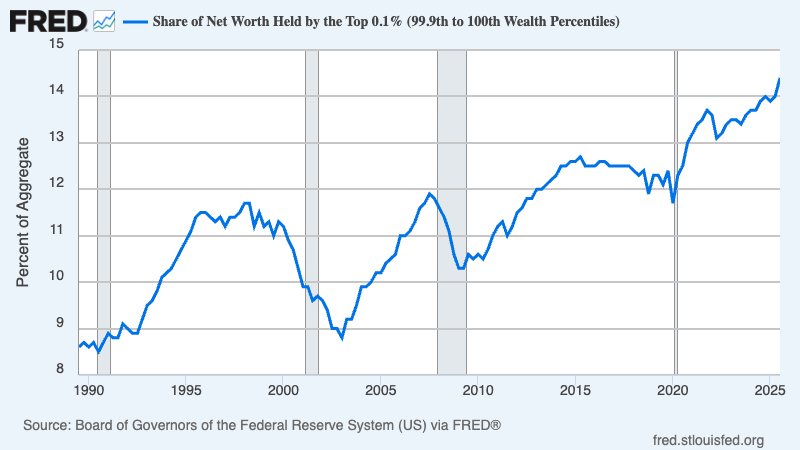
The growth in wealth concentration is even more extreme if we look at the very, very top. Gabriel Zucman, one of the world’s leading experts on wealth and income inequality, argues that the concentration of wealth is now much higher than it was at the peak of the Gilded Age: https://gzucman.substack.com/p/standing-up-to-trumps-imperial-blackmai
l
Tellingly, unlike the robber barons of yore, many modern plutocrats show little sense of gratitude for their good fortune, little inclination to give back to society by devoting a significant part of their wealth to good works. Forbes reports that Elon Musk and Peter Thiel have devoted almost none of their wealth to philanthropy, while Mark Zuckerberg and Jeff Bezos are only slightly better.
More important than the stinginess of the superrich, however, is the fact that their wealth has brought great political power, arguably more than the robber barons ever possessed — power that they abuse on an epic scale.
Thanks to the Roberts Supreme Court’s “Citizens United” ruling, plutocrats are able to pump vast amounts of money into elections. Here’s a recent headline from the New York Times:
BILLIONAIRE BOOM
The Scale of Billionaires’ Campaign Donations is Overwhelming U.S. Politics
Billionaires made 19 percent of all reported federal campaign contributions in 2024, a Times analysis shows, and even more in some local elections. Wealthy donors are reaping the rewards.
One example of many: Peter Thiel bankrolled J.D. Vance’s Ohio Senate campaign, burying his Democratic populist rival under a flood of PAC money. Without Thiel’s big bucks, J.D. Vance would not now be a heartbeat away from the presidency.
And Elon Musk actually controlled a significant part of U.S. government operations in 2025 — control that he used, among other things, to eviscerate foreign aid. Those aid cuts have already led to hundreds of thousands of preventable deaths, mostly children, with millions more deaths likely to come. https://www.impactcounter.com/dashboard?view=table&sort=interval_m
inutes&order=asc
The big political question going forward is whether there will be a significant backlash against the concentration of wealth and power in the hands of a small number of mean-spirited men.
I believe that there will be such a backlash, indeed that it is already starting, and that there is a political opening for some genuine populism if politicians have the courage to take a stand.
Polling suggests that an overwhelming majority of Americans — roughly speaking, almost everyone except MAGA Republicans — now consider the gap between rich and poor a major problem:
https://substackcdn.com/image/fetch/$s_!zMYd!,w_1456,c_limit,f_auto,q_
auto:good,fl_progressive:steep/https%3A%2F%2Fsubstack-post-media.s3.amazonaws.com%2Fpublic%2Fimage
NOTIFY: Y | REPLY | REPLY WITH QUOTE | PERMALINK | TOP | HOME

The only problem with that story is that you've had plenty of opportunity to reverse it, but it always gets worse when you guys run the show too.
Go fuck yourself, Paul.
Nobody trusts the likes of you either.
--------------------------------------------------
Be Nice. Don't be a dick. 
NOTIFY: Y | REPLY | REPLY WITH QUOTE | PERMALINK | TOP | HOME
Quote:6ix, you are completely fucked up in the head. What is wrong with you and run-of-the-mill Trumptards, and especially Trump, has been pondered by philosophers for decades. 6ix, you won't read it, but I did. Now I know how philosophically fucked up you are.
Originally posted by 6ixStringJack:
The only problem with that story is that you've had plenty of opportunity to reverse it, but it always gets worse when you guys run the show too.
Go fuck yourself, Paul.
Nobody trusts the likes of you either.
--------------------------------------------------
Be Evil. Be a dick.
Oh Well: On Nihilism
Posted on Tuesday, May 19, 2026 5:00AM by Marie Snyder
https://3quarksdaily.com/3quarksdaily/2026/05/oh-well-on-nihilism.html
“When asked about a ‘major cyberattack’ from China, the president shrugged with indifference. ‘It is what it is.’ … Three days earlier, the president described China’s support for Iran as just ‘one of those things’” —Steve Brown
A year after coming out with Nihilism and Technology, Nolen Gertz wrote just plain Nihilism (2019), an “examination of the meaning of meaninglessness: why it matters that nothing matters.” It’s a really short book, but it took a while to wade through it all. Here it all is even more briefly assembled to highlight the salient points.
Download for free from https://annas-archive.gl/search?q=Nolen+Gertz+Nihilism or https://z-lib.fm/s/Nolen%20Gertz%20Nihilism
We typically think of nihilism as very simply meaning, “we believe in nothing” (4), but he takes us through Western philosophy to get to a view that, “Nihilism is about evading reality rather than confronting it, about believing in other worlds rather than accepting this one, and about trying to make ourselves feel powerful rather than admitting our own weaknesses” (73).
THE HISTORY OF NIHILISM
Gertz explains the trajectory along lines similar to the move from pre-modernism to meta-modernism. We once trusted God, then flipped that trust on to science; then we questioned the possibility of knowing anything at all, and now we’re just starting to recognize the need for a few core Truths. Gertz goes back further to Socrates’ provocation to question everything: “From a Socratic perspective, nihilism can be overcome by enlightenment. From a Cartesian perspective, nihilism can be overcome by self-restraint. But from a Humean perspective, nihilism cannot be overcome. It is simply a product of human psychology” (28).
Then he gets to Kant who shifts us from the idea that we can’t know things to the idea that our values are contrary to genuine freedom. Freedom means obeying the self, and, since our desires aren’t within our control (we discover our tastes rather than choose them), our desires aren’t within our freedom but are “forced upon us.” So, true freedom (and morality) can only be understood as obedience to reason.
Then Nietzsche argued that there isn’t one universal morality, but “the end result of a war between rival moralities” (41), and the morality of the Christian church was against life itself. We’ve been conditioned to renounce strength in favour of group safety, but “repressing an instinct is not the same as removing that instinct . . . Since it was ‘immoral’ to be cruel to others, members of society could only maintain their morality by redirecting their cruelty at themselves. This self-cruelty is what became known as ‘guilt’” (46).
What’s all this got to do with nihilism? Suffering through life under the false hope of a better life in the great beyond means that we’ve been imprisoned by “a good and perfect God, a God who created this prison even though its only purpose seems to be to test whether the prisoners can get released for good behaviour” (51). If God is responsible for everything, then we’re responsible for nothing, and our existence has no meaning. And we also have science to take the blame for it all: “science is not the enemy of religion, but is instead a new religion. … The priests of science elevated scientific values like ‘objecti
NOTIFY: Y | REPLY | REPLY WITH QUOTE | PERMALINK | TOP | HOME