

A thread for Democrats Only
POSTED BY: THGRRI
UPDATED: Sunday, September 6, 2026 15:36
VIEWED: 755368
PAGE 706 of 725

Inequality, Part IV: Oligarchs
The rise of mega-fortunes
By Paul Krugman / Jun 22, 2025 at 5:33 AM
https://paulkrugman.substack.com/p/inequality-part-iv-oligarchs
Share of the top 0.01% in total wealth, from the GC Wealth Project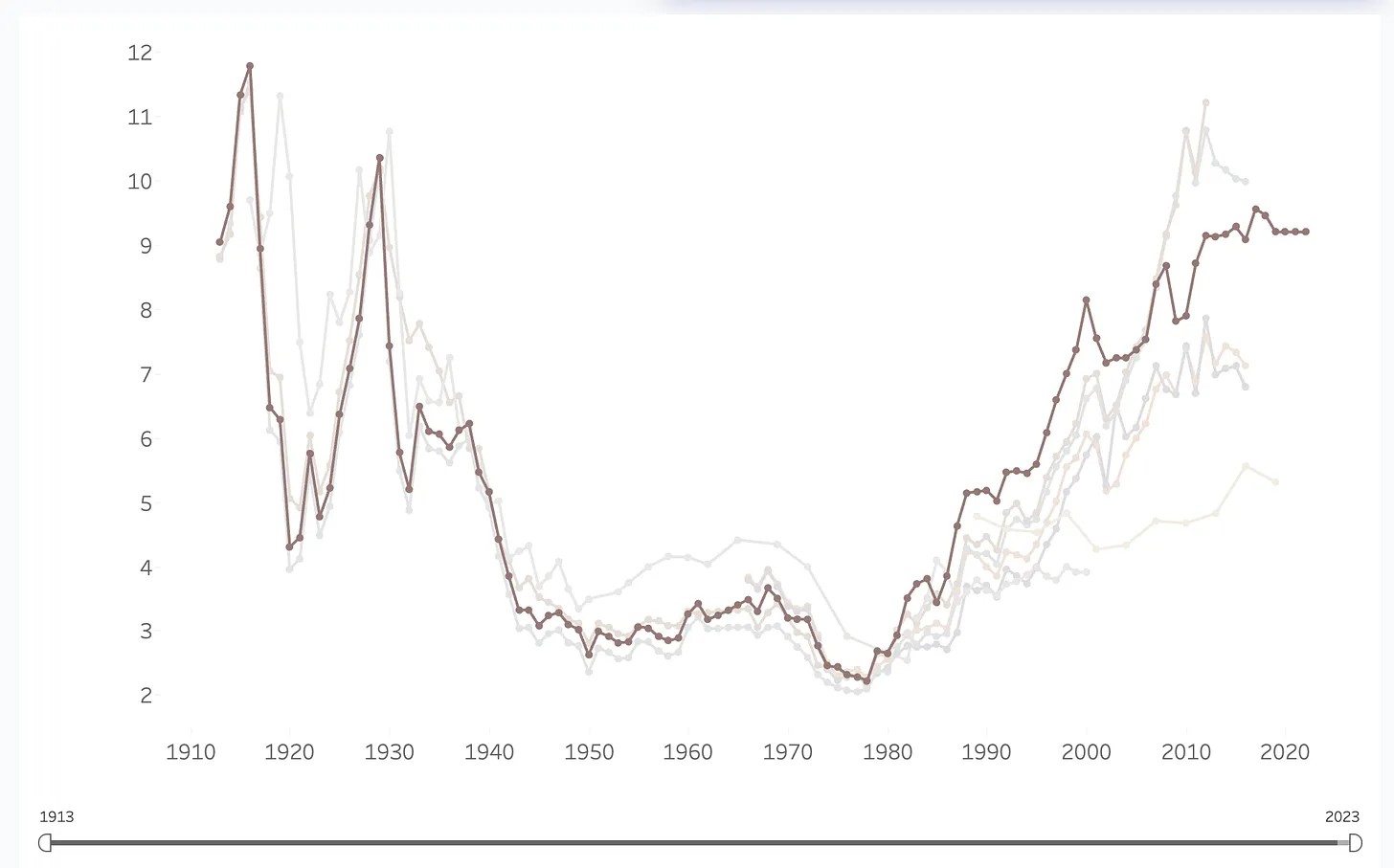
https://wealthproject.gc.cuny.edu/wealth-inequality-trends/inequality-
trends/#countryview
Who said this?
Quote:No, it wasn’t Bernie Sanders or Alexandria Ocasio-Cortez. It’s a quote from The New Freedom, Woodrow Wilson’s campaign platform in the 1912 presidential election.
If there are men in this country big enough to own the government of the United States, they are going to own it; what we have to determine now is whether we are big enough, whether we are men enough, whether we are free enough, to take possession again of the government which is our own.
Wilson was a vile racist, even for his time, and his reputation has suffered appropriately. But he was also a progressive on economic policy. And I’ve always been struck by the fact that in the early 20th century a politician could declare that great concentrations of wealth were a threat to democracy without being considered a radical, un-American Marxist. Wilson won that election!
Politicians, even progressives, are far more timid these days. Yet we are once again living in an era in which there are men big enough to own the U.S. government — and to a large extent they do. For a while Elon Musk exerted more power over the operations of the U.S. government than any cabinet member or elected official short of Donald Trump himself. Musk is currently on the outs, but the Trump administration is stuffed full of billionaires and people who take their marching orders from billionaires. Congress appears to be about to enact legislation, the One Big Beautiful Bill Act, that billionaires love even though the broader public hates all its main provisions.
How did we get here?
This is my latest entry in a series of primers on inequality; here are Part I, Part II, and Part III. Today my focus will be on extreme wealth concentration — the rise of an American oligarchy. Beyond the paywall I will address the following:
1. Tracking the rise of extreme wealth
2. How did our modern oligarchs get so rich?
I’ll eventually want to talk about the political and social consequences of extreme wealth concentration, and how it undermines democracy. But that will have to wait for later posts.
The Joss Whedon script for Serenity, where Wash lives, is Serenity-190pages.pdf at https://www.mediafire.com/two
NOTIFY: Y | REPLY | REPLY WITH QUOTE | PERMALINK | TOP | HOME

Looks like your garbage towelhead socialist Democrat won the NYC mayor primary.
NYC's only chance at saving itself now is if Adams wins as an independent, or the people of the city finally wake up and vote for the Republican.
Otherwise NYC is dead forever.
Good job, Democrats. You'll get what you deserve.
--------------------------------------------------
"I don't find this stuff amusing anymore." ~Paul Simon
NOTIFY: Y | REPLY | REPLY WITH QUOTE | PERMALINK | TOP | HOME
The American polity is cracked, and might collapse. Canada must prepare
The U.S. is becoming increasingly ungovernable, and some experts believe it could descend into civil war. What should Canada do then?
By Thomas Homer-Dixon
Published December 31, 2021
Updated January 2, 2022
This article was published more than 3 years ago. Some information may no longer be current.
https://www.theglobeandmail.com/opinion/article-the-american-polity-is
-cracked-and-might-collapse-canada-must-prepare/
Thomas Homer-Dixon is executive director of the Cascade Institute at Royal Roads University. His latest book is Commanding Hope: The Power We Have to Renew a World in Peril.
By 2025, American democracy could collapse, causing extreme domestic political instability, including widespread civil violence. By 2030, if not sooner, the country could be governed by a right-wing dictatorship.
We mustn’t dismiss these possibilities just because they seem ludicrous or too horrible to imagine. In 2014, the suggestion that Donald Trump would become president would also have struck nearly everyone as absurd. But today we live in a world where the absurd regularly becomes real and the horrible commonplace.
Leading American academics are now actively addressing the prospect of a fatal weakening of U.S. democracy.
This past November, more than 150 professors of politics, government, political economy and international relations appealed to Congress to pass the Freedom to Vote Act, which would protect the integrity of US elections but is now stalled in the Senate. This is a moment of “great peril and risk,” they wrote. “Time is ticking away, and midnight is approaching.”
I’m a scholar of violent conflict. For more than 40 years, I’ve studied and published on the causes of war, social breakdown, revolution, ethnic violence and genocide, and for nearly two decades I led a centre on peace and conflict studies at the University of Toronto.
Today, as I watch the unfolding crisis in the United States, I see a political and social landscape flashing with warning signals.
I’m not surprised by what’s happening there – not at all. During my graduate work in the United States in the 1980s, I sometimes listened to Rush Limbaugh, the right-wing radio talk show host and later television personality. I remarked to friends at the time that, with each broadcast, it was if Mr. Limbaugh were wedging the sharp end of a chisel into a faint crack in the moral authority of U.S. political institutions, and then slamming the other end of that chisel with a hammer.
In the decades since, week after week, year after year, Mr. Limbaugh and his fellow travellers have hammered away – their blows’ power lately amplified through social media and outlets such as Fox News and Newsmax. The cracks have steadily widened, ramified, connected and propagated deeply into America’s once-esteemed institutions, profoundly compromising their structural integrity. The country is becoming increasingly ungovernable, and some experts believe it could descend into civil war.
How should Canada prepare?
In 2020, president Donald Trump awarded Mr. Limbaugh the Presidential Medal of Freedom. The act signalled that Mr. Limbaugh’s brand of bullying, populist white ethnocentrism – a rancid blend of aggrieved attacks on liberal elites, racist dog-whistling, bragging about American exceptionalism and appeals to authoritarian leadership – had become an integral part of mainstream political ideology in the U.S.
But one can’t blame only Mr. Limbaugh, who died in early 2021, and his ilk for America’s dysfunction. These people and their actions are as much symptoms of that dysfunction as its root causes, and those causes are many. Some can be traced to the country’s founding – to an abiding distrust in government baked into the country’s political culture during the Revolution, to slavery, to the political compromise of the Electoral College that slavery spawned, to the overrepresentation of rural voting power in the Senate, and to the failure of Reconstruction after t
NOTIFY: Y | REPLY | REPLY WITH QUOTE | PERMALINK | TOP | HOME
The Psychology of Trump Voters
They're not following Trump because of what he does. They're following him because of how he makes them feel. Understanding it is the first step in breaking the spell.
By Jayne jayneconverse3 | June 27, 2025
https://www.tiktok.com/@jayneconverse3/video/7520454365123972365 (5 minutes: 36-second long video which is worth checking out)
I’ve been dying to dig into this. I’ve been asking myself why Trump’s followers can’t see reality. So I did my research, and I’m going to share it with you.
Let’s talk about the psychology behind the Trump Cult, because that’s what it is. It’s not a normal political movement anymore, it’s a cult of personality and if we want to fight it, we have to understand it. So, let’s break it down.
First, Trump doesn’t offer policies, he offers identity. He’s not popular because of what he does, but because of what he represents. To many of his followers, he’s a walking, talking middle finger to a system they believe has failed them.¹
They see him as “their guy,” not because he’s honest, not because he helps them, but because he talks like them, rages like them, and punches the people they’ve been told to blame for everything.²
In psychology, there’s a term for this: “Identity fusion.” It’s when your personal identity becomes fused with your group or leader. That’s why criticism of Trump feels like a personal attack to his supporters. It’s not just “he’s being criticized,” it’s “I’m being criticized.”
Second, he offers revenge, not solutions. He doesn’t promise to fix healthcare, or raise wages, or protect your rights; he promises to go after “them.” Whether it’s immigrants, the press, Black activists, LGBTQ people, liberals, college students, elites, anyone outside the tribe… that’s classic authoritarianism.
Give people a sense of loss, tell them who stole it, then promise to make them pay. And to some people, that rage, that promise of vengeance is more emotionally satisfying than actual policy. It doesn’t fix their problems, but it feels like power.
Third: People crave order, and Trump promises strength. When institutions fail, when you don’t trust the media, the courts, elections, schools³, you start to look for a savior: Someone who says, “Only I can fix it.” That’s why Trump acts like a strong man. He creates the crisis, then sells himself as the only one tough enough to stop it. He’s done that over and over and over again. He’s not leading a movement, he’s leading a dependency.
Fourth: His followers are trapped in an information bubble. They don’t just believe lies, they live inside them. Fox News, MAGA influencers, far-right churches, Trump’s own app Truth Social is a closed-loop ecosystem that tells them every day, “The elites hate you, the media lies, only Trump tells the truth.” 4 This is called “epistemic closure.” It’s cult logic. If Trump says it, it’s true. If the world says otherwise, the world is lying.
And then fifth: Shame is too powerful, so they double down, just like Trump does. Some Trump supporters know deep down that they’ve been conned. They’ve seen the cruelty, the corruption, the chaos, but they’ve already invested years of their identity into defending him.5 To walk away now would mean confronting shame, losing their community, admitting they were wrong, and that’s terrifying to them, so instead they dig in deeper.
And finally, and this one matters, Trump makes them feel seen. He tells them, “They’re not after me, they’re after you. I’m just in the way.” That line is emotional manipulation, but it works… because for millions of people who feel ignored, dismissed, mocked by elites, Trump says, “You matter. You’re not crazy, they are.” He gives them belonging, and in a country where loneliness is rising and inequality is everywhere, belonging is everything.
So when people ask, “Why do people love him? Why would they follow him off a cliff?” it’s not just politics, it’s psychology, it’s identity, and it’s fear. This is deliberate. Trump di
NOTIFY: Y | REPLY | REPLY WITH QUOTE | PERMALINK | TOP | HOME
Why Do So Many People Think That Trump Is Good?
The work of the moral philosopher Alasdair MacIntyre helps illuminate some central questions of our time.
By David Brooks | July 8, 2025, 6 AM ET
https://www.theatlantic.com/ideas/archive/2025/07/trump-administration
-supporters-good/683441/
There’s a question that’s been bugging me for nearly a decade. How is it that half of America looks at Donald Trump and doesn’t find him morally repellent? He lies, cheats, steals, betrays, and behaves cruelly and corruptly, and more than 70 million Americans find him, at the very least, morally acceptable. Some even see him as heroic, admirable, and wonderful. What has brought us to this state of moral numbness?
I’m going to tell you a story that represents my best explanation for how America has fallen into this depressing condition. It’s a story that draws heavily on the thinking of Alasdair MacIntyre, the great moral philosopher, who died in May at age 94. It’s a story that tries to explain how Western culture evolved to the point where millions of us—and not just Republicans and Trump supporters—have been left unable to make basic moral judgments.
The story begins a long time ago. Go back to some ancient city—say, Athens in the age of Aristotle. In that city, the question “How do you define the purpose of your life?” would make no sense. Finding your life’s purpose was not an individual choice. Rather, people grew up within a dense network of family, tribe, city, and nation. They inherited from these entities a variety of duties, responsibilities, and obligations. They also inherited a social role, serving the people around them as soldiers, farmers, merchants, mothers, teachers.
Each of these social roles came with certain standards of excellence, a code to determine what they ought to do. There was an excellent way of being a warrior, a mother, a friend. In this moral system, a person sought to live up to those standards not only for the honor and money it might bring them, but because they wanted to measure up. A teacher would not let a student bribe his way to a higher grade, because that would betray the intrinsic qualities of excellence inherent in being a teacher.
Read: The Trump voters who like what they see
https://www.theatlantic.com/politics/archive/2025/04/satisfied-trump-v
oters/682645/
By being excellent at my role, I contribute to the city that formed me. By serving the intrinsic standards of my practice, I gradually rise from being the mediocre person I am toward becoming the excellent person I could be. My life is given meaning within this lifelong journey toward excellence and full human flourishing. If I do this journey well, I have a sense of identity, self-respect, and purpose. I know what I was put on this Earth to do, and there is great comfort and fulfillment in that.
If all of this sounds abstract, let me give you a modern example. At his 2005 induction into the Baseball Hall of Fame, the former Chicago Cub Ryne Sandberg described his devotion to the craft of baseball: “I was in awe every time I walked onto the field. That’s respect. I was taught you never, ever disrespect your opponents or your teammates or your organization or your manager and never, ever your uniform. You make a great play, act like you’ve done it before; get a big hit, look for the third-base coach and get ready to run the bases.”
Sandberg gestured to the Hall of Fame inductees seated around him. “These guys sitting up here did not pave the way for the rest of us so that players could swing for the fences every time up and forget how to move a runner over to third. It’s disrespectful to them, to you, and to the game of baseball we all played growing up.” He continued: “I didn’t play the game right because I saw a reward at the end of the tunnel. I played it right because that’s what you’re supposed to do—play it right and with respect.”
Sandberg’s speech exemplifies this older moral code, with its inherited traditions of excellence. It conferred a moral template to evaluate the people around us and a
NOTIFY: Y | REPLY | REPLY WITH QUOTE | PERMALINK | TOP | HOME
The Contradiction at the Heart of All Conflict
By Daniel Shotkin| Sunday, Jul 13, 2025 5:30AM
https://3quarksdaily.com/3quarksdaily/2025/07/the-contradiction-at-the
-heart-of-all-conflict.html
Conflict follows us everywhere. Terrible drivers, horrible friends, evil politicians—the list goes on and on. For me, most conflicts never really made much sense. I avoid clashing with people as much as possible. It feels self-righteous, almost cringey, to be in a state of dispute. Ironic, because my favorite club in high school was debate. Still, I know people who, far from avoiding conflict, thrive in argument. So why do we conflict?
On a basic level, almost every human can agree on a core set of moral principles. Thou shalt not kill, thou shalt not steal, do unto others as you would have them do unto you. These are fundamental truths present in every culture. The three Abrahamic faiths, Hinduism, and Confucianism all espouse that last point independently. Even cultural practices that are, to us, morally questionable (think human sacrifice, headhunting) can’t be chalked up to evil intentions. Can you really blame the Aztecs for wanting to appease Quetzalcoatl?
At the end of the day, you’d be hard-pressed to find anyone who acts without explicit good intentions. Look at a morally deplorable historical figure, and you’ll see that even they acted with “good” in mind. Regimes don’t declare war, restrict speech, or commit genocide for evil’s sake; they do so in the name of national security. Similarly, ask any two beefing high schoolers, and you’ll see that neither did anything, and even if they did, it wasn’t on purpose—and actually, it was the other one who wanted to start shit.
So, logically, we’re in agreement. Then why do we still conflict?
Personal conflicts have been the focus of countless psychologists. John Dollard coined the frustration-aggression hypothesis in 1939, focusing on frustration as a root cause of conflict. Leon Festinger proposed that conflict occurs when people’s actions misalign with their beliefs. Finally, social psychologist Albert Bandura believed that children learn aggressive behavior from parents, media, and their environment—his social learning theory. A common thread among these explanations is a focus on a specific trait—frustration, dissonance, learning—as the cause of conflict.
On a broader level, sociologists have tried to explain conflict through a focus on societal traits. Critical theory proposes that conflict arises through power structures and imbalances. Its contentious namesake, critical race theory, focuses on race as a source of division. Extend sociology to broader political ideologies, and Marxists will tell you all conflict is class conflict, while Fascists argue it’s racial or national.
Global conflicts are tougher to pinpoint, mainly because of the countless factors involved. Realist international theorists argue that conflict is rooted in the rational actions of self-interested states. All international conflict is, therefore, the result of overlapping security interests. Liberal theorists posit a global international order based on rules, statutes, and conventions. Conflict comes when states fail to participate in the rules-based order.
All these theories focus on traits at various levels of conflict, but there’s a broader way to unify them. If you’ve ever talked to someone who radically disagrees with you, you understand that conflict is more than just a difference in opinion, cognitive traits, or social circumstance—it’s a clash of realities.
A perfect example of this, in my experience, comes when discussing current events at my high school. The war in Ukraine is a central talking point in the news, and so it’s come up more than once in discussions with friends. As someone who speaks Russian at home, has friends and family in Russia, and has visited more than once, I’m inevitably asked about my thoughts on the war. Of course, I’m no supporter of Putin—I am against the war in every way. Then comes the follow-up: Do they support the war in Russia? I’
NOTIFY: Y | REPLY | REPLY WITH QUOTE | PERMALINK | TOP | HOME
Lasching Out - The Ideas Letter
By Soli Özel | July 10, 2025 | The Ideas Letter 44
https://www.theideasletter.org/essay/lasching-out/
(Christopher Lasch leading a student Seminar at the University of Buffalo in the 1980s. Photo courtesy of the University of Buffalo)
“Everything in Trumpworld happens twice,” the Irish journalist Fintan O’Toole wrote recently—“the first time as performance and the second as reality.” He was commenting on the deployment of the U.S. National Guard and U.S. Marines in Los Angeles against protesters challenging President Donald Trump’s immigration policies. If Trump’s victory in 2016 was performance, the aftermath of his 2024 victory is reality. And that reality, now manifest daily, is one that most liberals, leftists, or middle-of-the-roaders had not fully anticipated, despite warnings.
Among the most prescient, consistent, and insistent critics to warn the United States of its own frailties was the historian Christopher Lasch.
Some observers were blinded by their belief in the rootedness and resilience of the country’s institutions, its liberal political tradition, and the irreversibility of progress. Others failed to fully appreciate how money would corrode the American political system and would so deepen cultural-cum-class polarization. But beginning several decades ago, Lasch identified the growing divide between the educated managerial elites and the bulk of the lesser educated public.
Writing of “an enlightened elite (as it thinks of itself),” he argued that it “seeks not so much to impose its values on the majority (a majority perceived as incorrigibly racist, sexist, provincial, and xenophobic), much less to persuade the majority by means of rational public debate, as to create parallel or ‘alternative’ institutions in which it will no longer be necessary to confront the unenlightened at all.” American democracy would deteriorate based on “the routine acceptance of professionals as a class apart.”
Lasch was erudite. He was engaged in intellectual conversation with different disciplines, theories, and approaches worldwide, including the Frankfurt School, which inspired his texts from the late 1970s and 1980s. His major works present an archeology of social and political upheavals today: He identified long ago the roots of the current crisis of liberalism in the United States. After arguing that neither socialism nor fascism represented the future, Lasch asserted that “the danger to democracy comes less from totalitarian or collectivist movements abroad than from the erosion of its psychological, cultural, and spiritual foundations from within.”
Lasch’s last book, The Revolt of the Elites and the Betrayal of Democracy, was published posthumously, in 1995; he had rushed it into print as he was fighting cancer. In that work, along with what is arguably his most famous book, The Culture of Narcissism: American Life in an Age of Diminishing Expectations (1979), and his most substantive one, The True and Only Heaven: Progress and Its Critics (1991), he identified, with alarm, the corrosive influence of markets and bureaucratization on individualism and responsible citizenship. He also tracked the economic and cultural trends that turned citizens into consumers and created an environment in which “indifference, not the fear of deeply divisive disagreements, underlies the public’s refusal to get excited about politics.” And, for Lasch, “this indifference betrays the erosion of the capacity to take any interest in anything outside the self.”
To read Lasch, therefore, is in part to read the history of the transformation of capitalism, class, and cultural conflict in America over the last few decades—the rise of a mainly white, middle-age, and middle-class rebellion with patriarchal leanings—well before all those issues crystallized over wokeness and the inequalities caused by globalization.
Writing The Revolt of the Elites in the heyday of the West’s triumphalism after the end of the Cold War, Lasch questioned its self-congratulatory tone over t
NOTIFY: Y | REPLY | REPLY WITH QUOTE | PERMALINK | TOP | HOME
More walls of text that nobody will read from failed "intellectuals" who got too high off of their own farts...
*yawn*
--------------------------------------------------
"I don't find this stuff amusing anymore." ~Paul Simon
NOTIFY: Y | REPLY | REPLY WITH QUOTE | PERMALINK | TOP | HOME
Quote:
Originally posted by second:
The American polity is cracked, and might collapse. Canada must prepare
The U.S. is becoming increasingly ungovernable, and some experts believe it could descend into civil war. What should Canada do then?
By Thomas Homer-Dixon
Published December 31, 2021
Updated January 2, 2022
This article was published more than 3 years ago. Some information may no longer be current.
We're a lot more governable than we were 3 years ago.
We're kicking out millions who don't belong here and people are going to prison for breaking the law again. And the world gets to see how you Leftoids burning everything down are insane. AND the NGO money that was funding all of these inorganic protests is basically gone, so that won't be happening much if at all anymore either.
This article came from long ago, years before the end of the shithole world from 6 months ago that you're still stuck in.
--------------------------------------------------
"I don't find this stuff amusing anymore." ~Paul Simon
NOTIFY: Y | REPLY | REPLY WITH QUOTE | PERMALINK | TOP | HOME
Quote:Trump is failing to deport millions. His promise will eventually be that despite only deporting a million in the first 3 and a half years, he'll deport the next 10,000,000 in his final 6 months:
Originally posted by 6ixStringJack:
We're a lot more governable than we were 3 years ago.
We're kicking out millions who don't belong here and people are going to prison for breaking the law again. And the world gets to see how you Leftoids burning everything down are insane. AND the NGO money that was funding all of these inorganic protests is basically gone, so that won't be happening much if at all anymore either.
This article came from long ago, years before the end of the shithole world from 6 months ago that you're still stuck in.
The discrepancy between arrests and deportations highlights the challenges the Trump administration faces to make good on Trump’s Inauguration Day vow to deport “millions and millions” of immigrants.
According to ICE data, its agents arrested roughly 30,000 immigrants last month, the most since monthly data was made publicly available in November 2020. But the number of immigrants deported in June — more than 18,000 — amounted to roughly half the number of arrests, according to internal figures obtained by NBC News.
The difference between arrests and deportations was similar the previous month. The Trump administration took roughly 24,000 immigrants into custody in May and deported over 15,000, according to the ICE data.
https://www.nbcnews.com/politics/immigration/trumps-immigration-record
-far-high-arrests-low-deportations-rcna217752
The Joss Whedon script for Serenity, where Wash lives, is Serenity-190pages.pdf at https://www.mediafire.com/two
NOTIFY: Y | REPLY | REPLY WITH QUOTE | PERMALINK | TOP | HOME