

A thread for Democrats Only
POSTED BY: THGRRI
UPDATED: Sunday, September 6, 2026 15:36
VIEWED: 755368
PAGE 703 of 725

An Autopsy Report on Biden’s In-Office Decline
“Five people were running the country,” a political insider told the authors of the new book Original Sin. “And Joe Biden was at best a senior member of the board.”
By Tyler Austin Harper | May 16, 2025, 6 AM ET
https://www.theatlantic.com/books/archive/2025/05/biden-original-sin-d
ecline/682818/
Halfway through King Lear, storm clouds gather, and Shakespeare’s protagonist rages, “You see me here, you gods, a poor old man, / As full of grief as age; wretched in both.” And so, the mental unraveling of one of literature’s greatest characters begins. That Lear starts to lose his mind in this moment, in Act II, is important: If he were mad from the jump, the cause of his eventual downfall would be medical, not moral, and the king would bear no responsibility for the catastrophe that greets his kingdom. Precisely because the aging ruler is of sound mind in Act I, during which he sets into motion the events that threaten his sanity and his life, the blame is his to bear in Act V, when he has lost both.
Last year, the United States went through a presidential election filled with Shakespearean echoes. As Joe Biden tottered and fell (literally as well as metaphorically), more than a few pundits compared him to Lear, a man who was ruined by age, pride, and the flattery of sycophants. That analogy is picked up by Original Sin, the latest and most significant book to date about Biden’s cognitive decline, which was written by CNN’s Jake Tapper and Axios’s Alex Thompson and draws on hundreds of interviews. It features an epigraph from Lear, and its first chapter gives airing to the view that, like Lear, Biden bears responsibility for his country’s fate. Quoting a senior adviser to Kamala Harris’s presidential campaign, the title of that chapter is simply: “He Totally Fucked Us.”
Tapper and Thompson’s exposé joins a growing list of post-election appraisals blaming Biden for Harris’s loss. (I wrote one of these myself.) Yet the curious thing about the experience of reading Original Sin is that one comes away unable to lay the blame, or the majority of it anyway, at the feet of Scranton Joe. Here, the Lear analogy falls apart.
Original Sin suggests that, unlike Lear, who begins his rule flawed but with his mind intact, Biden may have been losing his grip before he took his oath of office. If this is true, Americans unwittingly voted for and were then led by a president who was not up to the job, a state of affairs that certain among the Biden faithful seemed committed to concealing. Tapper and Thompson studiously avoid saying this outright; to their credit, they do little editorializing. The book is written not unlike an autopsy report, describing a gruesome political car crash in dispassionate, clinical detail. The American people, however, must confront the possibility that the book raises: that we may not have had a president capable of discharging the office since Barack Obama left the White House, in 2017.
One might debate whether the former president can be held fully responsible for his disastrous reelection bid given his seemingly shaky mental acuity (which he continues to deny, saying that reports of his decline in office are “wrong”; Original Sin does not include his responses to any of the book’s allegations). Biden’s claims that he would have won a rematch with Donald Trump—which he reiterated in an appearance on The View last week—suggest that he is not fully tethered to political reality. But Original Sin leaves little doubt that his enablers, at least, understood what they were doing. (Former first lady Jill Biden denies this as well. She said on The View that her husband was “a great president”; though she did not mention Original Sin by name, she said, “The people who wrote those books were not in the White House with us.”)
In an author’s note, Tapper and Thompson offer a forewarning: “Readers who are convinced that Joe Biden was little more than a husk from the very beginning of his presidency, barely capable of stringing two sentences toge
NOTIFY: Y | REPLY | REPLY WITH QUOTE | PERMALINK | TOP | HOME
Deindustrialization: Causes and Consequences
It’s not mostly about globalization, and it’s not what ails workers
By Paul Krugman | May 18, 2025
https://paulkrugman.substack.com/p/deindustrialization-causes-and-cons
equences
A few months before the 1992 election, I, along with some other Democratic-leaning economists, flew to Little Rock to meet with Governor and presidential candidate Bill Clinton. The ostensible purpose was to discuss policy, but it was obviously also an audition for a job in the administration. At one point, Clinton asked what could be done to restore manufacturing to its previous share of employment.
Heads turned to me; this was clearly my department. I said something like this: “Sorry, governor, but that’s really not feasible. Even if we could eliminate the trade deficit, manufacturing employment would only rise modestly and would still be a much smaller share of the economy than in the past.”
Needless to say, I didn’t get a job. It was one of the best things that has ever happened to me.
The inconvenient fact is that economy changes over time, and so do the industries in which people work. A century and a half ago, despite the growth of manufacturing, America was still largely a nation of farmers. Today, hardly any of us work on the land: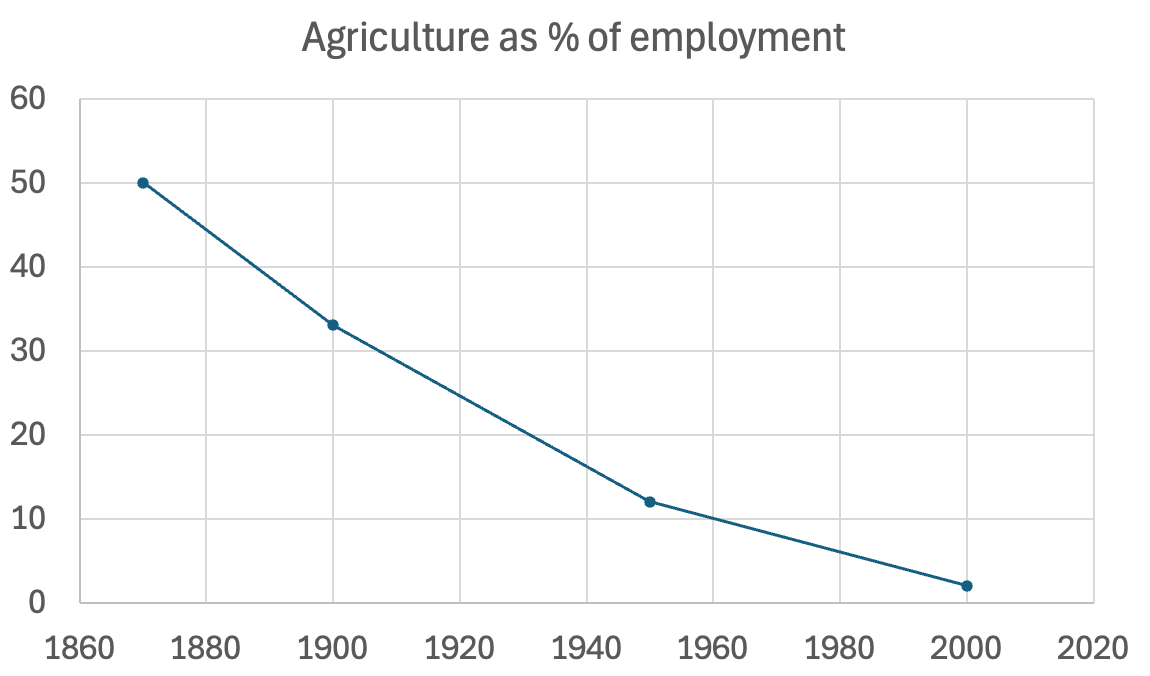
Source: Census, BLS
Oh, and many, possibly a majority of farm workers are foreign-born, and many of them undocumented.
Although some politicians still portray rural areas and small towns as the “real America,” you don’t hear a lot of nostalgia for the days when agriculture dominated American employment. (If you ask me, Queens, New York comes a lot closer to being who we are now.)
There is, however, a lot of nostalgia for the 1950s and 1960s, when more than a quarter of U.S. workers were employed in manufacturing. Income inequality was much lower in that era, so much so that many blue-collar workers considered themselves middle-class. And there’s a widespread narrative that (a) attributes those good times for American workers to the availability of well-paid jobs in manufacturing (b) attributes the relative decline of American manufacturing to overseas outsourcing and trade deficits.
But is this narrative right? Yes, it’s a simple, compelling story. But as I tried to explain to Clinton all those years ago, the math behind the story doesn’t work. To preview the conclusions: Even if we could somehow eliminate our trade deficit (which Trump’s tariffs won’t do, but that’s another story), America would not reindustrialize. — our manufacturing sector would be slightly bigger, but nothing like what it used to be in the 1950s and 1960s. And any wage gains for ordinary workers would be trivial at best.
I should say that some people who have bought into the deindustrialization-through-globalization story get annoyed if you point out that it’s mostly wrong. They seem to believe that pointing out the weakness of the deindustrialization story means that you don’t care about American workers. So let me be clear: I do care, a lot, about the fate of American workers. But as I’ll explain later, trying to recreate the economy of the 1950s won’t help them.
This post will, by the way, be a somewhat wonky exercise. But it’s important to understand that policies based on misplaced nostalgia (especially those being wielded so disastrously by Donald Trump) will hurt workers, not help them.
Beyond the paywall I’ll discuss:
1. The limited (not zero) role of international trade in deindustrialization
2. The limited (again not zero) role of deindustrialization in depressing wages
3. What would actually help restore the middle-class society I grew up in
The Joss Whedon script for Serenity, where Wash lives, is Serenity-190pages.pdf at https://www.mediafire.com/two
NOTIFY: Y | REPLY | REPLY WITH QUOTE | PERMALINK | TOP | HOME
The Talented Mr. Vance
J. D. Vance could have brought the country’s conflicting strands together. Instead, he took a divisive path to the peak of power.
By George Packer | May 19, 2025, 6 AM ET
https://www.theatlantic.com/magazine/archive/2025/07/jd-vance-reinvent
ion-power/682828/
J. D. Vance poses a problem, and at its core is a question about character. In the years after the 2016 election, he transformed himself from a center-right memoirist and public speaker, offering a complex analysis of America’s social ills and a sharp critique of Donald Trump, into a right-wing populist politician whose illiberal ideas and vitriolic rhetoric frequently out-Trump the original. According to Vance and his supporters, this change followed a realization during Trump’s first term that the president was lifting up the fallen working class of the heartland that had produced young J.D. To help his people, Vance had to make his peace with their champion. According to his critics, Vance cynically chose to betray his true values in order to take the only path open to an ambitious Republican in the Trump era, and as a convert under suspicion, he pursued it with a vengeance. In one account, a poor boy from the provinces makes good in the metropole, turns against his glittering benefactors, and goes home to fight for his people. In the other, the poor boy seizes every opportunity on his way up, loses his moral compass, and is ruined by his own ambition.
Both versions suggest the protagonist of a 19th-century novel—Pip in Dickens’s Great Expectations, Lucien in Balzac’s Lost Illusions. A novelist who set out to narrate the decline of the American empire in the 21st century might invent a protagonist like J. D. Vance. He turns up in all the key places, embodying every important theme. He’s the product of an insular subculture (the Scots-Irish of Appalachian Kentucky) and grows up amid the ills (poverty, addiction, family collapse) of a dying Ohio steel town ravaged by deindustrialization. He escapes into the Marine Corps in time for the Iraq War, and then into the dubious embrace of the cognitive meritocracy (Yale Law School, West Coast venture capital, East Coast media). At a turning point in his life and the country’s—in 2016, with the surprise success of Hillbilly Elegy and then the surprise victory of Trump—Vance becomes a celebrity, the anointed spokesman for the 40 percent of the country that comprises the white working class, which has sudden political power and cultural interest. He’s tasked with explaining the world he came from to the world he recently joined.
With his gifts of intellect and rhetoric, Vance might have brought the country’s conflicting strands together. They had combined to make him, and he knew them deeply—their flaws, their possibilities, their entwined fate. Instead, he took a path of extreme divisiveness to the peak of power, becoming a hard-line convert to the Catholic Church, post-liberal populism, and the scorched-earth cause of Donald Trump. Vance became a scourge of the elites among whom he’d found refuge, a kingpin of a new elite, avenging wrongs done to his native tribe.
At every step the reader wonders: Is our hero motivated by conviction, or is he the creature of a corrupt society? Does he deserve our admiration, our sympathy, or our contempt?
Still only 40, Vance is likelier than anyone to be the next president. (The biggest obstacle, for several reasons, is Trump himself.) His rise has been so dramatic and self-dramatized that he calls to mind those emblematic figures from history who seem both out of a storybook and all too human, such as Shoeless Joe Jackson and Huey Long. In the end, the question of Vance’s character—whether his about-face was “authentic”—is probably unanswerable. Few people are capable of conscious, persistent self-betrayal. A change that begins in opportunism can become more passionate than a lifelong belief, especially when it’s rewarded. Ventriloquize long enough and your voice alters; the mask becomes your face.
What’s more important than Va
NOTIFY: Y | REPLY | REPLY WITH QUOTE | PERMALINK | TOP | HOME

Quote:
Originally posted by second:
An Autopsy Report on Biden’s In-Office Decline
What decline, you stupid fuck?
I have 4 years worth of posts out of you telling me that Joe Biden* was fine.
--------------------------------------------------
"I don't find this stuff amusing anymore." ~Paul Simon
NOTIFY: Y | REPLY | REPLY WITH QUOTE | PERMALINK | TOP | HOME
The Coming Democratic Civil War
By Jonathan Chait | May 25, 2025, 9 AM ET
A seemingly wonky debate about the “abundance agenda” is really about power.
What has drawn many Americans to Trump is his claim that the system is so broken that, as he promised, “I alone can fix it.” The last time they held power, Democrats did little to rebut that claim. Now they must decide if they will abandon their legalistic commitment to fragmentary proceduralism or allow Trump’s boast to be vindicated.
https://www.theatlantic.com/ideas/archive/2025/05/abundance-democrats-
political-power/682929/
A civil war has broken out among the Democratic wonks. The casus belli is a new set of ideas known as the abundance agenda. Its supporters herald it as the key to prosperity for the American people and to enduring power for the liberal coalition. Its critics decry it as a scheme to infiltrate the Democratic Party by “corporate-aligned interests”; “a gambit by center-right think tank & its libertarian donors”; “an anti-government manifesto for the MAGA Right”; and the historical and moral equivalent of the “Rockefellers and Carnegies grinding workers into dust.”
The factional disputes that tear apart the left tend to involve wrenching, dramatic issues where the human stakes are clear: Gaza, policing, immigration. And so it is more than a little odd that progressive activists, columnists, and academics are now ripping one another to shreds over such seemingly arcane and technical matters as zoning rules, permitting, and the Paperwork Reduction Act.
The intensity of the argument suggests that the participants are debating not merely the mechanical details of policy, but the very nature and purpose of the Democratic Party. And in fact, if you look closely beneath the squabbling, that is exactly what they are fighting over.
The abundance agenda is a collection of policy reforms designed to make it easier to build housing and infrastructure and for government bureaucracy to work. Despite its cheerful name and earnest intention to find win-win solutions, the abundance agenda contains a radical critique of the past half century of American government. On top of that—and this is what has set off clanging alarms on the left—it is a direct attack on the constellation of activist organizations, often called “the groups,” that control progressive politics and have significant influence over the Democratic Party.
Quote:In recent years, the party’s internal divides have been defined almost entirely in relation to the issue positions taken by the groups. The most progressive Democrats have been the ones who advocated the groups’ positions most forcefully; moderate Democrats have been defined more by their relative lack of enthusiasm for the groups’ agenda than by any causes of their own. The Democratic Party’s flavors have been “progressive” and “progressive lite.” The abundance agenda promises to supply moderate Democrats with a positive identity, rather than merely a negative one.
What initiated this Civil War? A book by Ezra Klein and Derek Thompson – Abundance – Simon & Schuster (2025)
Download a free copy from the mirrors at https://libgen.rs/search.php?req=Ezra+Klein+Abundance
That dynamic has only raised the stakes of the abundance agenda within the party. Its ideas are ambitious enough, but its political implications have set off a schismatic conflict not just over a collection of proposals and the Democratic Party’s direction—but over who should have the standing to direct it.
After percolating for years among policy wonks, the abundance agenda—a term coined by my colleague Derek Thompson in a 2022 essay—ascended suddenly in response to the deflating failure of the Biden administration’s policy program.
“We have to prove democracy still works,” Joe Biden said in his first speech to Congress. “That our government still works—and can deliver for the people.” That summer, after the Senate had approved a trillion-dollar infrastructure bill, Biden declared the mission accomplished. “Today,” he announ
NOTIFY: Y | REPLY | REPLY WITH QUOTE | PERMALINK | TOP | HOME
Been watching Ezra Klein recently.
He sounds more MAGA every time a camera is put in front of him.
--------------------------------------------------
"I don't find this stuff amusing anymore." ~Paul Simon
NOTIFY: Y | REPLY | REPLY WITH QUOTE | PERMALINK | TOP | HOME
An article about Trump, Trumptards and the Republican Party without mentioning those proper nouns.
5 ‘Argument Tactics’ That Narcissists Rely On — By A Psychologist
By Mark Travers | May 31, 2025, 04:15pm EDT
Mark Travers writes about the world of psychology.
https://www.forbes.com/sites/traversmark/2025/05/31/5-argument-tactics
-that-narcissists-rely-on---by-a-psychologist/
To strip the power from an emotional abuser, you must recognize their argument tactics for what they are: logical fallacies.
Narcissists tend to vastly overestimate the accuracy of their own beliefs. They become defensive, or even combative, when confronted with viewpoints that don’t align with their own. As a 2023 study published in Frontiers in Psychology explains, this is due to the fact that narcissists often exhibit very low levels of intellectual humility.
As a result, they rely heavily on manipulative argument tactics that serve to protect their inflated self-image. At face value, these tactics might seem clever, or maybe even intellectually sound. In reality, however, these tactics focus more on control than they do logic.
A 2024 study in published in Memory & Cognition also notes that individuals prone to such poor argument tactics are highly likely to accept and perpetuate information that confirms their existing beliefs.
Narcissists exploit this cognitive bias to others’ wits end: they frame their arguments to align with their victims’ fears or insecurities, or in ways that defend their warped self-image.
As such, they’re adept at spinning webs of flawed reasoning that feel convincing — but, under any actual scrutiny, they fall right apart. In other words, many of their go-to argument tactics are riddled with errors that are designed to deflect blame and derail conversations. In turn, they keep themselves in a position of control.
Here are five logical fallacies narcissists often rely on, and why they keep them in their repertoire.
1. Ad Hominem
The ad hominem fallacy occurs when someone chooses to attack the person making an argument instead of addressing the actual argument itself. They refuse to engage with the issue that was brought up, and instead discredit the speaker by focusing on their personal traits, emotions or past behavior. As a result, they shut down the discussion in its entirety.
For instance, say you confront a narcissist about their manipulative behavior. With an ad hominem attack, they might respond with, “You’re just insecure and bitter, that’s why you’re making such a big deal out of this.”
Rather than addressing your very real concerns, they attack you instead. As a result, your criticisms are rendered “irrational” in their eyes.
Narcissists heavily rely on ad hominem attacks, largely due to the fact that they will avoid engaging with facts that threaten their self-image at all costs. By turning the discussion into a critique of the accuser rather than their own actions, they change the course of the conversation. They make the victim feel self-conscious about raising concerns, which ensures the narcissist remains in control.
2. False Dichotomy
The false dichotomy fallacy arises once someone presents two extreme options as the only possible choices; they ignore the existence of middle-ground or nuance. This type of reasoning serves to force the victim (and the conversation as a whole) into a total gridlock. In turn, they prevent the possibility of any thoughtful discussions ensuing.
For instance, if you critique something that a narcissist says or does, they might respond in black-or-white statements like, “Either you agree with me, or you’re against me.” They equate any disagreement whatsoever with outright hostility.
But, in reality, relationships cannot function without compromise. Nor can discussions be productive without acknowledging the existence of both parties’ perspectives. Regardless, the narcissist limits the conversation to two opposing sides, which takes reasonable discourse out of the question entirely.
Narcissists favor false dichotom
NOTIFY: Y | REPLY | REPLY WITH QUOTE | PERMALINK | TOP | HOME
Shut up, faggot.
--------------------------------------------------
"I don't find this stuff amusing anymore." ~Paul Simon
NOTIFY: Y | REPLY | REPLY WITH QUOTE | PERMALINK | TOP | HOME
Hating New York
Paul Krugman / Jun 2, 2025 at 5:33 AM
https://paulkrugman.substack.com/p/hating-new-york
MAGA and MAGA-adjacent types are very good at finding things and people to hate. They hate immigrants (unless they’re white South Africans), LGBTQ people and wokeness. They hate universities and are doing their best to destroy American science. The New York Times reports that they hate Europe. And they very much hate New York City.
OK, I’m not impartial on this issue. I grew up on Long Island and still think of NYC proper as “the city.” I live in Manhattan now, and my experience is that if you can afford housing — which is admittedly a huge problem — it’s actually a very good life, with an incredible range of things to do either in walking distance or a short subway ride away. Not everyone wants to live this way, but nobody is saying they should. All we ask is that some Americans be allowed to have favorable views of a place that provides the advantages density and, yes, diversity can offer.
But that, of course, is exactly what the U.S. right refuses to accept. New York is one of the safest places in America, yet much of the country insists on seeing it as a terrifying urban hellscape. Sean Duffy, the transportation secretary, insists that everyone is afraid to ride the subway:
If you want people to take the train, to take transit, then make it safe, make it clean, make it beautiful, make it wonderful, don’t make it a shithole.
Indeed, the subway is such an intolerable shithole that more than 4 million people ride it every day, myself among them. To be honest, the subway isn’t beautiful by any stretch of the imagination, and you can’t take it without coming into close contact with people who don’t look like you. But it’s quite safe — more on that in a minute — and it works very well at getting people quickly across the heart of a densely populated city.
As an aside, it’s remarkable that federal officials — who are supposed to work for all of us — feel free to trash-talk major American cities, as long as the cities in question vote Democratic.
But anyway, Duffy is an idiot, so I found it more interesting when Scott Bessent, the treasury secretary, who reputedly isn’t an idiot, declared that “We want the U.S. to be more like Florida and less like New York.” I guess that he gets some points for trash-talking the whole state, not just the big city. But still.
What was he going on about? Well, Florida spends considerably less money on government programs and hence manages without an income tax. “And I can tell you having lived in both, it’s better not to have an income tax, and Florida gives better services.”
So is Florida clearly a better place than New York? Let’s look at some numbers: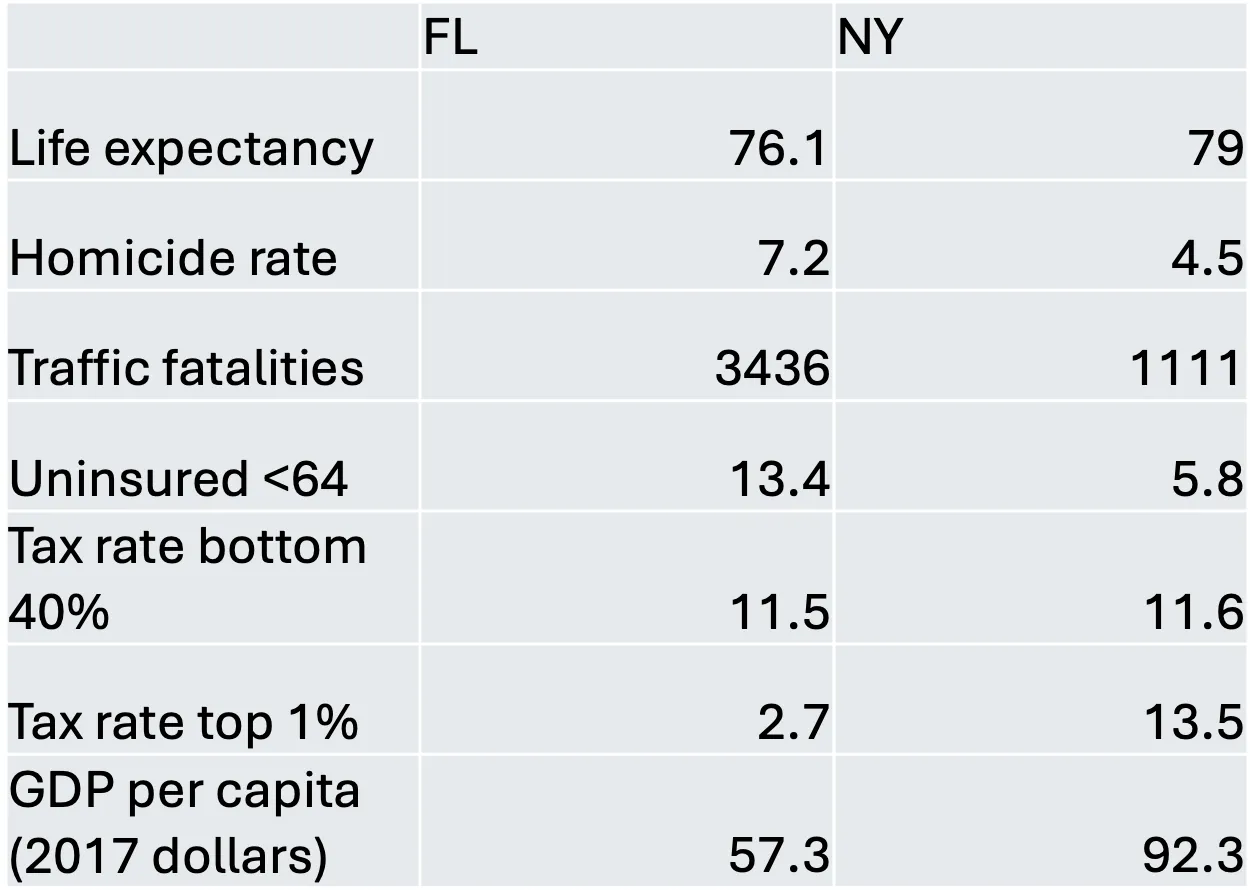
Sources: Centers for Disease Control, KFF, Bureau of Economic Analysis, Institute for Taxation and Economic Policy
Start at the top. In my opinion, one important aspect of the quality of life is not being dead, and New Yorkers on average live three years longer than Floridians. Life expectancy is even higher, 81.5 years, in New York City.
Why do New Yorkers live longer? One answer is that city life — which involves a lot more walking than suburban life — is generally good for you.
Another is that New Yorkers are considerably less likely than Floridians to be murdered. In my experience many Americans simply refuse to believe that New York in 2025 isn’t what it was in 1975, that it’s actually a low-crime city. But it is.
And New Yorkers are much less likely than most Americans to die in traffic accidents. Why? In the city and surrounding areas, one main answer has to be that so many people take public transit rather than driving.
Which brings us to the whole issue of subway safety. Last year was unusually bad, with ten people murdered on the subway. Some of the murders were grueso
NOTIFY: Y | REPLY | REPLY WITH QUOTE | PERMALINK | TOP | HOME
Shut up, faggot.
--------------------------------------------------
"I don't find this stuff amusing anymore." ~Paul Simon
NOTIFY: Y | REPLY | REPLY WITH QUOTE | PERMALINK | TOP | HOME