

A thread for Democrats Only
POSTED BY: THGRRI
UPDATED: Sunday, September 6, 2026 15:36
VIEWED: 755368
PAGE 699 of 725

Quote:
Originally posted by second:Quote:There was no video connecting Nixon to Watergate or anything at all, and yet he resigned and 40 people who worked for Nixon went to jail. There was no video of any of their crimes. It was circumstantial evidence, the evidence that Trumptards fail to understand, which is doubtlessly why they are also failing in the non-political parts of life such as family, finances, health, and work.
Originally posted by 6ixStringJack:
Video or it didn't happen.
Video or it didn't happen.
--------------------------------------------------
"I don't find this stuff amusing anymore." ~Paul Simon
NOTIFY: Y | REPLY | REPLY WITH QUOTE | PERMALINK | TOP | HOME

Welcome to Weimar 2.0
Today, China, Russia, and the United States, to say nothing of the mid-level and smaller powers, are all running a strange simulation of the Weimar Republic: that weak and wobbly political organism that governed Germany for 15 years from the ashes of World War I to the ascension of Adolf Hitler.
By Robert D. Kaplan, the Robert Strausz-Hupé chair in geopolitics at the Foreign Policy Research Institute. | January 17, 2025, 3:00 PM
https://foreignpolicy.com/2025/01/17/global-crisis-geopolitics-conflic
t-technology-history-weimar-republic/
This article is adapted from Waste Land: A World in Permanent Crisis by Robert D. Kaplan (Random House, 224 pp., $31, January 2025). Download Robert D. Kaplan’s books from https://libgen.is//search.php?&req=Robert+D.+Kaplan
America’s Weimar syndrome may be obvious with the reelection of the institution-destroyer Donald Trump as president. But the entire world is one big Weimar now, connected enough for one part to mortally influence the other parts, yet not connected enough to be politically coherent. Like the various parts of the Weimar Republic, we find ourselves globally in an exceedingly fragile phase of technological and political transition.
I see no Hitler in our midst, or even a totalitarian world state. But don’t assume that the next phase of history will provide any relief to the present one. It is in the spirit of caution that I raise the subject of Weimar.
Analogies can be futile, I know, since no thing is exactly like another. Yet they are often the only way to communicate and explain. While on the one hand an analogy is an imperfect distortion, on the other hand it can create a new awareness, another way to see the world. It is only through an analogy that I can begin to describe the depth of our global crisis. We have to be able to consider that literally anything can happen to us. This is the usefulness of Weimar.
What, exactly, was Weimar? The great German historian Golo Mann called Weimar a sprawling and unwieldy “empire without an emperor.” World War I—which lasted four long years, and which ordinary Germans thought originally would be a triumph—ended in defeat, 1.75 million German military deaths, and almost a half-million German civilian deaths. The country was shattered, the royal imperial governing structure had collapsed, and Germany was on the verge of social chaos. It was in that context that leading German politicians and lawyers, meeting in the Thuringian town of Weimar, devised a new constitutional arrangement that sought to avoid the autocratic tendencies of Kaiser Wilhelm II and Otto von Bismarck before him.
But the new arrangement was just too weak to withstand the pressures of what was to come. There was no night watchman to keep the peace between its constituent parts. The federal states (Länder) legislated through the Reichsrat (upper house of parliament), retaining all rights not explicitly transferred to the central government. The nation as a whole elected the head of state, or Reich president. The president then appointed the chancellor, who with his cabinet ran the government at the behest of the Reichstag, the lower house, which was elected by the people. Two-thirds of Germany was still called Prussia, and was governed under different rules than the Länder. As for Bavaria—which, like Prussia, was a state within a state—there was constant talk of separation from the Reich.
If all this seems like a far more complicated version of the U.S. Constitution with its separation of powers and 50 states, it was—and it was made more unwieldy by economic and social anarchy. There was catastrophic inflation during the early Weimar years and catastrophic depression toward the end: a result of a very difficult postwar economy, made worse by reparations demanded by the Treaty of Versailles and by world economic dislocations.
Germany during the Weimar period from 1918 to 1933 was a vast and barely united world unto itself, where the rules of order scarcely applied. It was less a government than
NOTIFY: Y | REPLY | REPLY WITH QUOTE | PERMALINK | TOP | HOME
No, Trump Can’t Make Manufacturing Great Again
We’re a service economy now — and that’s OK
By Paul Krugman | Jan 25, 2025
https://paulkrugman.substack.com/p/no-trump-cant-make-manufacturing
This post is about how Donald Trump’s policies couldn’t “make us a manufacturing nation again” even if they succeeded in greatly reducing trade deficits. They won’t, which makes it something of a moot point, but people should understand both that we are going to be a service economy no matter what, and that that’s OK: a fixation on manufacturing as the only source of good jobs is generations out of date.
In the summer of 1992 I flew to Little Rock, Arkansas for an audition. Officially, of course, that wasn’t what it was; then-governor Bill Clinton had invited a number of Democratic-leaning economists to talk about policy issues. But everyone understood that our performance would help determine whether we would be offered jobs if he won the presidential election.
At one point Clinton asked how we could get employment in U.S. manufacturing back up to historical levels as a share of total employment. Heads turned to me, since this was clearly my lane, and I answered something like this: “Well, Governor, that really isn’t possible. Even if we could eliminate our trade deficit, the manufacturing share would still be much lower than it was in the 50s and 60s.”
Needless to say, I didn’t get a job in the Clinton administration. I’ve been thankful ever since.
But I was right, and what I said then is still true. Donald Trump declared in his inaugural speech that “America will be a manufacturing nation once again.” No, it won’t. As I’ll explain shortly, Trump’s policies are actually likely to shrink manufacturing, but even if they weren’t, we aren’t going back to the days when manufacturing employed a quarter of the work force rather than its current 8 percent.
To be clear, there is a case for promoting U.S. manufacturing in sectors of strategic importance. Between Putin and Xi, the national security case for tariffs or subsidies looks stronger now than it has for generations. But such policies won’t change the fact that these days we are overwhelmingly a service economy.
And that’s OK. The popular belief that only manufacturing can offer good jobs to ordinary workers is wrong; in fact, at this point manufacturing doesn’t offer especially good jobs. We can make things better for American workers, but a fixation on manufacturing gets in the way of real solutions.
Let’s look at some numbers.
For a generation or so after World War II, America really was a manufacturing nation. Industry employed more than a quarter of the nonfarm work force: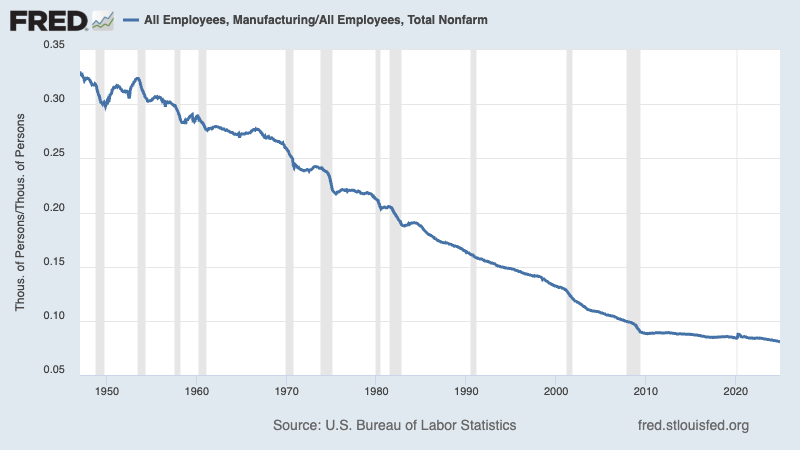
And it accounted for a comparable share of GDP: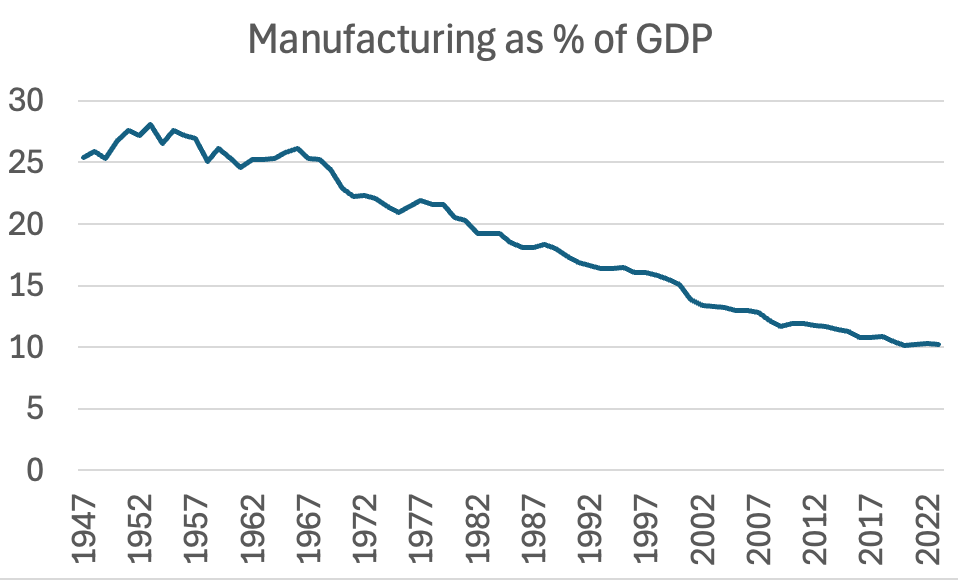
Source: BEA
But manufacturing’s relative importance has steadily declined. At this point substantially more Americans work in h
NOTIFY: Y | REPLY | REPLY WITH QUOTE | PERMALINK | TOP | HOME
A Review of Martin Wolf’s The Crisis of Democratic Capitalism
The Ungovernable Economy
“When I look at the world around us, I perceive a gigantic crisis of political legitimacy.”
By Trevor Jackson, interviewed by Irza Waraich | January 25, 2025
https://www.nybooks.com/online/2025/01/25/the-ungovernable-economy-tre
vor-jackson/
Free download at https://libgen.is//search.php?req=Martin+Wolf+The+Crisis+of+Democratic
+Capitalism
The reviewer also has a book available for free at https://libgen.is//search.php?req=Trevor+Jackson+Impunity+and+Capitali
sm
“Capitalism is predicated on atomized individuals, democracy on shared publics,” writes Trevor Jackson in the Review’s January 16 issue.
Reviewing Martin Wolf’s The Crisis of Democratic Capitalism, Jackson examines capitalist democracies past and present to find where the economic system of capitalism and the political system of democracy have aligned and where they have diverged. He is particularly interested in the history of policies designed to revitalize economies and nations after an economic crisis and charts the way these policies have privatized gains and socialized losses. But Jackson also insists that these events—both the crises and the state’s responses—must be understood as historically contingent, lest “expressions of ruthless class interest are reframed as basic truths.” Without considering the contemporaneous debates about class and conditions of economic inequality, he argues, we won’t understand how crisis continues to be the order of the day.
Jackson is an economic historian and teaches history and political economy at UC Berkeley. Though his research focuses on early modern Europe, he has taught courses on capitalism and inequality, the history of economic crises, and the history of economic thought. A regular contributor to the Review, Jackson has written about cryptocurrency, student debt, and economic bubbles. He is the author of Impunity and Capitalism, and his writing has also appeared in Dissent, The Baffler, and The Nation.
Trevor Jackson
I recently spoke with Jackson about his research interests in early modern Europe, the evolving relationship between capitalism and democracy, and different interpretations of historical analogy.
Irza Waraich: What initially drew you to research the economic history of early modern Europe?
Trevor Jackson: It was in part interest and in part accident. Accident in the sense that I once thought I’d become a development economist, and so I did a degree in what was known as the “political economy of late development” at the London School of Economics. There’s not a lot of undergraduate teaching in economic history, so this was the first time I encountered that material, and I found it fascinating.
Early modern Europe is one of the great focal points of economic history research. That’s where we tend to think capitalism, the industrial revolution, and the modern economy originated. The era has attracted a great deal of attention from economic historians over the years, and so it turned out to be an ideal place to learn the tools, techniques, ideas, concepts, and arguments of economic history writ large.
What specific parallels do you see between early modern capitalism and today?
One of the first things that comes to mind is in the eighteenth century, when the institutions of what today we would call financial capitalism were created. There was a great deal of anxiety among contemporaneous observers that the ability to create fortunes based on movable, intangible capital would allow the owners of those fortunes to remove themselves from communities of obligation. They would no longer be bound by the laws and customs of the nations where they resided or were citizens, because they could always leave and take their capital with them. That was perceived as a corrosive threat to the social order.
That conflict in turn became part of what I would call a crisis of political legitimacy for the old regime in Europe, which had governed the economy and society f
NOTIFY: Y | REPLY | REPLY WITH QUOTE | PERMALINK | TOP | HOME
MAGA's true believers don't understand capitalism — Trump will teach them a hard lesson
Today's Republicans have swallowed so many economic myths that reality has disappeared. They face a wakeup call
By Rich Logis | January 26, 2025 9:00AM (EST)
https://www.salon.com/2025/01/26/magas-true-believers-dont-understand-
capitalism--will-teach-them-a-hard-lesson/
America is a nation at war with its mythologies.
For all the electoral postmortems about the desire for economic change, what’s unsurprisingly absent is what seems, to me, an obvious omission: an all-enveloping misunderstanding of American capitalism.
I’m not dismissing the importance of anxiety about solvency, about the challenges that small businesses face (I’m a proprietor of one myself) and about the cost of future entitlements. (We’ll get to the problems of liberalism in a bit). Most of us in this country will worry about money for the duration of our lives.
One delusional mythology about American capitalism that has been instilled in We the People is that we somehow have a guaranteed right to prosperity; this imaginary right has been deployed by politicians who are afraid of educating their constituents about how our model of commerce actually works. Our national press has largely been lazy on this score as well.
With due respect to the many Americans who voted for Donald Trump, their overwhelming sense of entitlement dwarfs that of the hard-working immigrants who cut their grass, scrub pots and pans in the restaurants they frequent, and care for their kids and elderly loved ones. Too many Americans have come to believe they are owed financial comfort and material abundance, not to mention eggs and gasoline at predictable prices.
“Are you better off today than you were four years ago?” Frankly, it’s an illogical question in a capitalist nation. Some people are of course worse off, and I don’t mean to make light of that. But in fact, many millions are better off; Joe Biden’s administration oversaw the recovery of millions of jobs lost during the COVID pandemic and the creation of millions more. Some people out there will be worse off by the time they finish this article than when they commenced reading it. I’m not being flippant; that’s reality.
Welcome to capitalism, a system whose proponents always cite unequal outcomes as a reason for extolling it.
So eggs are expensive? Eat fewer of them. Cut down on egg whites. Let them eat yolks.
Are gas prices high? Is insurance for health care, real estate and vehicles increasing? Are supply chain constraints harming your livelihood, or your quality of life? The person in the White House has very little to do with that. Let’s recall that gas prices steadily increased during George W. Bush’s second term.
Gas was cheap in 2020 because — hello! — tens of millions of drivers weren’t driving. In fact, Trump threatened the Saudis, in the early days of the pandemic: Cut oil production, or lose U.S. military support. Why? More oil flooding the market would have driven prices still lower, and “cheap gas” does not sound like “ka-ching.”
Are gas prices high? Insurance going up for health care, real estate and vehicles? Are supply chain constraints harming your livelihood, or your quality of life? The person in the White House has very little to do with that.
Welcome to the “laws” of supply and demand, which all of us must navigate on a daily basis. If you don’t know or don’t remember these details, ask yourself why you don’t. If you’re a Trump voter, then ask yourself whether you might have voted differently in November had you been aware.
Meanwhile, we have endless debates about whether needs — access to medical care, food, affordable housing — should be rights, or should be left to the exigencies of good luck and near-perfect health.
Jeremiads about grocery prices are now an acceptable element of political discourse and, per GOP logic, we have a right to complain about them. Feeding the hungry, though? That edges too close to pinko communism. But the point our fe
NOTIFY: Y | REPLY | REPLY WITH QUOTE | PERMALINK | TOP | HOME
Revenge of the Black Zero
Paul Krugman / Jan 29, 2025 at 5:33 AM
https://paulkrugman.substack.com/p/revenge-of-the-black-zero
Back in 2010 — just as the disastrous push for fiscal austerity in the face of high unemployment was gaining momentum across the advanced world — my wife and I attended a conference at the Institut für Weltwirtschaft in Kiel, Germany. The keynote speaker was Wolfgang Schäuble, Angela Merkel’s finance minister, widely considered the father of the “black zero,” Germany’s commitment to balanced budgets no matter what.
Partway through the speech Robin took off the headphones carrying the simultaneous translation to focus on Schäuble’s body language. She eventually leaned over to say, “As we leave the room we’ll be given whips to scourge ourselves.”
Unlike U.S. conservatives, who rail about the evils of government debt, then pass budget-busting tax cuts which they claim will magically pay for themselves, the Germans have been serious about fiscal austerity. On the eve of the 2007 financial crisis America and Germany had similar levels of public debt as a share of GDP. Since then, however, Germany has kept debt low, while we very much haven’t: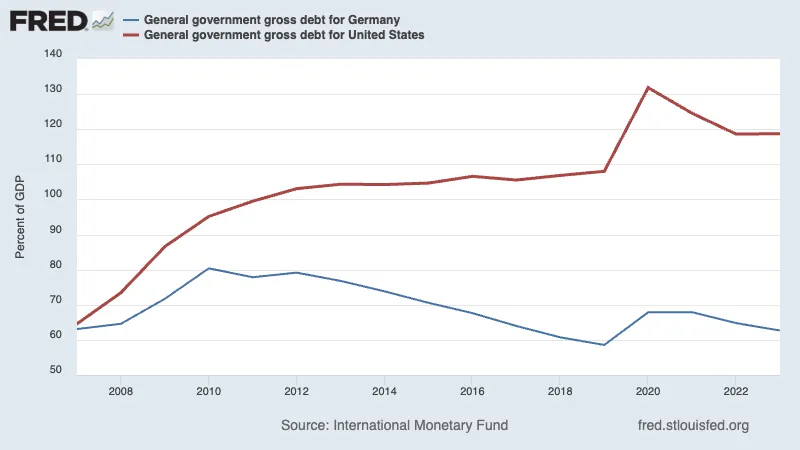
Germany has also achieved huge trade surpluses, especially in manufactured goods, that are beyond Donald Trump’s wildest dreams. America runs a trade deficit in manufactures of more than 4 percent of GDP, while Germany runs a surplus of more than 8 percent. Largely as a result, manufacturing plays a bigger role in Germany’s economy than it does in ours, although it’s still smaller than the role industry played in, say, the 1960s: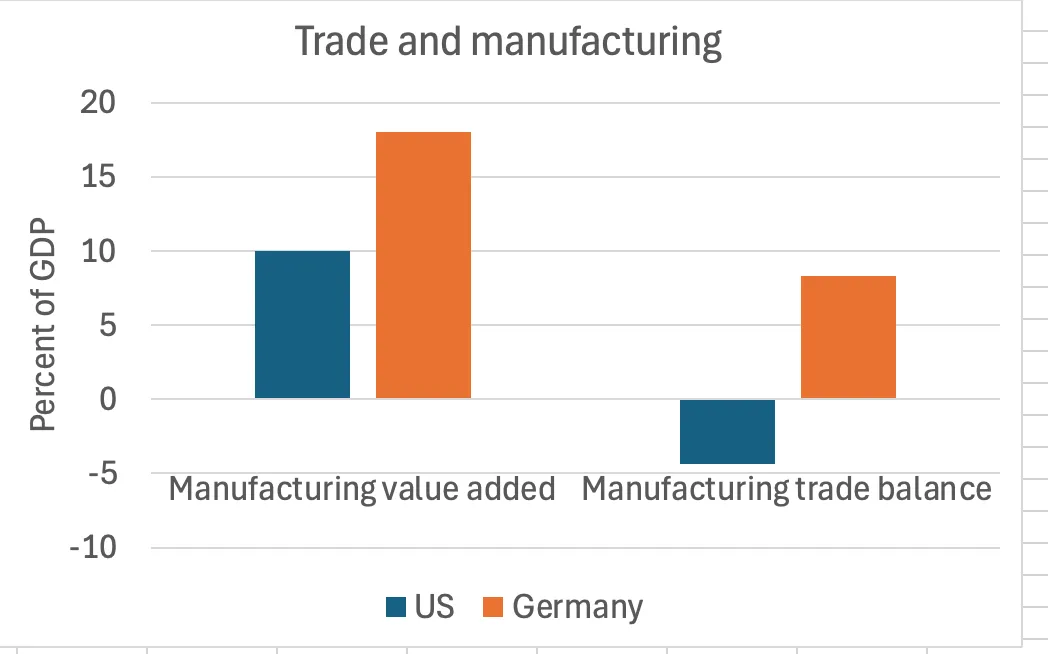
Source: World Trade Organization and World Bank
From a fiscal point of view, then, Germany looks like a model of virtue. From a Trumpian point of view it looks like a big winner in international competition. So how has the German economy been doing?
Nicht gut.
Most glaringly, Germany’s economic growth has stalled. The contrast with the United States, which boomed under Biden, is stark: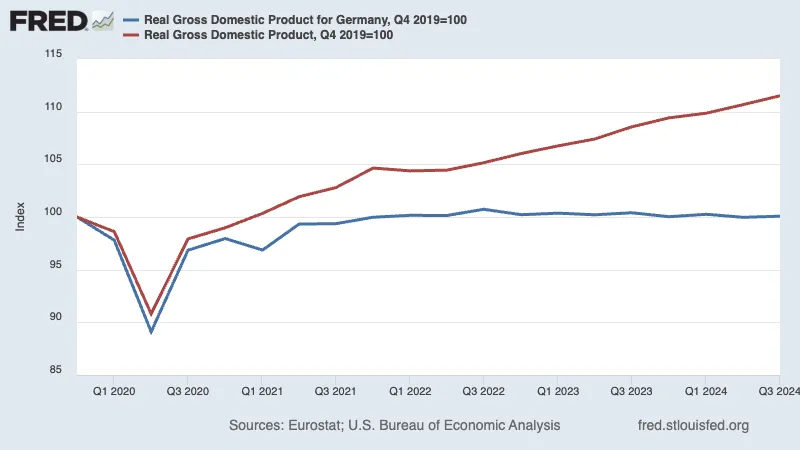
Back when we were listening — or, in Robin’s case, not listening — to Schäuble’s sermon, many policymakers had bought into the notion that fiscal austerity would actually promote growth by increasing business confidence. At the time, I derided this view as belief in the “confidence fairy.” And Tinker Bell certainly hasn’t come through for the Germans.
Incidentally, for those complaining that Biden’s spending caused inflation, it seems worth noting that German inflation since the start of Covid has been roughly the same as in the U.S.: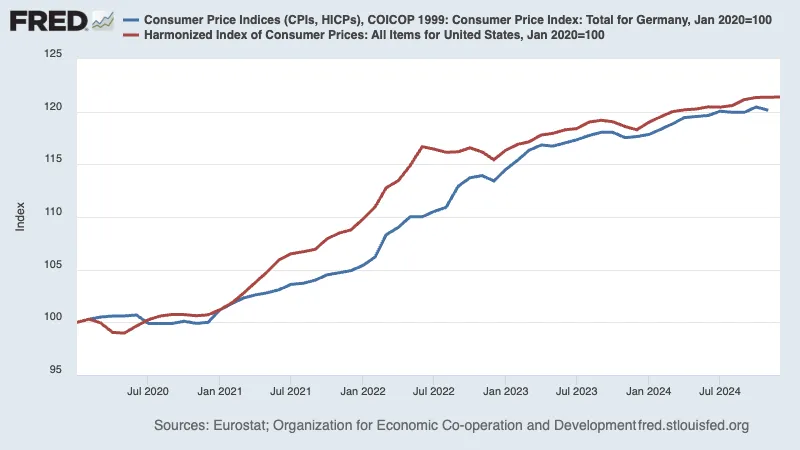
And no, that’s not because of gas prices. As the International Monetary Fund points out,
It’s certainly true that the shutoff of Russian gas in 2022 contributed to spiking inflation and cost-of-living pressures. However, the rise in gas prices has proven to be temporary. After soaring in 2022, wholesale gas prices have now fallen back to 2018 levels.
Less stark as a short-run issue but obvious if you spend time visiting Germany is that the obsession with holding debt down has led to inadequate investment in infrastructure.
NOTIFY: Y | REPLY | REPLY WITH QUOTE | PERMALINK | TOP | HOME
What to do with sincere but unpopular beliefs?
The division of labor in political change
By Matthew Yglesias / Feb 5, 2025 at 5:06 AM
https://www.slowboring.com/p/what-to-do-with-sincere-but-unpopular
My basic electoral advice for Democrats is so banal as to, at times, hardly seem worth writing down: They should get on the popular side of political issues rather than the unpopular side and try to raise the salience of their most-popular stances rather than their least-popular ones.
This was conventional wisdom in the very recent past, but it’s become controversial.
Consider gay marriage in 2008. This was a roughly 60-40 issue at the time, so Barack Obama wasn’t for it. And it wasn’t just him. All kinds of mainstream Democrats in boring safe blue seats were against it. The caucus leaders in the House and the Senate were against it. And while, of course, many liberals (myself included) thought they were wrong about this (40 percent of the population is a lot of people), nobody was angry or confused about what was going on. Everyone understood that you don’t take the 40 percent side of a 60-40 position if you want to participate in electoral politics. There were no angry anonymous staffer letters about it.
You also didn’t have today’s level of empiricism about the issue. Did Dick Durbin have to be against marriage equality to win re-election in Illinois in 2008? Obviously not. But he didn’t come out in favor until 2013 when it had become more popular. Everybody understood that, generally speaking, a political party’s mainstream leaders should avoid espousing unpopular causes. You didn’t need to prove in a laboratory experiment that it was really hurting you with swing voters; you just didn’t do it. It’s a striking contrast to the way politics is practiced today, where a view like, “Democrats shouldn’t take the losing side of a 70-30 issue about who plays on which sports team” is a controversial statement litigated in long essays and panel discussions. Among donors and operatives, it’s considered more plausible to try to win a Senate majority by running Dan Osborn-like independent candidates in states where the party brand is toxic than to try to de-toxify the brand by adopting popular positions on cultural issues.
A sticking point in this conversation, of course, is that when you have a 60-40 issue or a 70-30 issue or even an 80-20 issue, you still have lots of people with sincere beliefs (and often very strong feelings) on the unpopular side. And they don’t want to just give up, which is understandable — the outcomes of these policy debates have a real impact on people’s lives. So I think we need to revive some kind of sense that there are ways of making political progress toward progressive goals that don’t involve trying to bully politicians into adopting suicidal stances on the issues.
The division of labor
The fundamental breakdown we’ve experienced, it seems to me, is a kind of context collapse, a breakdown of the idea that different people have different jobs.
Something that I believe strongly, that I do not think the electorate particularly agrees with, is that we should provide universal cash benefits for parents of young kids.
My view of what I do in life is “persuasive writing aimed at relatively elite audiences.” So my main theory of how I can contribute to this cause is that I can try to convince progressive-minded elites that this is a better idea than competing ideas about how to spend large sums of money on helping families and try to convince conservative-minded elites that their worries about this policy are misguided. I like to talk about evidence that the negative shock to labor supply that conservatives are worried about is very small. Offsetting this, we have meaningful improvements to child well-being and some evidence of long-term benefits, including on things conservatives care about, like crime. There’s also reason to believe a more generous Child Tax Credit would increase fertility, which I’d think would appeal to conservatives.
Will my strategy on this work
NOTIFY: Y | REPLY | REPLY WITH QUOTE | PERMALINK | TOP | HOME
Murc's Law
The widespread assumption that only Democrats have any agency or causal influence over American politics.
By attacking the Democrats for not blocking a tax bill that they unanimously opposed, you revealed yourself to be a firm believer in Murc's Law.
“Murc’s Law” was named after a commenter at the blog Lawyers, Guns, and Money who noticed years ago the habitual assumption among the punditry that Republican misbehavior can only be caused by Democrats. Do Republicans reject climate science? Must be because Democrats failed to persuade them! Did Republicans pass unpopular tax cuts for the rich? Must be that Democrats didn’t do enough to guide them to better choices! Do Republicans keep voting for lunatics and fascists? It must be the fault of Democrats for being mean to them! Even D_T_’s election in 2016 was widely blamed on Democrats — who voted against him, to be clear — on the bizarre grounds that Barack Obama should have rolled over and just let Mitt Romney win in 2012.
https://imgur.com/gallery/imgur-needs-to-have-conversation-about-what-
murcs-law-is-how-to-spot-x6FB9ru
The Joss Whedon script for Serenity, where Wash lives, is Serenity-190pages.pdf at https://www.mediafire.com/two
NOTIFY: Y | REPLY | REPLY WITH QUOTE | PERMALINK | TOP | HOME
Quote:
Originally posted by second:
The widespread assumption that only Democrats have any agency or causal influence over American politics.
CORRECTION: Only Democrats had agency and influence over American politics up until the end of 2024.
Now they are being gutted.
The world you thought you were living in 6 months ago no longer exists.

--------------------------------------------------
"I don't find this stuff amusing anymore." ~Paul Simon
NOTIFY: Y | REPLY | REPLY WITH QUOTE | PERMALINK | TOP | HOME
Quote:Trumptard, if your life is fucked up, it is your fault, not the Democrats'. Your fault. All yours. But there is something to blame on Democrats:
Originally posted by 6ixStringJack:Quote:
Originally posted by second:
The widespread assumption that only Democrats have any agency or causal influence over American politics.
CORRECTION: Only Democrats had agency and influence over American politics up until the end of 2024.
Now they are being gutted.
The world you thought you were living in 6 months ago no longer exists.
How Progressives Froze the American Dream
The U.S. was once the world’s most geographically mobile society. Now we’re stuck in place—and that’s a very big problem.
By Yoni Appelbaum | February 10, 2025, 5:59 AM ET
https://www.theatlantic.com/magazine/archive/2025/03/american-geograph
ic-social-mobility/681439/
The sharp decline in geographic mobility is the single most important social change of the past half century, although other shifts have attracted far more attention. In that same span, fewer Americans have started new businesses, and fewer Americans have switched jobs—from 1985 to 2014, the share of people who became entrepreneurs fell by half. More Americans are ending up worse off than their parents—in 1970, about eight out of every 10 young adults could expect to earn more than their parents; by the turn of the century, that was true of only half of young adults. Church membership is down by about a third since 1970, as is the share of Americans who socialize several times a week. Membership in any kind of group is down by half. The birth rate keeps falling. And although half of Americans used to think most people could be trusted, today only a third think the same.
These facts by now form a depressingly familiar litany. They are often regarded as disparate phenomena of mysterious origins. But each of them can be traced, at least in part, to the loss of mobility.
In 2016, Donald Trump tapped into the anger, frustration, and alienation that these changes had produced. Among white voters who had moved more than two hours from their hometown, Hillary Clinton enjoyed a solid six-point lead in the vote that year. Those living within a two-hour drive, though, backed Trump by nine points. And those who had never left their hometown supported him by a remarkable 26 points. Eight years later, he tapped that support again to recapture the White House.
Today, America is often described as suffering from a housing crisis, but that’s not quite right. In many parts of the country, housing is cheap and abundant, but good jobs and good schools are scarce. Other areas are rich in opportunities but short on affordable homes. That holds true even within individual cities, neighborhood by neighborhood.
As a result, many Americans are stranded in communities with flat or declining prospects, and lack the practical ability to move across the tracks, the state, or the country—to choose where they want to live. Those who do move are typically heading not to the places where opportunities are abundant, but to those where housing is cheap. Only the affluent and well educated are exempt from this situation; the freedom to choose one’s city or community has become a privilege of class.
The sclerosis that afflicts the U.S.—more and more each year, each decade—is not the result of technology gone awry or a reactionary movement or any of the other culprits that are often invoked to explain our biggest national problems. The exclusion that has left so many Americans feeling trapped and hopeless traces back, instead, to the self-serving actions of a privileged group who say that inclusion, diversity, and social equality are among their highest values.
Reviving mobility offers us the best hope of restoring the American promise. But it is largely self-described progressives who stand in the way.
Find out what Democrats did wrong at https://www.theatlantic.com/magazine/archive/2025/03/
NOTIFY: Y | REPLY | REPLY WITH QUOTE | PERMALINK | TOP | HOME