

human actions, global climate change, global human solutions
POSTED BY: 1kiki
UPDATED: Sunday, September 6, 2026 19:38
VIEWED: 60750
PAGE 84 of 111

Quote:
Hidden Behind Climate Policies, Data From Nonexistent Temperature Stations
https://www.zerohedge.com/political/hidden-behind-climate-policies-dat
a-nonexistent-temperature-stations
It's both important that this be brought up, and unfair that it's presented as it is.
Measuring temperature across the globe is fraught with difficulties. One problem is that temperature sensors are unevenly distributed. Most are around cities, which create their own heat domes. You won't find any in the middle of the Brazilian rainforest, and not many in the middle of the Australian outback or at the poles. Sea surface temperature is measured by buoys, some of which are set adrift and a number of which are located to detect El Nino. Because sensors are unevenly distributed it would be unfair to take a simple average, as that would "overweight" some regions and underweight others.
Historic stations are obsoleted, not just by aging equipment but also by development. If a highrise is built where a station used to be, you can't replace it.
And unfortunately there's no satellite detector that can read surface temperatures.
The best can be done is make a good- faith effort to estimate the actual average, AND to note regional anomalies. We know, for example, that the northern Arctic and subartic region is warming far faster than anywhere else. What that ultimately does to ocean and air currents is anyone's guess, but we can already see the jet streams shifting northward, slowing down, and "looping" far further north and south than previously.
-----------
"It may be dangerous to be America's enemy, but to be America's friend is fatal." - Henry Kissinger
Why SECOND'S posts are brainless: "I clocked how much time: no more than 10 minutes per day. With cut-and-paste (Ctrl C and Ctrl V) and AI, none of this takes much time."
Or, any verification or thought.
NOTIFY: Y | REPLY | REPLY WITH QUOTE | PERMALINK | TOP | HOME

Quote:Signym, this is what rationality looks like, not another of your "eat the rich" solutions. Each one of these emission sources goes to zero:
Originally posted by SIGNYM:
Let's tackle the biggest problems and hte biggest emitteres first in a rational, sincere, and effective effort to slow down climate change, not pick on "little people" in a naked power- and money-grab by the already obscenely powerful.
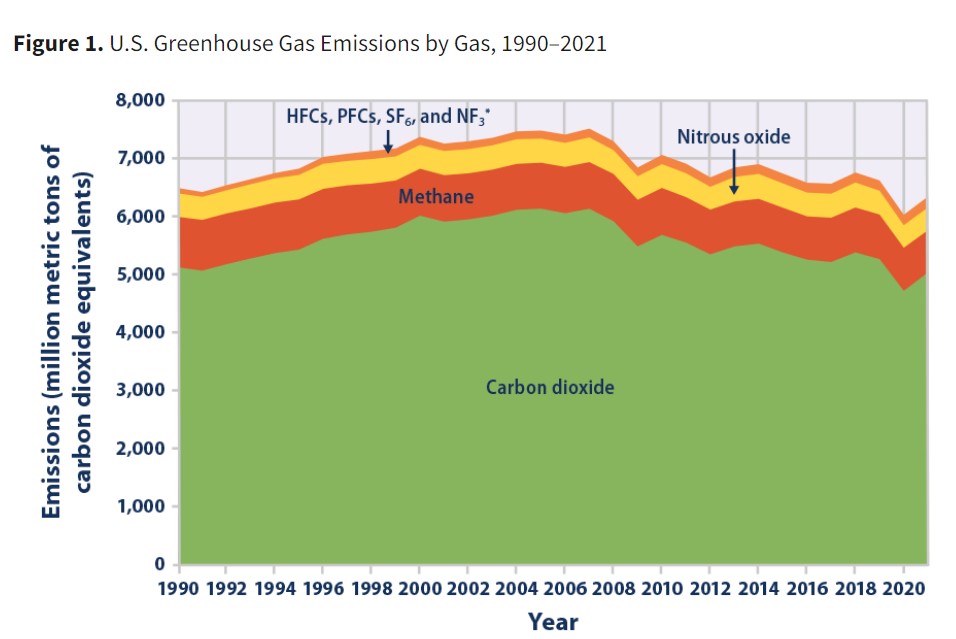
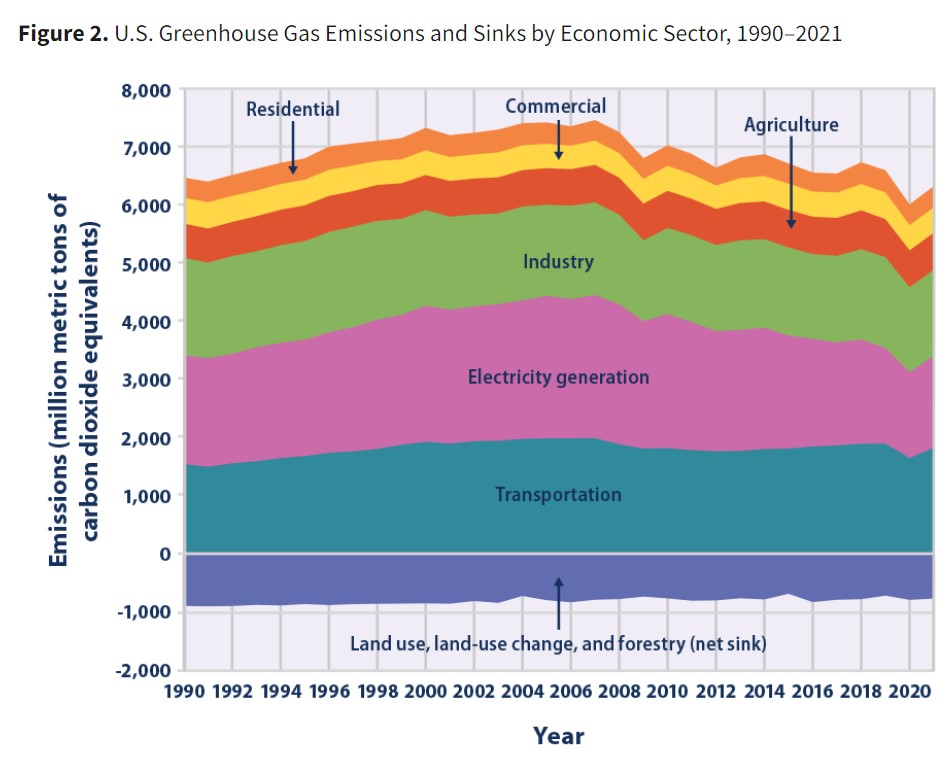
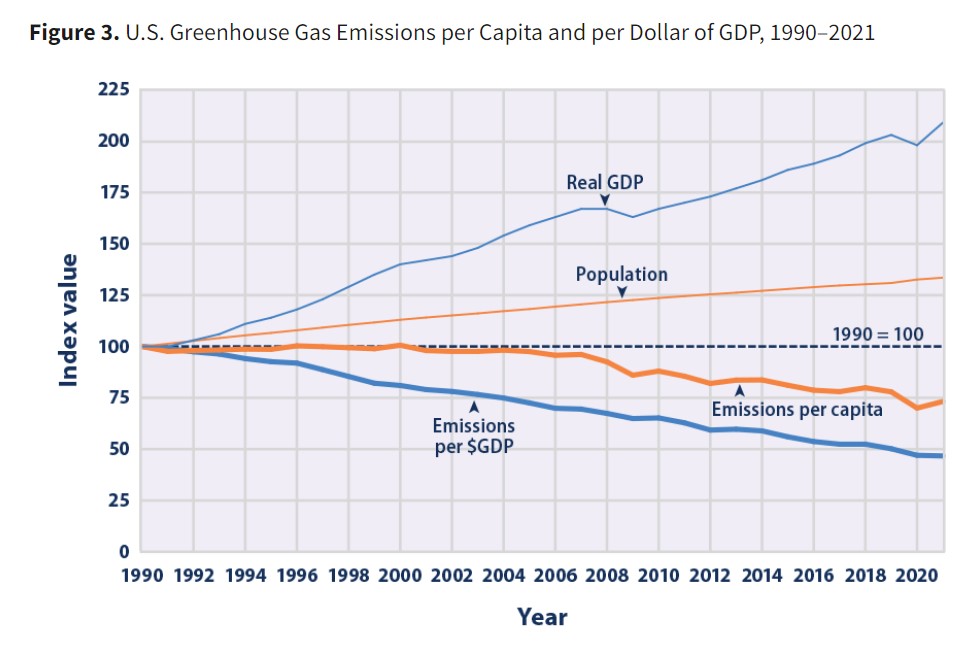
Climate Change Indicators: U.S. Green House Gas Emissions
Angry Bear | April 1, 2024 7:00 am
https://angrybearblog.com/2024/04/climate-change-indicators-u-s-green-
house-gas-emissions
The Joss Whedon script for Serenity, where Wash lives, is Serenity-190pages.pdf at
https://www.mediafire.com/folder/1uwh75oa407q8/Firefly
NOTIFY: Y | REPLY | REPLY WITH QUOTE | PERMALINK | TOP | HOME
Notice, however, that they didn't break out the sources of GHGs by institution or wealth, or mention that the USA has oursourced a lot of its manufacturing emissions to China. Forest fires didn't even get a mention. And altho "agriculture" (and ranching? Forestry?) may not be huge emitters, they have the capacity to be big sinks.
It's like "per capita GDP": if you chose your categories correctly, you can hide a multitude of sins.
One more comment: electricity generation emissions go up steadily. How do you think that'll look if EVs are mandated?
And finally ... didn't hear objections to the whole idea of depopulation when applied to the poor masses. Suddenly, it becomes an issue when it's applied to the biggest emitters, the wealthy?
That's not rationality, that's severe bias.
Just sayin'.
-----------
"It may be dangerous to be America's enemy, but to be America's friend is fatal." - Henry Kissinger
Why SECOND'S posts are brainless: "I clocked how much time: no more than 10 minutes per day. With cut-and-paste (Ctrl C and Ctrl V) and AI, none of this takes much time."
Or, any verification or thought.
NOTIFY: Y | REPLY | REPLY WITH QUOTE | PERMALINK | TOP | HOME
Quote:Signym, I am biased against stupid and lazy people like you. Meanwhile, there are Californians expending money and building a future despite the stupid and lazy people objecting to spending money fixing the problem because killing their enemies ("depopulation" is Signym's term for murder) seems to be a cost-free way around problems:
Originally posted by SIGNYM:
And finally ... didn't hear objections to the whole idea of depopulation when applied to the poor masses. Suddenly, it becomes an issue when it's applied to the biggest emitters, the wealthy?
That's not rationality, that's severe bias.
Just sayin'.
Apr 15, 2024
In a major clean energy benchmark, wind, solar, and hydro exceeded 100% of demand on California’s main grid for 30 of the past 38 days.
On April 2, the California Independent System Operator (ISO) recommended 26 new transmission projects worth $6.1 billion, with a big number being devoted to offshore wind.
California will entirely be on renewables and battery storage 24/7 by 2035.
California passed a law that commits to achieving 100% net zero electricity by 2045. Will it beat that goal by a decade?
https://electrek.co/2024/04/15/renewables-met-100-percent-california-e
nergy-demand-30-days/
The Joss Whedon script for Serenity, where Wash lives, is Serenity-190pages.pdf at
https://www.mediafire.com/folder/1uwh75oa407q8/Firefly
NOTIFY: Y | REPLY | REPLY WITH QUOTE | PERMALINK | TOP | HOME
Why Wind and Solar Won't Solve Climate Change
By Ted Nordhaus | April 21, 2024
https://foreignpolicy.com/2024/04/21/christophers-price-is-wrong-book-
review-climate-change-policy-renewable-energy-wind-solar/?tpcc=recirc_latest062921
Book Review
The Price Is Wrong: Why Capitalism Won’t Save the Planet, Brett Christophers, Verso, 432 pp., $26.07 (that’s the price on the affiliate link), March 2024
Download for free from the mirrors at https://libgen.is//search.php?req=Brett+Christophers+Price
In 2015, the British economist Nicholas Stern argued that the reason for excessive carbon emissions was not just one market failure—the familiar fact that fossil fuel prices do not include the environmental and social costs of burning them—but rather six such failures. Laid out in Why Are We Waiting? The Logic, Urgency, and Promise of Tackling Climate Change, Stern’s fusillade of market failures cut against the prevailing case for pricing carbon, long considered a silver bullet: Get the price of carbon right, the argument went, and market actors would come up with the best and most efficient solutions without the need for policymakers to pick clean-technology winners, devise complex regulatory schemes, or otherwise micromanage the transition.
To his credit, Stern’s diagnosis of multiple market failures was an acknowledgment that climate change could not be solved in such a simple, elegant fashion. But his approach also smacked of dogmatism. In neoclassical economic theory, a properly functioning market will always produce an optimal amount of desired goods at an optimal cost—and when it fails to do so, it must be because prices have been distorted for some reason. The solution, then, is to discover the distortion, get the prices right, and allow the market to deliver the optimal amount of the desired good—in this case, clean energy.
But when one needs to invoke six market failures instead of one, it is fair to ask whether the lens of market failure is really the best or most parsimonious framework for looking at the problem. Like pre-Galilean astronomers, who produced ever more complex epicycles to describe the movement of celestial objects in order to sustain their belief that the Earth sat at the center of the universe, Stern’s proliferating cosmology of market failures was necessary to keep markets at the center of climate policy.
This, more or less, is where Brett Christophers’s new book, The Price Is Wrong: Why Capitalism Won’t Save the Planet, begins. Christophers, a geographer at Sweden’s Uppsala University, argues that getting prices right, whether by making fossil fuels expensive through pricing carbon or making clean energy cheap through subsidies and technological innovation, is entirely insufficient to drive the rapid deployment of renewable energy. Much heavier-handed intervention will be necessary, Christophers argues, including government price guarantees or even public ownership of electricity generation and distribution. The book is convincing at times in its case that neoliberal schemes to deregulate electricity markets can undermine efforts to mitigate climate change. But without intending to do so, Christophers also shows why wind and solar energy alone are unlikely to get us very far in decarbonizing the global economy.
The Price Is Wrong has been hotly anticipated. The New York Times’ David Wallace-Wells previewed it in a column in January. Robinson Meyer, an Atlantic and New York Times contributor and editor of a widely read climate newsletter, described the book as “one of the most insightful and clarifying books yet written on the relationship between climate change and capitalism.”
Readers expecting an anti-capitalist polemic, however, will be disappointed. Christophers is more wonk than firebrand, immersing his audience in an often technical description of how electricity systems have evolved, how electricity markets work, and how renewable energy projects are financed and make money. At the core of his argument is what he describes as a paradox: “If renewables are now cheapes
NOTIFY: Y | REPLY | REPLY WITH QUOTE | PERMALINK | TOP | HOME
I wasn't worried about climate change. Now I am. - Sabine Hossenfelder, Jan 27, 2024
In this video I explain what climate sensitivity is and why it is important. Climate sensitivity is a number that roughly speaking tells us how fast climate change will get worse. A few years ago, after various software improvements, a bunch of climate models began having a much higher climate sensitivity than previously. Climate scientists have come up with reasons for why to ignore this. I think it's a bad idea to ignore this.
The Joss Whedon script for Serenity, where Wash lives, is Serenity-190pages.pdf at https://www.mediafire.com/two
NOTIFY: Y | REPLY | REPLY WITH QUOTE | PERMALINK | TOP | HOME
I thought Electric Cars Were the Future. I Changed My Mind to Hybrid Vehicles.
EVs will be delayed by decades because the electric grid is expanding too slowly and there will be too few public charging stations.
There are 2,128 Tesla Superchargers locations in the United States as of January 15, 2024.
https://www.scrapehero.com/location-reports/Tesla%20Superchargers-USA/
There are 196,643 retail gas station locations in United States as of Mar 13, 2024.
https://www.xmap.ai/blog/gas-stations-in-united-states-of-america-ever
ything-you-need-to-know
The Joss Whedon script for Serenity, where Wash lives, is Serenity-190pages.pdf at https://www.mediafire.com/two
NOTIFY: Y | REPLY | REPLY WITH QUOTE | PERMALINK | TOP | HOME
How EVs became so polarized
https://www.msn.com/en-us/news/politics/how-evs-became-so-polarized/ar
-BB1lTxdL
Between 2012 and 2022 about half of all EVs sold went to the top 10 percent most Democratic counties in the United States. Around a third of all EVs sold went to the top 5 percent most Democratic counties. That pattern persisted when researchers analyzed the most Democratic states. “There’s an incredible correlation with political ideology,” said Lucas Davis, a professor of business and technology at the University of California at Berkeley and the lead author on the analysis.
Democratic areas have much more than their fair share of electric cars. So why did electric cars become — and stay — so polarized?
One reason is that Republican leaders have injected electric vehicles into the culture wars. Donald Trump has railed against electric cars, calling support of them “electric car lunacy” and the push for an EV future “very, very stupid.”
Electric cars have taken off across the United States. Even amid news of slowing sales, the country sold almost 1.2 million fully electric vehicles in 2023, more than quadruple the number in 2019.
Personal cars account for 20 percent of U.S. planet-warming emissions, but more Americans still prefer gas-powered ones. If that doesn’t change, it will be almost impossible for the United States to meet its climate goals.
The Joss Whedon script for Serenity, where Wash lives, is Serenity-190pages.pdf at https://www.mediafire.com/two
NOTIFY: Y | REPLY | REPLY WITH QUOTE | PERMALINK | TOP | HOME
We asked 380 Climate Scientists About the Future - Wed 8 May 2024 05.00 EDT
In Mérida on the Yucatán peninsula, where Cerezo-Mota lives, the heat is ramping up. “Last summer, we had around 47C maximum (116.6F). The worst part is that, even at night, it’s 38C (100.4F), which is higher than your body temperature. It doesn’t give a minute of the day for your body to try to recover.”
She says record-breaking heatwaves led to many deaths in Mexico. “It’s very frustrating because many of these things could have been avoided. And it’s just silly to think: ‘Well, I don’t care if Mexico gets destroyed.’ We have seen these extreme events happening everywhere. There is not a safe place for anyone.
More at https://www.theguardian.com/environment/ng-interactive/2024/may/08/hop
eless-and-broken-why-the-worlds-top-climate-scientists-are-in-despair
The Joss Whedon script for Serenity, where Wash lives, is Serenity-190pages.pdf at https://www.mediafire.com/two
NOTIFY: Y | REPLY | REPLY WITH QUOTE | PERMALINK | TOP | HOME

Quote:
Originally posted by second:
How EVs became so polarized
https://www.msn.com/en-us/news/politics/how-evs-became-so-polarized/ar
-BB1lTxdL
Between 2012 and 2022 about half of all EVs sold went to the top 10 percent most Democratic counties in the United States. Around a third of all EVs sold went to the top 5 percent most Democratic counties. That pattern persisted when researchers analyzed the most Democratic states. “There’s an incredible correlation with political ideology,” said Lucas Davis, a professor of business and technology at the University of California at Berkeley and the lead author on the analysis.
Democratic areas have much more than their fair share of electric cars. So why did electric cars become — and stay — so polarized?
One reason is that Republican leaders have injected electric vehicles into the culture wars. Donald Trump has railed against electric cars, calling support of them “electric car lunacy” and the push for an EV future “very, very stupid.”
Electric cars have taken off across the United States. Even amid news of slowing sales, the country sold almost 1.2 million fully electric vehicles in 2023, more than quadruple the number in 2019.
Personal cars account for 20 percent of U.S. planet-warming emissions, but more Americans still prefer gas-powered ones. If that doesn’t change, it will be almost impossible for the United States to meet its climate goals.
The Joss Whedon script for Serenity, where Wash lives, is Serenity-190pages.pdf at https://www.mediafire.com/two
Because you guys are brainwashed idiots.
How's that piece of shit running? Can you even get 200 miles on a full charge anymore?
Good luck selling it on the used market, since there is zero used market for coal burning cars with $30,000 batteries.

You are a stupid, stupid person, and a fool and his money are easily parted.
--------------------------------------------------
Trump will be fine.
He will also be your next President.

NOTIFY: Y | REPLY | REPLY WITH QUOTE | PERMALINK | TOP | HOME