
Alas, poor Europe. I knew it well, Horatio.
POSTED BY: SIGNYM
UPDATED: Tuesday, August 18, 2026 23:33
VIEWED: 7239
PAGE 11 of 14

Quote:
French Gas [gasoline] Rationing Begins As Refinery Strikes Worsen After Government Calls Back Essential Workers
https://www.zerohedge.com/commodities/french-gas-rationing-begins-refi
nery-strikes-worsen-after-government-calls-back
-----------
Pity would be no more,
If we did not MAKE someone poor - William Blake
NOTIFY: Y | REPLY | REPLY WITH QUOTE | PERMALINK | TOP | HOME

One of the Most Famous Ideas in Economics Is Wrong
History shows that free trade can’t buy world peace.
By Jacob Soll 10/05/2022 04:30 AM EDT
10-13 minutes
Jacob Soll is a professor of philosophy, history and accounting at the University of Southern California. He is the author of Free Market: The History of an Idea (Basic Books).
One of the most enduring ideas in economics is that free markets bring peace between countries. It comes from the notion that commerce drives humans to follow their mutual material interests rather than make destructive war due to passions.
This was the animating force behind the U.S. granting China its “most-favored-nation” trade status in 2000, which allows for free trade and economic cooperation. Republicans and Democrats alike assured the public that the deal would bring “constructive engagement” and expose communist China to America’s “ideals” of democracy. Where are we today? Beijing has moved closer to authoritarianism, economic competition is fiercer than ever, and American and Chinese diplomatic relations are near a crisis point, with both countries brandishing threats of war. Free trade has brought some peace, but it has not brought lasting friendship between the world’s two superpowers.
The same point could be made for Russia. Germans clearly thought that free trade for Russian oil would bind Vladimir Putin’s kleptocracy to democratic Europe and lead it toward a more prosperous and open society. Instead, it weakened democratic Europe’s capacity to respond to Putin’s dictatorship and his bloody invasion of Ukraine.
Does this mean that the old idea of a “gentle commerce” of free markets, famously espoused in the French Enlightenment, is dead? Perhaps it never really existed. History shows that free markets can be a basis for friendship between powerful nations, but they are far less successful at securing peace and democracy than many have hoped. In fact, the noble talk of the free market was sometimes simply an excuse to engage in the kind of “great power” competition that too often leads to war and plunder.
The idea that trade brings peace has its origins in humanist thought, which looked to understand natural rights and trade through classical philosophy. In The Freedom of the Seas in 1609, the Dutch jurist Hugo Grotius argued that God made the air and water limitless and as such, they were the common property of humankind. This meant that “Every nation is free to travel to every other nation, and to trade with it.” But it also meant that the Spanish and Portuguese could not claim a monopoly on the seas in their empire. Meanwhile, in spite of Grotius’ theory that free passage meant peaceful passage, the Dutch used the freedom of the seas to raid the Spanish and Portuguese empires with their superior naval capacity and famous pirate ships.
The idea that free trade could bring peace also found defenders among those searching for a Christian solution for human conflict. According to the influential French jurist and religious thinker Jean Domat, trade was humankind’s punishment for Original Sin. The Garden of Eden was a place where all was provided. Once humans had fallen from grace and into the earthly realm, their punishment was labor and trade. Like Grotius, Domat thought that it was possible to discern immutable laws in nature that, once permitted to operate freely, would set in motion a dynamic market system that would rein in the mercenary tendencies of individuals. The exchange of things would bring with them contracts and “Engagements” between people that would force them to interact civilly with each other for the common good. According to Domat, a free, legally based market would wipe away “Double-dealing, Deceit, Knavery, and all other ways of doing Hurt and Wrong.”
This approach was also at the basis of Bernard of Mandeville’s Fable of the Bees (1714), by which the “private vices” of greed could turn into the “public virtues” of peace and prosperity. The French philosopher Montesquieu had a less cynical vision. In his 1748 treati
NOTIFY: Y | REPLY | REPLY WITH QUOTE | PERMALINK | TOP | HOME
Quote:
New Data Shows Immigrants Are Driving Down Wages For German Workers
https://rmx.news/germany/new-data-shows-immigrants-are-driving-down-wa
ges-for-german-workers/
Jeez. Ya think?!?
-----------
Pity would be no more,
If we did not MAKE someone poor - William Blake
NOTIFY: Y | REPLY | REPLY WITH QUOTE | PERMALINK | TOP | HOME
Quote:
Originally posted by SIGNYM:Quote:
New Data Shows Immigrants Are Driving Down Wages For German Workers
https://rmx.news/germany/new-data-shows-immigrants-are-driving-down-wa
ges-for-german-workers/
Jeez. Ya think?!?
-----------
Pity would be no more,
If we did not MAKE someone poor - William Blake
It's not as if somebody wasn't telling you that's how it happens, Germany.
Meanwhile, stateside...
North America Goes South: The Plan To Dismantle USA
https://www.realclearpolitics.com/articles/2022/10/24/north_america_go
es_south_the_plan_to_dismantle_usa_148358.html
Remember this? It's a thing again.
--------------------------------------------------
Falsus in unum, falsus in omnibus
NOTIFY: Y | REPLY | REPLY WITH QUOTE | PERMALINK | TOP | HOME
The ‘War of Terror’ may be about to hit Europe
October 24
by Pepe Escobar, posted with the author’s permission and widely cross-posted
Never underestimate a wounded and decaying Empire collapsing in real time.
Imperial functionaries, even in a “diplomatic” capacity, continue to brazenly declare that their exceptionalist control over the world is mandatory.
If that’s not the case, competitors may emerge and steal the limelight – monopolized by US oligarchies. That, of course, is absolute anathema.
The imperial modus operandi against geopolitical and geoeconomic competitors remains the same: avalanche of sanctions, embargos, economic blockades, protectionist measures, cancel culture, military uptick in neighboring nations, and assorted threats. But most of all, warmongering rhetoric – currently elevated to fever pitch.
The hegemon may be “transparent” at least in this domain because it still controls a massive international network of institutions, financial bodies, politicos, CEOs, propaganda agencies and the pop culture industry. Hence this supposed invulnerability breeding insolence.
Panic in the “garden”
The blowing up of Nord Stream (NS) and Nord Stream 2 (NS2) – everybody knows who did it, but the suspect cannot be named – took to the next level the two-pronged imperial project of cutting off cheap Russian energy from Europe and destroying the German economy.
From the imperial perspective, the ideal subplot is the emergence of a US-controlled Intermarium – from the Baltic and the Adriatic to the Black Sea – led by Poland, exercising some sort of new hegemony in Europe, on the heels of the Three Seas Initiative.
But as it stands, that remains a wet dream.
On the dodgy “investigation” of what really happened to NS and NS2, Sweden was cast as The Cleaner, as if this was a sequel of Quentin Tarantino’s crime thriller Pulp Fiction.
That’s why the results of the “investigation” cannot be shared with Russia. The Cleaner was there to erase any incriminating evidence.
As for the Germans, they willingly accepted the role of patsies. Berlin claimed it was sabotage, but would not dare to say by whom.
This is actually as sinister as it gets, because Sweden, Denmark and Germany, and the whole EU, know that if you really confront the Empire, in public, the Empire will strike back, manufacturing a war on European soil. This is about fear – and not fear of Russia.
The Empire simply cannot afford to lose the “garden.” And the “garden” elites with an IQ over room temperature know they are dealing with a psychopathic serial killer entity which simply cannot be appeased.
Meanwhile, the arrival of General Winter in Europe portends a socio-economic descent into a maelstrom of darkness – unimaginable only a few months ago in the supposedly “garden” of humanity, so far away from the rumbles across the “jungle.”
Well, from now on barbarism begins at home. And Europeans should thank the American “ally” for it, skillfully manipulating fearful, vassalized EU elites.
Way more dangerous though is a specter that very few are able to identify: the imminent Syrianization of Europe. That will be a direct consequence of the NATO debacle in Ukraine.
From an imperial perspective, the prospects in the Ukrainian battlefield are gloomy. Russia’s Special Military Operation (SMO) has seamlessly morphed into a Counter-Terror Operation (CTO): Moscow now openly characterizes Kiev as a terrorist regime.
The pain dial is incrementally going up, with surgical strikes against Ukrainian power/electricity infrastructure about to totally cripple Kiev’s economy and its military. And by December, there’s the arrival on the front lines and in the rear of a properly trained and highly motivated partial mobilization contingent.
The only question concerns the timetable. Moscow is now in the process of slowly but surely decapitating the Kiev proxy, and ultimately smashing NATO “unity.”
The process of torturing the EU economy is relentless. And the real world outside of the collective West – the Global South
NOTIFY: Y | REPLY | REPLY WITH QUOTE | PERMALINK | TOP | HOME
Think the Energy Crisis Is Bad? Wait Until Next Year
https://time.com/6226587/energy-crisis-next-winter/
If he is still in power next year, the Russian President will demonstrate his famous ability to hold a grudge by doing whatever he can to continue punishing Europe for backing Ukraine. He would not have sabotaged Nord Stream 1 and 2, his own gas pipelines to Germany, if he were considering starting to again send fuel to Europe. Putin is instead playing a long game, waiting for the energy crisis to cause enough inflation to bring about enough popular unrest to topple western governments opposed to Russian imperialism. He would also not be damaging Russia’s oil and gas industry if energy relief for the West were in his plans. The physics of natural gas and oil wells are such, to differing degrees, that they are not like a light switch that can be flicked on and off. The sanctions coupled with the loss of western expertise and reduced export volumes mean Russia will have trouble quickly getting its petroleum industry back up and running at scale after the war, if ever.
If Putin is not in power next year, then possibly new Russian leadership so deftly takes the helm of the Russian economy and its petroleum industry that sanctions are lifted and oil and natural gas again flow westward freely, but probably not. Far more likely to flourish in the power vacuum Putin would leave in a situation of political and economic instability. So, either way, Russia is probably not going to be the world’s energy bank in 2023, and likely not for years after.
This means that when Europe emerges from this winter in April 2023 it will have exhausted its fuel reserves and will have a much harder time finding ways to replenish them. Over 40% of Europe’s stored gas for this winter came from Russia, despite sanctions and conflict. In 2023 and beyond, Europe will try to — will have to — source its energy imports from elsewhere, which will put it in direct competition with other countries and result in a bidding war for resources. This will, in turn, drive prices up even higher. Although natural gas prices have dropped precipitously for now, down 70% as Europe has stopped buying now that its storages are relatively full and Autumn has been mostly warm, they will spike again in 2023 as soon as demand rises.
The simple reality is that there aren’t adequate supplies anywhere in the short to medium term — 6 months to 2 years. U.S. LNG cannot save the world. This year’s 12% increase in U.S. LNG exports is a rate of growth that cannot be sustained. Existing U.S. production is already mostly maxed out for now and there is inadequate infrastructure — not enough pipeline capacity to move gas to LNG terminals, and no new LNG terminals planned for another two years.
Taken together, Europe is likely to be short by as much as 20% of its needed fuel in 2023. The bulk of what it can secure will come at a price so high that recession-hit governments will have trouble buying it while simultaneously paying their populations’ energy bills. Without the ability to bring new energy sources online in a hurry, the single tool governments have at their immediate disposal is cutting consumption. This is the equivalent of zipping up the tent in a hurricane, but it is what’s available. As the German experience in September shows, however, getting people to use less gas and electricity is very, very difficult. A mild winter in Europe this year will also make people less likely to conserve for 2023.
the political fallout from the energy crisis will be felt everywhere, even in net energy exporting countries. Record energy prices have almost certainly pushed European and other countries into recession, which will necessarily reverberate in the U.S., Canada, OPEC countries, and elsewhere. Even in Norway (a massive exporter of energy), inflation has tripled, up from a 20-year average of 1.84% to almost 7% in September 2022. Economies are simply too interlinked for problems on one continent not to affect everywhere else.
More at https://time.com/6226587/energ
NOTIFY: Y | REPLY | REPLY WITH QUOTE | PERMALINK | TOP | HOME
Putin sabotaged his own pipelines?
BWAHAHAHA!!!
-----------
Pity would be no more,
If we did not MAKE someone poor - William Blake
NOTIFY: Y | REPLY | REPLY WITH QUOTE | PERMALINK | TOP | HOME
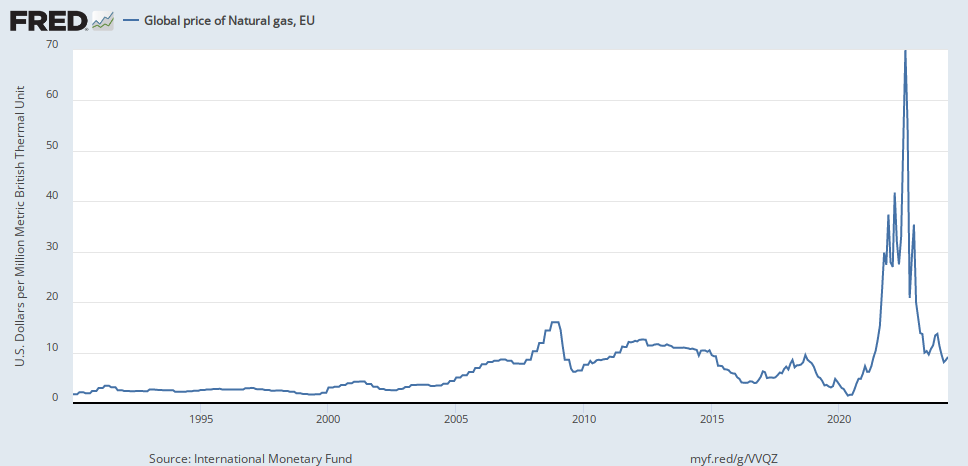
Quote:Texas sabotaged those pipelines to gouge the hell out of European natural gas distributors. Russia also gets benefits because Russia continues to supply gas to Europe but at a price higher because of the sabotage. When supply is limited, suppliers can gouge their customers. Back in 2020, Russia was given the gas away for next to nothing. Same gas, different year, and much higher price.
Originally posted by SIGNYM:
Putin sabotaged his own pipelines?
BWAHAHAHA!!!
https://fred.stlouisfed.org/graph/?g=VVQZ
Europe Faces 1 Tcf Natural Gas Shortfall Next Winter, IEA Warns
By Therese Robinson, November 4, 2022
Europe could face a 30 billion cubic meter (Bcm) natural gas shortfall for the 2023-2024 winter if the European Union (EU) doesn’t start planning ahead now, the International Energy Agency (IEA) said in a report released Thursday. https://www.iea.org/reports/never-too-early-to-prepare-for-next-winter
That’s the equivalent of about 1 Tcf of natural gas. And even though European gas storage facilities are currently 95% full, or about 5 Bcm (176 Bcf) above their 5-year average, it is wrong to expect the same conditions in 2023, the IEA warned.
“With the recent mild weather and lower gas prices, there is a danger of complacency creeping into the conversation around Europe’s gas supplies, but we are by no means out of the woods yet,” said IEA Executive Director Fatih Birol.
A gas supply shortfall next year could mean Europe would lack half the volume it needs to fill storage facilities up to 95%, which means inventories would only reach 65% of capacity for the 2023-2024 winter season.
Russian gas deliveries were close to normal for the first half of this year, but they’ve been cut dramatically since. Total pipeline supply from Russia to the EU in 2022 is likely to amount to around 60 Bcm (2.1 Tcf), according to the report, “but it is highly unlikely that Russia will deliver another 60 Bcm of pipeline gas in 2023 – and Russian deliveries to Europe could halt completely.”
“The IEA has rightly pointed out a more challenging time in 2023 than in 2022,” senior researcher Marco Giuli, of the Brussels School of Governance in Belgium, told NGI.
“This winter might leave us with very low inventories,” he added. “Under an optimistic assumption, the current Russian flows through Ukraine and TurkStream might continue, but we’ll be nowhere near the amount of Russian gas imported in 2022. The shortfall will especially hit the region that used to be served by Nord Stream.”
Russia halted deliveries on the 6 Bcf/d, 745-mile Nord Stream pipeline in September, citing problems with equipment.
China imported less LNG in the first ten months of this year due to an economic slowdown caused by Covid-19 lockdowns. If Chinese demand for LNG imports recovers next year, “this would capture over 85% of the expected 20 Bcm increase in global LNG supply in 2023,” the IEA wrote, limiting the number of LNG cargoes available to the European market next year.
The 20 Bcm (706 Bcf) increase in global LNG supply in 2023 is supported by the ramp-up of the Calcasieu Pass LNG facility in Louisiana and the Coral-Sul floating LNG facility in Mozambique, as well as the expected return to service of the Freeport LNG facility in Texas, the IEA noted. However, that’s not enough to offset the estimated decline in Russian pipeline deliveries.
“We see that Europe is set to face an even sterner challenge next winter,” Birol said. “This is why governments need to be taking immediate action to speed up improvements in energy efficiency and accelerate the deployment of renewables and heat pumps – and other steps to structurally reduce gas demand.”
https://www.naturalgasintel.com/europe-faces-1-tcf-natural-gas-shortfa
ll-next-winter-iea-warns/
The Joss Whedon script for Serenity, where Wash lives, is Serenity-190pages.pdf at https://www.mediafire.com/two
NOTIFY: Y | REPLY | REPLY WITH QUOTE | PERMALINK | TOP | HOME
Quote:
Germany Preparing For Emergency Cash Deliveries, Bank Runs And "Aggressive Discontent" Ahead Of Winter Power Cuts
Wednesday, Nov 16, 2022 - 04:20 PM
While Europe has been keeping a generally optimistic facade ahead of the coming cold winter, signaling that it has more than enough gas in storage to make up for loss of Russian supply even in a "coldest-case" scenario, behind the scenes Europe's largest economy is quietly preparing for a worst case scenario which include angry mobs and bankruns should blackouts prevent the population from accessing cash.
As Reuters reports ( Exclusive: Germany steps up emergency cash plans to cope in blackout https://www.reuters.com/world/europe/exclusive-germany-steps-up-emerge
ncy-cash-plans-cope-blackout-sources-2022-11-15/) citing four sources, German authorities have stepped up preparations for emergency cash deliveries in case of a blackout (or rather blackouts) to keep the economy running, as the nation braces for possible power cuts arising from the war in Ukraine. The plans include the Bundesbank hoarding extra billions to cope with a surge in demand, as well as "possible limits on withdrawals", one of the people said. And if you think crypto investors are angry when they can't access their digital tokens in a bankrupt exchange, just wait until you see a German whose cash has just been locked out.
Officials and banks are looking not only at origination (i.e., money-printing) but also at distribution, discussing for example priority fuel access for cash transporters, according to other sources commenting on preparations that accelerated in recent weeks after Russia throttled gas supplies.
The planning discussions involve the central bank, its financial market regulator BaFin, and multiple financial industry associations, said the Reuters sources most of whom spoke on condition of anonymity about plans that are private and in flux.
Although German authorities have publicly played down the likelihood of a blackout and bank runs - for obvious reasons - the discussions show both how seriously they take the threat and how they struggle to prepare for potential crippling power outages caused by soaring energy costs or even sabotage. They also underscore the widening ramifications of the Ukraine war for Germany, which has for decades relied on affordable Russian energy and now faces double-digit inflation and a threat of disruption from fuel and energy shortages.
As everyone familiar with the recent history of the Wimar Republic Germany knows, access to cash is of special concern for Germans, who value the security and anonymity it offers, and who tend to use it more than other Europeans, with some still hoarding Deutschmarks replaced by euros more than two decades ago.
According to a recent Bundesbank study, roughly 60% of everyday German purchases are paid in cash, and Germans, on average, withdrew more than 6,600 euros annually chiefly from cash machines.
...
At times politics can get in the way of blackout planning. In Frankfurt, Germany's banking capital, one city council member proposed requiring it to present a blackout plan by Nov. 17. The politician, Markus Fuchs of the right-wing AfD party, told the council it would be irresponsible not to plan for one. But the other parties rejected the proposal, accusing Fuchs and his party of inciting panic.
Fuchs later said in a phone interview: "If we found a solution for world peace, it would be rejected." The issue also underscores the dependence of commerce on technology, with transactions increasingly electronic, and where most cash machines have no emergency power source.
Cash would be the only official payment method that would still work, said Thomas Leitert, chief of KomRe, a company that advises cities on planning for blackouts and other catastrophes.
"How else will the ravioli cans and candles be paid for?" Leitert said. Well, there is that whole crypto thing, but the 2nd biggest Democratic donor did a bang up job there...
NOTIFY: Y | REPLY | REPLY WITH QUOTE | PERMALINK | TOP | HOME
Quote:
You are under contrôle: French elites privately fear the US and new research explains why
Intelligence services worry about American economic warfare more than terrorism or the prospect of confrontation with Russia or China
New research published by France’s Ecole de Guerre Economique [School of Economic War] has revealed some extraordinary findings about who and what the French intelligence services fear most when it comes to threats to the country’s economy.
The findings are based on extensive research and interviews with French intelligence experts, including representatives of spy agencies, and so reflect the positions and thinking of specialists in the under-researched field of economic warfare. Their collective view is very clear- 97 percent consider the US to be the foreign power that “most threatens” the “economic interests” of Paris.
Who is your true enemy?
The research was conducted to answer the question, “what will become of France in an increasingly exacerbated context of economic war?”. This query has become increasingly urgent for the EU as Western sanctions on Moscow’s exports, in particular energy, have had a catastrophic effect on European countries, but have not had the predicted effect Russia. Nor have they hurt the US, the country pushing most aggressively for these measures.
Yet, the question is not being asked in other EU capitals. It is precisely the continent-wide failure, or unwillingness at least, to consider the “negative repercussions on the daily lives” of European citizens that inspired the Ecole de Guerre Economique report.
As the report’s lead author Christian Harbulot explains, ever since the end of World War II, France has “lived in a state of the unspoken,” as have other European countries. [kind of like an abused wife]
At the conclusion of that conflict, “manifest fear” among French elites of the Communist Party taking power in France “strongly incited a part of the political class to place our security in the hands of the US, in particular by calling for the establishment of permanent military bases in France.”
“It goes without saying that everything has its price. The compensation for this aid from across the Atlantic was to make us enter into a state of global dependence - monetary, financial, technological - with regard to the US,” Harbulot says. And aside from 1958 - 1965 when General Charles de Gaulle attempted to increase the autonomy of Paris from Washington and NATO, French leaders have “fallen into line.”
This acceptance means aside from rare public scandals such as the sale of French assets to US companies, or Australia canceling its purchase of French-made submarines in favor of a controversial deal with the US and UK (AUKUS), there is little recognition - let alone discussion - in the mainstream as to how Washington exerts a significant degree of control over France’s economy, and therefore politics.
As a result, politicians and the public alike struggle to identify “who their enemy” truly is. “In spheres of power” across Europe, Harbulot says, “it is customary to keep this kind of problem silent,” and economic warfare remains an “underground confrontation which precedes, accompanies and then takes over from classic military conflicts.”
...
I spy with my Five Eyes
Harbulot believes the “state of the unspoken” to be even more pronounced in Germany, as Berlin “seeks to establish a new form of supremacy within Europe” based on its dependency on the US.
... It is certainly hard to imagine such an illuminating and honest report being produced by a Berlin-based academic institute, despite the country being the most badly affected by anti-Russian sanctions. Some analysts have spoken of a possible deindustrialization of Germany, as its inability to power energy-intensive economic sectors has destroyed its 30-year-long trade surplus - maybe forever.
... It was clearly not for nothing that veteran US graNOTIFY: Y | REPLY | REPLY WITH QUOTE | PERMALINK | TOP | HOME