

In the garden, and RAIN!!!!
POSTED BY: SIGNYM
UPDATED: Thursday, December 25, 2025 04:27
VIEWED: 1005090
PAGE 251 of 1154

Yeah, Jack, Signy asked an important question that I really didn't want to get into, and that's that your foundation blocks should not be shifted out of place if they're part of the main structure. If you're just talking about the porch it's not so bad.
Structural foundations are really technical. They need to be engineered and checked for compliance with local codes. You need a footing - all engineered as to how deep (due to the frostline), how thick, how wide, what kind and how much rebar and where, what kind of psi concrete (it's the pounds-per-square inch compressive load capacity of concrete which is what pressure can it take before it fails structurally, normal is about 3000 - 3500psi; generally improved by adding more sand to the mix) ... and so on. And then there's the block walls!!
Way, WAAAAaaaaaaay above my pay grade! as they say.
NOTIFY: N | REPLY | REPLY WITH QUOTE | PERMALINK | TOP | HOME
Since here's where I've been posting about earthquakes ...
https://www.latimes.com/california/story/2019-08-31/an-earthquake-faul
t-long-thought-dormant-could-devastate-los-angeles-reseachers-say
Earthquake fault long thought dormant could devastate Los Angeles, researchers say
By Deborah NetburnStaff Writer
Aug. 31, 2019
9:42 AM
Scientists citing new research say an earthquake fault along the Los Angeles coast, previously believed to be dormant, is active and could cause a destructive 6.4 magnitude earthquake if it ruptured.
And if it linked with other faults, it could trigger an earthquake in the magnitude 7 range, according to a team of researchers from Harvard, USC and the U.S. Geological Survey.
The fault, known as the Wilmington Blind-Thrust fault, stretches for about 12.5 miles, running northwest from Huntington Beach, directly beneath the Los Angeles and Long Beach harbors, past the east side of the Palos Verdes Pensinula and out toward Santa Monica Bay.
Researchers have known for decades that the fault existed, but it was long thought to be dormant and therefore of no concern for the residents of Los Angeles.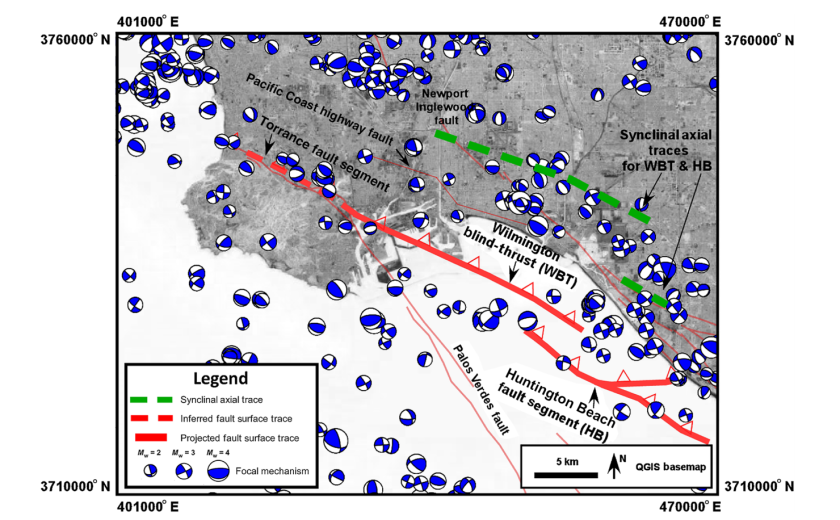
However, a new report, led by Franklin Wolfe, a doctoral student in the structural modeling and earth resources group at Harvard, has found that the Wilmington Blind Thrust Fault is in fact alive and kicking and could affect the overlying ports of Los Angeles and Long Beach.
“It doesn’t rupture frequently, but it’s like a sleeping giant beneath the harbor, " Wolfe said. “Just because it’s slow, doesn’t mean it’s not dangerous.”
A blind-thrust fault is so named because the fault itself doesn’t reach the surface of the Earth. There are no hills, cracks or breaks to indicate its existence.
Scientists knew the Wilmington fault was there because it sits below the Wilmington Oil Fields and data collected by the oil industry revealed folding in deep layers of rock that indicated the existence of a fault. However, the tell-tale folding of the rock did not appear to extend to more shallow layers of earth. Therefore, the data suggested that the fault had gone dormant at least 2 million years ago.
Then, about 10 years ago, a scientist at the USGS who was studying the architecture of groundwater reservoirs discovered that, in fact, there did appear to be some folding in the rock in more shallow layers than the oil industry researchers would have looked at.
Further research revealed that he was right. The folding in both the deep rock and the very shallow rock appeared to be caused by the same fault. That meant the Wilmington fault was still active.
https://ca-times.brightspotcdn.com/dims4/default/83d110a/2147483647/st
rip/true/crop/1300x730+0+0/resize/840x472!/quality/90/?url=https%3A%2F%2Fca-times.brightspotcdn.com%2Ff3%2F18%2Faef22fff7777c01387e5be9e2a02%2Fla-me-g-newport-inglewood-map-20150630
Wolfe said that the fault is very slow moving and could be expected to rupture sometime in the next 3,000 to 5,000 years.
“It makes you wonder how many other faults are in California that are not detected and slow moving,” Wolfe said. “The San Andreas fault is the most noteworthy, but many other of faults in California capable of generating damage.”
The Wilmington fault runs near another notorious fault, the Newport-Inglewood.
That fault unleashed the 1933 Long Beach earthquake, which killed 120 people and prompted some of the state’s first seismic building regulations.
The Newport-Inglewood has long been considered one of Southern California’s top seismic danger zones because it runs under some of the region’s most densely populated areas, from the Westside of Los Angeles to the Orange County coast.
Research published in 2017 found the fault may be even more dangerous than experts had believed, c
NOTIFY: N | REPLY | REPLY WITH QUOTE | PERMALINK | TOP | HOME

About the sealer/ primer
SIX, as much as people swear by the KILZ oil-based primer, it's not sold anywhere in theSouth Coast Air Basin (SCAB) so that's out of the question.
I think the problem happened because I used KLIZ 2 (Latex paint, probably a styrene/divinyl benzene/acrylic formulation) on bare plaster instead of KILZ PVA (polyvinyl acetate). KILZ2 works best on pre-painted surfaces as a stain blocker/matte finish, PVA is literally a matte-finish glue, much better at bonding to and sealing fresh drywall or plaster. The funny thing is, I had actualy used PVA on almost all of the fresh drywall, but I ran out and switched to the latex stuff instead for that part of the wall. Fortunately, it only failed in a few small spots.
The specialty primer that I painted over the other primer worked well, it seems very durbale and it did not fail, the KILZ2 did.
-----------
Pity would be no more,
If we did not MAKE men poor - William Blake
You idiots have been oppressing the entire sexual spectrum as long as you have existed. I can't wait for the day your kind is dead - WISHIMAY
NOTIFY: Y | REPLY | REPLY WITH QUOTE | PERMALINK | TOP | HOME
Quote:
Originally posted by 1kiki:
Yeah, Jack, Signy asked an important question that I really didn't want to get into, and that's that your foundation blocks should not be shifted out of place if they're part of the main structure. If you're just talking about the porch it's not so bad.
Structural foundations are really technical. They need to be engineered and checked for compliance with local codes. You need a footing - all engineered as to how deep (due to the frostline), how thick, how wide, what kind and how much rebar and where, what kind of psi concrete (it's the pounds-per-square inch compressive load capacity of concrete which is what pressure can it take before it fails structurally, normal is about 3000 - 3500psi; generally improved by adding more sand to the mix) ... and so on. And then there's the block walls!!
Way, WAAAAaaaaaaay above my pay grade! as they say.
Yeah...
It's just a three season room attached to the house that was built 20 years after the house went up. There is electricity run to it (and, I know it's shocking, but it was done up right with conduit), but there's no heat/air-conditioning out to it or water.
It's VERY apparent that Uncle Bob came over and built it and it wasn't done by a professional mason. Even without gutters for who knows how many years and that busted drain pipe the masonry the house is sitting on is still rock solid. The porch cinder block masonry is cracked to shit. Fortunately, the only place where they were being pushed in was right under the screen door and was relatively easy to put back into place. Also fortunate, there is enough "crap" still inside the seams that everything is still level and none of the bricks are sinking, so my idea is to get the right stuff and push as much into the cracks as I can.
I'm going to do a little research today and get the right stuff to put in all the cracks around the interior of the whole thing while I've got it exposed. My friends dad who's done this a lot actually told me to use tile grout. I'm just going to double check that this is a good solution before going what would be a pretty cheap way. I don't mind paying more for something better and doing it right if this is not ideal. Then I'm going to at least tar all of the stuff from the outside that is currently exposed. I might do the front down the line as well at some point, but that's on the back burner for now.
I might even tar all the stuff inside when I'm done filling it in, but I'd have to know that it was even worth doing or not first. I don't think you can buy that stuff in smaller than 5 gallon pails, so I'm going to have a ton left over if I don't find something worthwhile to do with it.
Do Right, Be Right. :)
NOTIFY: Y | REPLY | REPLY WITH QUOTE | PERMALINK | TOP | HOME
Quote:
Originally posted by SIGNYM:
About the sealer/ primer
SIX, as much as people swear by the KILZ oil-based primer, it's not sold anywhere in theSouth Coast Air Basin (SCAB) so that's out of the question.
I think the problem happened because I used KLIZ 2 (Latex paint, probably a styrene/divinyl benzene/acrylic formulation) on bare plaster instead of KILZ PVA (polyvinyl acetate). KILZ2 works best on pre-painted surfaces as a stain blocker/matte finish, PVA is literally a matte-finish glue, much better at bonding to and sealing fresh drywall or plaster. The funny thing is, I had actualy used PVA on almost all of the fresh drywall, but I ran out and switched to the latex stuff instead for that part of the wall. Fortunately, it only failed in a few small spots.
The specialty primer that I painted over the other primer worked well, it seems very durbale and it did not fail, the KILZ2 did.
-----------
Pity would be no more,
If we did not MAKE men poor - William Blake
You idiots have been oppressing the entire sexual spectrum as long as you have existed. I can't wait for the day your kind is dead - WISHIMAY
That's a shame about Kilz2. I've only ever used it for drywall before painting and nothing heavy duty. I knew there is no way it could compete against the oil based variety on heavy duty stuff, but I didn't think it would be crap either. :(
Is Kilz not sold by you because of some environmental regulations that make it illegal to use there? (I ask because, well yanno, California!)
If it isn't (or maybe even if it is), you should look on Amazon and see if you can get some that way if you ever need something that works. As much as I'm not a fan of what Amazon is doing, I have to admit that I made 4 purchases with them in the last few months and aside from a $1.99 fee I had to pay for an extra week of Prime shipping vs a $9.99 shipping charge for the last order (because my free 30 day trial had expired a month or so earlier), I got these things within a day or two tops and much cheaper than I would have got them in a store.
But if Kilz is illegal by you, knowing how far we've come with computers and tech, it wouldn't surprise me if Amazon flat out prohibits the sale of it in your area.
Glad you seemed to have figured it all out though. :)
Do Right, Be Right. :)
NOTIFY: Y | REPLY | REPLY WITH QUOTE | PERMALINK | TOP | HOME
Hey Signy
Thanks for letting me know !!! about the specialty sealer.
When I went to Lowes for genuine TSP I did look up oil-based KILZ, and you're right, it's no longer sold (according to them). I should check out Ace hrdwr b/c they're usually more on top of things. It might be available in small containers. (Many years ago I was looking for oil-based porch floor paint at Ace, and it was available in small containers but not large ones.) Just a detail to track down.
Lowes did recommend another product they said works even better than Kilz did. You know I have a particular reason to be looking for something like Kilz but my second pick was milk paint with maximum tung oil.
NOTIFY: N | REPLY | REPLY WITH QUOTE | PERMALINK | TOP | HOME
Hey Jack - phew !!! about the foundation !!!
NOTIFY: N | REPLY | REPLY WITH QUOTE | PERMALINK | TOP | HOME
Weird...
Amazon seems to only have oil based Kilz in 1 quart interior.
https://www.amazon.com/Original-Multi-Surface-Blocking-Interior-Oil-Ba
sed/dp/B000SKURCS/ref=sr_1_1?fst=as%3Aoff&qid=1567284804&refinements=p_89%3AKILZ%7CKilz%2Cp_n_material_two_browse-bin%3A17870950011&rnid=17870948011&s=hi&sr=1-1
Just did a search at Home Depot and they've got it in 1 and 5 gallon buckets for $18.27 and $82.98 respectively. That is with my local store plugged in though. I'm thinking that they banned Original Kilz and similar paints in your area, perhaps the entire state of California.
Do Right, Be Right. :)
NOTIFY: Y | REPLY | REPLY WITH QUOTE | PERMALINK | TOP | HOME
Oil-based anything paint, due to high organic vapors, which create serious air pollution here!
NOTIFY: N | REPLY | REPLY WITH QUOTE | PERMALINK | TOP | HOME

Quote:
Originally posted by 1kiki:
Hi Brenda!
BTW, I'm assuming these are 'machine' screws (fine threaded, flat-tipped) that fit into a metal threaded fitting, and not wood screws or sheet metal screws (coarse threaded, pointed tip).
A good salesperson should be able to match the screw thread and width (and head style, which may be important if it's a counter-sunk head)
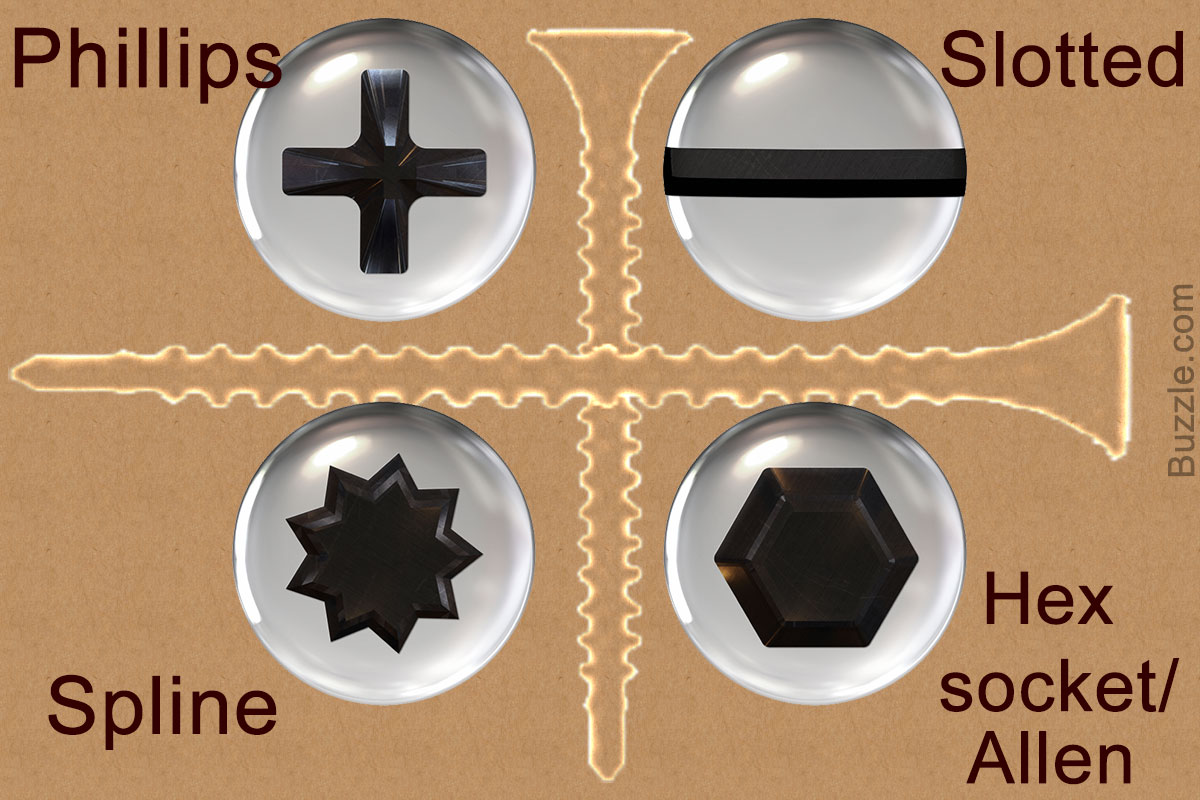
or merely cosmetic otherwise); and if the off-the-shelf replacement is too long, be able to cut it down to the right length without damaging the thread. Unless you have a preference either phillips or slotted should be OK if there isn't a match otherwise,
but stay away from anything else including torx if you are asked.
If you know something about its origins (time and place of mfg) it might be easier to determine metric v 'standard' thread. Sometimes a metric thread can look like a 'standard' thread. If you get one for the other, oftentimes you'll be able to get about 3 turns in before it gets stuck-ish. Don't force it if that happens, just back it out and get the right one instead.
That's why, when installing screws, bolts, or nuts, it's important to thread them down by hand ALL THE WAY - so you can feel if it's either starting cross-threaded or getting tight a few turns down. Use your tools to tighten ONLY after it's installed.
Very small, fine-threaded screws can be tricky to install ... hard to hold on to and easy to cross thread. Try PARTIALLY removing your 'example' screw, and then putting it back in all the way a few times for practice; then once you remove it completely, try putting it back in its original hole a few times for practice; and then in the empty hole (to check for bad threads in the MT hole) a few times.
I've had some very skilled people give me many of these tips, and also, too many times by my own self getting hung up on what should be an easy job because it was trickier than I thought!!!

Hi Kiki
The screws are easy to see. Flat head, slotted. The box is wooden. The screw would be standard as this box is older than me. Metric wasn't brought in Canada until the 70s. This box was something that my dad bought my mom in Vancouver BC. Not sure if it was made here though.
I have tightened the other screws but I am sure that I can get one of them out if I choose to go that route.
NOTIFY: Y | REPLY | REPLY WITH QUOTE | PERMALINK | TOP | HOME