

When Lower Tax RATES Produce Higher Tax Revenue
POSTED BY: JEWELSTAITEFAN
UPDATED: Thursday, July 4, 2019 03:19
VIEWED: 9588
PAGE 3 of 8

JSF:
Quote:
Reaganomics Tax Cuts.
At the same time that Reagan cut rates, he also subject MORE INCOME to taxes by eliminating a lot of personal deductions. Many families and businesses saw a tax HIKE, not a tax cut. It's easy to increase revenues if you give with one hand and take with two.
http://money.cnn.com/2010/09/08/news/economy/reagan_years_taxes/
Also, during America's big boom years- post WWII to about 1960 - the tax RATES were much much higher- up to 90%. So high tax RATES ... as high as 94% .... didn't slow down the economy at all during those years.
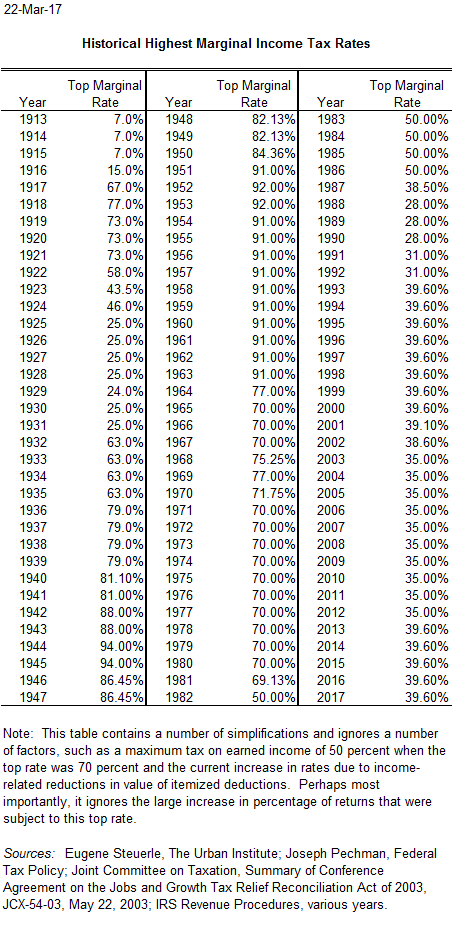
Overall, tax cuts are not a huge driver of the economy, and never have been.
Other, MORE IMPORTANT, factors were at work then, such as the American dominance in manufacturing post-WWII, when all of the other manufacturing facilities had either been destroyed by the war (Germany, France, Japan, Italy) and/or were not yet developed (China). In today's crowded manufacturing environment, that kind of dominance will be impossible to achieve. The best you can hope for is parity and a neutral balance of trade.
Oh, and BTW- the top marginal tax RATE under Regan was 70%, not 78%.
Quote:https://en.wikipedia.org/wiki/Reaganomics
The four pillars of Reagan's economic policy were to reduce the growth of government spending, reduce the federal income tax and capital gains tax, reduce government regulation, and tighten the money supply in order to reduce inflation.[2] During Reagan's presidency, the national debt nearly tripled, and the U.S. went from being the world's largest creditor nation to the world's largest debtor nation in under eight years.
I was old enough to be aware of politics when Reagan was running for President, and he promised
(1) a decrease in taxes
(2) an increase in government (DOD) spending ("Star Wars" anyone?), and
(3) a decrease in the deficit.
Common sense told me that the best he could hope to achieve was 2 out of 3, and anything else was just wishful thinking. As it turns out, he only met 1 out of 3 goals.
-----------
Pity would be no more,
If we did not MAKE men poor - William Blake
NOTIFY: Y | REPLY | REPLY WITH QUOTE | PERMALINK | TOP | HOME
G, I have no idea what you're trying to say with this, so please rephrase ...
Quote:True. That is the situation that we have now: Things are made outside of the USA and sold here, and businesses profit mightily. That leads to lost jobs here, increased personal debt and huge balance-of-trade deficits.
Things don't have to be made in the US for their sales to profit the US businesses that sell them.
Quote:I find this completely uninterpretable.
If manufacturers were the sole profiteer from product sales, as you suggest, then you can bet you paycheck American manufacturing would be booming.
Are you saying that "Americans" in general benefit (not "profit", wrong word) from overseas manufacturing? That, on balance, the situation is more acceptable/ more tolerable to the population at large the way it is now than it would be if manufacturing were brought back home to America?
Quote:Again, not sure what you're trying to say here.
Americans are greedy - we'd find a way to manufacture goods if there was so much profit in it.
Quote:Restate!
Rethink!
-----------
Pity would be no more,
If we did not MAKE men poor - William Blake
NOTIFY: Y | REPLY | REPLY WITH QUOTE | PERMALINK | TOP | HOME
Quote:You are not making sense. He reduced the Tax RATES. The Revenue intake shifted towards high income earners paying more than the average or lower income earners. Your claims are implying the lower income earners ended up paying a greater share of the Tax burden, which is the opposite of truth and fact.
Originally posted by SIGNYM:
JSF:Quote:
Reaganomics Tax Cuts.
At the same time that Reagan cut rates, he also subject MORE INCOME to taxes by eliminating a lot of personal deductions. Many families and businesses saw a tax HIKE, not a tax cut. It's easy to increase revenues if you give with one hand and take with two.
http://money.cnn.com/2010/09/08/news/e
conomy/reagan_years_taxes/
Also, during America's big boom years- post WWII to about 1960 - the tax RATES were much much higher- up to 90%. So high tax RATES ... as high as 94% .... didn't slow down the economy at all during those years.
Overall, tax cuts are not a huge driver of the economy, and never have been.
Other, MORE IMPORTANT, factors were at work then, such as the American dominance in manufacturing post-WWII, when all of the other manufacturing facilities had either been destroyed by the war (Germany, France, Japan, Italy) and/or were not yet developed (China). In today's crowded manufacturing environment, that kind of dominance will be impossible to achieve. The best you can hope for is parity and a neutral balance of trade.
Oh, and BTW- the top marginal tax RATE under Regan was 70%, not 78%.Quote:https://en.wikipedia.org/wiki/Reaganomics
The four pillars of Reagan's economic policy were to reduce the growth of government spending, reduce the federal income tax and capital gains tax, reduce government regulation, and tighten the money supply in order to reduce inflation.[2] During Reagan's presidency, the national debt nearly tripled, and the U.S. went from being the world's largest creditor nation to the world's largest debtor nation in under eight years.
I was old enough to be aware of politics when Reagan was running for President, and he promised
(1) a decrease in taxes
(2) an increase in government (DOD) spending ("Star Wars" anyone?), and
(3) a decrease in the deficit.
Common sense told me that the best he could hope to achieve was 2 out of 3, and anything else was just wishful thinking. As it turns out, he only met 1 out of 3 goals.
Also, he doubled the personal exemptions and greatly increased standard deductions, benefitting the lower and average income earners more.
Hard to argue that the Democrap controlled Congress found ways to outspend every extra penny that Reagan brought in, but that is their legacy always, not just during Reagan. The fact remains that Tax Revenue doubled, as a resultresult of cuts in the Tax Rate.
Oooooh. Only 70% Tax Confiscation. How generous of the Democraps to allow you to retain 30% of your earnings, before other taxes are levied.
What year did Reagan promise deficit reduction?
Quoting CNN as fiscal relevance? What a joke. These are the clowns that told everybody to lose over half their money all through 2008. Everything they rationalize about Reaganomics and Tax Cuts is revisionist drivel, they were so inconsequential then.
NOTIFY: Y | REPLY | REPLY WITH QUOTE | PERMALINK | TOP | HOME

Quote:
Originally posted by G:Quote:
Originally posted by JEWELSTAITEFAN:
Some reality deniers keep claiming that history never actually happens, and the proven effect of Lower Tax RATES increasing Tax Revenue is absent from their indoctrinations.
The examples of these facts keep getting buried in other threads, so I'd like to put some examples in a common thread which can be referenced, either by specific posts, or the whole thread.
I'll detail some later.
Feel free to post examples you know about. Including years, rate changes, revenues, nations would be helpful.
U.S. Treasury Secretary Mellon was able to get Income Tax RATES lowered from 73% down to eventual 24% and Revenues from 1921 to 1929 increased from $719 Million to over $1 Billion, an average increase of 4.2% per year for 8 straight years. This info can be found in the wiki entry for Laffer Curve, which has a pile of BS as the regular info, but has a "History" link with some actual facts - including Keynes understanding this dynamic.
So you only had to go back 96 years - good catch. [ / snarkasm ]
BTW, do you have any HISTORICAL CONTEXT you want to use to give that some deeper understanding? Like how we were still coming out of WW1? And what happened right after that 1921-29 period? Something called "Great" but wasn't so great?? You just illustrated the dangers of using raw data to prove things.
==============================
He had to go back 96 years, and then his prime example of how great an idea this is resulted in the Great Depression.
Republicans just cannot think; it's that simple.
NOTIFY: Y | REPLY | REPLY WITH QUOTE | PERMALINK | TOP | HOME
Quote:Not implying that at all. What I posted was
You are not making sense. He reduced the Tax RATES. The Revenue intake shifted towards high income earners paying more than the average or lower income earners. Your claims are implying the lower income earners ended up paying a greater share of the Tax burden, which is the opposite of truth and fact.
Quote:Small and medium-sized businesses often don't bother to incorporate, so business income is often treated as personal income. You're right that the tax hike affected higher income earners more than lower.
Many families and businesses saw a tax HIKE, not a tax cut.
But my main point about the effect of tax rate cuts in general remains: They don't stimulate the economy and therefore they don't increase revenues.
-----------
Pity would be no more,
If we did not MAKE men poor - William Blake
NOTIFY: Y | REPLY | REPLY WITH QUOTE | PERMALINK | TOP | HOME
Quote:Sure, a roaring economy and increased Tax Revenue is what caused The Great Depression. Great logic there, Chief.
Originally posted by ElvisChrist:Quote:
Originally posted by G:Quote:
Originally posted by JEWELSTAITEFAN:
Some reality deniers keep claiming that history never actually happens, and the proven effect of Lower Tax RATES increasing Tax Revenue is absent from their indoctrinations.
The examples of these facts keep getting buried in other threads, so I'd like to put some examples in a common thread which can be referenced, either by specific posts, or the whole thread.
I'll detail some later.
Feel free to post examples you know about. Including years, rate changes, revenues, nations would be helpful.
U.S. Treasury Secretary Mellon was able to get Income Tax RATES lowered from 73% down to eventual 24% and Revenues from 1921 to 1929 increased from $719 Million to over $1 Billion, an average increase of 4.2% per year for 8 straight years. This info can be found in the wiki entry for Laffer Curve, which has a pile of BS as the regular info, but has a "History" link with some actual facts - including Keynes understanding this dynamic.
So you only had to go back 96 years - good catch. [ / snarkasm ]
BTW, do you have any HISTORICAL CONTEXT you want to use to give that some deeper understanding? Like how we were still coming out of WW1? And what happened right after that 1921-29 period? Something called "Great" but wasn't so great?? You just illustrated the dangers of using raw data to prove things.
==============================
He had to go back 96 years, and then his prime example of how great an idea this is resulted in the Great Depression.
Republicans just cannot think; it's that simple.
That was one handy example. The whole of historical data supports this truth, stated in the thread title.
More pertinent that tripling the Tax Rate was able to create or prolong the Depression, making it Great. 25% in 1931, then 63% 1932-5, then 79% 1936 on.
Clearly, you have proven that you just cannot think. It's that simple.
NOTIFY: Y | REPLY | REPLY WITH QUOTE | PERMALINK | TOP | HOME
Quote:ALL brackets got a Tax Rate Cut. Please specify which Income range was given a Tax Rate increase.
Originally posted by SIGNYM:Quote:Not implying that at all. What I posted was
You are not making sense. He reduced the Tax RATES. The Revenue intake shifted towards high income earners paying more than the average or lower income earners. Your claims are implying the lower income earners ended up paying a greater share of the Tax burden, which is the opposite of truth and fact.Quote:Small and medium-sized businesses often don't bother to incorporate, so business income is often treated as personal income. You're right that the tax hike affected higher income earners more than lower.
Many families and businesses saw a tax HIKE, not a tax cut.
But my main point about the effect of tax rate cuts in general remains: They don't stimulate the economy and therefore they don't increase revenues.
-----------
Pity would be no more,
If we did not MAKE men poor - William Blake
And it was the TAX CUT that affected higher income earners more than lower.
And yes, it was Tax Cuts which increased Tax Revenue. Just like the thread title says.
NOTIFY: Y | REPLY | REPLY WITH QUOTE | PERMALINK | TOP | HOME
Quote:And which Regan had 70% Tax Rate? Your table shows Reagan's first budget year was 50%, and the year he took office it was at 69% from Carter's budget.
Originally posted by SIGNYM:
JSF:Quote:
Reaganomics Tax Cuts.
At the same time that Reagan cut rates, he also subject MORE INCOME to taxes by eliminating a lot of personal deductions. Many families and businesses saw a tax HIKE, not a tax cut. It's easy to increase revenues if you give with one hand and take with two.
http://money.cnn.com/2010/09/08/news/econo
my/reagan_years_taxes/
Also, during America's big boom years- post WWII to about 1960 - the tax RATES were much much higher- up to 90%. So high tax RATES ... as high as 94% .... didn't slow down the economy at all during those years.
Overall, tax cuts are not a huge driver of the economy, and never have been.
Other, MORE IMPORTANT, factors were at work then, such as the American dominance in manufacturing post-WWII, when all of the other manufacturing facilities had either been destroyed by the war (Germany, France, Japan, Italy) and/or were not yet developed (China). In today's crowded manufacturing environment, that kind of dominance will be impossible to achieve. The best you can hope for is parity and a neutral balance of trade.
Oh, and BTW- the top marginal tax RATE under Regan was 70%, not 78%.Quote:https://en.wikipedia.org/wiki/Reaganomics
The four pillars of Reagan's economic policy were to reduce the growth of government spending, reduce the federal income tax and capital gains tax, reduce government regulation, and tighten the money supply in order to reduce inflation.[2] During Reagan's presidency, the national debt nearly tripled, and the U.S. went from being the world's largest creditor nation to the world's largest debtor nation in under eight years.
I was old enough to be aware of politics when Reagan was running for President, and he promised
(1) a decrease in taxes
(2) an increase in government (DOD) spending ("Star Wars" anyone?), and
(3) a decrease in the deficit.
Common sense told me that the best he could hope to achieve was 2 out of 3, and anything else was just wishful thinking. As it turns out, he only met 1 out of 3 goals.
-----------
Pity would be no more,
If we did not MAKE men poor - William Blake
NOTIFY: Y | REPLY | REPLY WITH QUOTE | PERMALINK | TOP | HOME
I saw a table at taxpolicycenter that listed Federal Receipts. When Tax rates dropped in 1966-68, the Receipts jumped up faster for those 3 years compared to the pace preceding that.
Also, the yearly increase wasn't much in the 1990s, but jumped up faster per year after 2002, when the Tax rate was again lowered.
NOTIFY: Y | REPLY | REPLY WITH QUOTE | PERMALINK | TOP | HOME