

The Role of Education
POSTED BY: SIGNYM
UPDATED: Wednesday, November 19, 2025 15:34
VIEWED: 4228
PAGE 1 of 2

Listening to NPR as usual, they had on Eloy Ortiz Oakley, chancellor for the California Community Colleges, speaking about the Community College's strategic vision for the future.
http://www.scpr.org/programs/take-two/2017/07/17/58009/ca-community-co
lleges-board-sets-new-goals-to-grow/
He spoke about all of the difficulties of that Community College students face: Having to work and study at the same time, the high percentage of students who drop out before completion, the lack of clear course requirements for graduation - leading to students taking too many credits (more about that in a bit*) etc.
The entire goal of this new CA Community College strategic plan was how to more efficiently feed better-trained students into the CA workplace.
This makes sense for the colleges, the students, and business in a very limited context. I believe that everyone should have a skill when leaving school, whether a trade or a profession.
However, given the clusterfuck that is our politics/ government today, it would be nice if they added one more requirement: The ability to ask insightful questions.
A course on debate, rhetoric, or logic might help. Not only might it help us be better-informed citizens, but also help us guide our personal lives better.
There was just something about the relentless focus on turning out worker-droids that I found disturbing, especially coming from a college "strategic vision". So short-sighted, can hardly be called "strategic". more like "tactical".
* One of the problems I hear about is the lack of scheduling for relevant coursework. For example, when I took chemistry, I was required to take basic chemistry (yanno, Chem 101, 102), basic Differential Equations, basic Physics, etc. all in my first year. The problem is, nowadays, Chem 101 might be available, but Math 101 might not be available until the following year; leading me to "cool my heels" by taking Sociology or some such. A lot of college students wind up needing five years to get a four-year degree because of lack of appropriate instructors.
NOTIFY: Y | REPLY | REPLY WITH QUOTE | PERMALINK | TOP | HOME

Quote:
Originally posted by SIGNYM:
Listening to NPR as usual,

That is why you fail.
NOTIFY: N | REPLY | REPLY WITH QUOTE | PERMALINK | TOP | HOME

Yoda would listen to NPR. I've heard some of the best stories ever from them.
NOTIFY: Y | REPLY | REPLY WITH QUOTE | PERMALINK | TOP | HOME

Quote:Post of the week for RWED.
Originally posted by Riverlove:Quote:
Originally posted by SIGNYM:
Listening to NPR as usual,
That is why you fail.
NOTIFY: Y | REPLY | REPLY WITH QUOTE | PERMALINK | TOP | HOME
Quote:your thread title didn't specify which level of education.
Originally posted by SIGNYM:
Listening to NPR as usual, they had on Eloy Ortiz Oakley, chancellor for the California Community Colleges, speaking about the Community College's strategic vision for the future.
http://www.scpr.org/programs/take-two/2017/07/17/58009/ca-community-co
lleges-board-sets-new-goals-to-grow/
He spoke about all of the difficulties of that Community College students face: Having to work and study at the same time, the high percentage of students who drop out before completion, the lack of clear course requirements for graduation - leading to students taking too many credits (more about that in a bit*) etc.
The entire goal of this new CA Community College strategic plan was how to more efficiently feed better-trained students into the CA workplace.
This makes sense for the colleges, the students, and business in a very limited context. I believe that everyone should have a skill when leaving school, whether a trade or a profession.
However, given the clusterfuck that is our politics/ government today, it would be nice if they added one more requirement: The ability to ask insightful questions.
A course on debate, rhetoric, or logic might help. Not only might it help us be better-informed citizens, but also help us guide our personal lives better.
There was just something about the relentless focus on turning out worker-droids that I found disturbing, especially coming from a college "strategic vision". So short-sighted, can hardly be called "strategic". more like "tactical".
* One of the problems I hear about is the lack of scheduling for relevant coursework. For example, when I took chemistry, I was required to take basic chemistry (yanno, Chem 101, 102), basic Differential Equations, basic Physics, etc. all in my first year. The problem is, nowadays, Chem 101 might be available, but Math 101 might not be available until the following year; leading me to "cool my heels" by taking Sociology or some such. A lot of college students wind up needing five years to get a four-year degree because of lack of appropriate instructors.
The role of education.
1. To control what enters impressionable minds.
2. To keep the population dumbed down enough to require 16 years to accomplish 7th grade material. Yes, college graduates still cannot pass an 8th grade exam from 1895. Some college graduates cannot even read, let alone could comprehend.
3. To prevent and prohibit youngsters from developing insightful questions, or critical thinking, logic - otherwise they will all become conservatives and the iron grip of liberals on the uneducation system would collapse.
4. To encourage unmerited self esteem to gloss over the previous 3 items.
NOTIFY: Y | REPLY | REPLY WITH QUOTE | PERMALINK | TOP | HOME
JSF- you forgot to add:
1) To babysit junior and juniorette because mom, or mom and dad, have to work.
2) To acclimatize youngsters to a centralized authoritarian competitive environment
3) To keep "excess" workers out of the workforce
Just to get a little philosophical here, for millenia, children learned from their parents. Whether they were learning how to chip flints or make fire or plow a straight furrow or raise chicks or spin yarn or pick cotton, kids learned their survival skills from mom and dad.
It wasn't until the advent of large centralized factories, when production moved from the home/farm to the factory/city that "what to do with the working-class kids during work hours" became a problem. (The wealthy had nannies and tutors.)
Children sometimes worked in factories along with their mother or in the mines with their father; or were packed into poorhouses; or sold bits of scavenged coal, flowers, or themselves; or formed roaming gangs that engaged in pick-pocketing, smuggling, and drugs, until compulsory schooling* was introduced (USA approx 1900, *did not apply to blacks).
Taking a lesson from the "efficiencies" of the factory, schooling became more and more centralized, standardized, and regulated. Schools looked like nothing so much as a factories for producing widgets 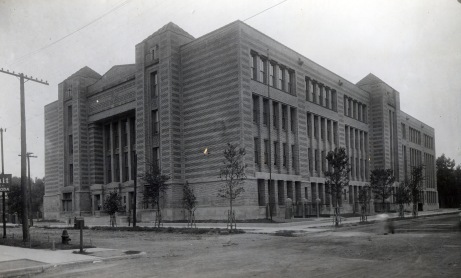
and although modern architecture is prettier, the same idea lies behind it: process, sort, and grade as many children as possible for as little money as possible.
All of this had unintended consequences. The goal of education is no longer to "educate" - which IMHO in the broadest sense is to teach children how to learn for a lifetime - but to become "useful", "compliant", and "employable" in a competitive authoritarian society. To sit down and accept what's being said (yanno, swallow dogma and advertising equally well and without question).
Also, with a student-teacher ratio of 35 (or more) to one, and the separation of parents from their child's education, children are left to socialize each other into their own youth subculture.
Schools DO teach actual useful skills - reading, writing (sort of), and arithmetic. Schools should also be prepared to teach an actual trade or profession. But I think they waste a lot of their time teaching "scientific facts" when they should teach the scientific method, and rather than teaching algebra they should teach how to be rational (to ratio) in real life - distinguish the large from the small, the important from the trivial. And definitely focus on teaching some form of logical thinking- either rhetoric or debate would be a useful start.
-----------
By the way, GSTRING, I predicted your response PERFECTLY
* ... and then you'll say I'm "too wordy". And then you will - as always- refuse to address the pertinent points, and respond with even more lies and even more bullshit personal attacks.*
And voila! Here it is http://www.fireflyfans.net/mthread.aspx?bid=18&tid=61835&mid=1
035581#1035581
NOTIFY: Y | REPLY | REPLY WITH QUOTE | PERMALINK | TOP | HOME
Quote:If you have good reading comprehension and decent visualization skills, you can get educated ANYWHERE. Even online or from a library.
Originally posted by COMDAT:
Yes, now it's not easy for students: the need to pay for study and, as a consequence, job search, makes such disappointing statistics. Of course, there are problems in our educational system and they need to be solved systematically. But, all the same, it's possible and necessary to get an education in such conditions. There are resources, like https://buyessay.org/college-essay.html, that offer their services (writing an essay, article review or presentation) in order to slightly "unload" the students and focus on them in specific areas.
Of course, your education will not be recognized and won't have any impact on your job prospects without that almighty diploma/ certificate,
I'm just pointing out that "education" is an entirely separate concept from getting a degree; it's possible to be extremely well-educated (no, I don't mean having a dozen degrees; I mean to have learned a lot about a lot of things) and not be able to find a job on the basis of that knowledge.
In order to survive AND be well-educated, you have to run your intellectual life on dual tracks. By all means, get that diploma, BUT ALSO pursue knowledge for knowledge's sake. That extra knowledge won't get you more money, but it will help you see the bigger picture and make more rational life choices.
-----------
By the way, GSTRING, I predicted your response PERFECTLY
* ... and then you'll say I'm "too wordy". And then you will - as always- refuse to address the pertinent points, and respond with even more lies and even more bullshit personal attacks.*
And voila! Here it is http://www.fireflyfans.net/mthread.aspx?bid=18&tid=61835&mid=1
035581#1035581
NOTIFY: Y | REPLY | REPLY WITH QUOTE | PERMALINK | TOP | HOME
Quote:
Originally posted by SIGNYM:
If you have good reading comprehension and decent visualization skills, you can get educated ANYWHERE. Even online or from a library.
LOL... tell that to people like reaverfan who feel that if you don't have a good dose of liberal brainwashing for 4 or more years from a university than you are too uneducated to have a conversation with.
NOTIFY: Y | REPLY | REPLY WITH QUOTE | PERMALINK | TOP | HOME
The two most intelligent people that I know are both extremely well-educated and woefully under-degreed (one in philosophy and one in sociology). It also helps that they both have near-eidetic memories. Fortunately for both of them, they managed to work their way in to professions which make use of their prodigious talents.
Just pointing out (again) that education and degrees aren't synonymous.
But, for us mere mortals, a degree does help in landing a decent job.
-----------
By the way, GSTRING, I predicted your response PERFECTLY
* ... and then you'll say I'm "too wordy". And then you will - as always- refuse to address the pertinent points, and respond with even more lies and even more bullshit personal attacks.*
And voila! Here it is http://www.fireflyfans.net/mthread.aspx?bid=18&tid=61835&mid=1
035581#1035581
NOTIFY: Y | REPLY | REPLY WITH QUOTE | PERMALINK | TOP | HOME
Quote:those 3 are good adds, but sometimes it is difficult to differentiate between the primary purpose and secondary, tertiary, or further derivativations.
Originally posted by SIGNYM:
JSF- you forgot to add:
1) To babysit junior and juniorette because mom, or mom and dad, have to work.
2) To acclimatize youngsters to a centralized authoritarian competitive environment
3) To keep "excess" workers out of the workforce
Just to get a little philosophical here, for millenia, children learned from their parents. Whether they were learning how to chip flints or make fire or plow a straight furrow or raise chicks or spin yarn or pick cotton, kids learned their survival skills from mom and dad.
It wasn't until the advent of large centralized factories, when production moved from the home/farm to the factory/city that "what to do with the working-class kids during work hours" became a problem. (The wealthy had nannies and tutors.)
Children sometimes worked in factories along with their mother or in the mines with their father; or were packed into poorhouses; or sold bits of scavenged coal, flowers, or themselves; or formed roaming gangs that engaged in pick-pocketing, smuggling, and drugs, until compulsory schooling* was introduced (USA approx 1900, *did not apply to blacks).
Taking a lesson from the "efficiencies" of the factory, schooling became more and more centralized, standardized, and regulated. Schools looked like nothing so much as a factories for producing widgets
and although modern architecture is prettier, the same idea lies behind it: process, sort, and grade as many children as possible for as little money as possible.
All of this had unintended consequences. The goal of education is no longer to "educate" - which IMHO in the broadest sense is to teach children how to learn for a lifetime - but to become "useful", "compliant", and "employable" in a competitive authoritarian society. To sit down and accept what's being said (yanno, swallow dogma and advertising equally well and without question).
Also, with a student-teacher ratio of 35 (or more) to one, and the separation of parents from their child's education, children are left to socialize each other into their own youth subculture.
Schools DO teach actual useful skills - reading, writing (sort of), and arithmetic. Schools should also be prepared to teach an actual trade or profession. But I think they waste a lot of their time teaching "scientific facts" when they should teach the scientific method, and rather than teaching algebra they should teach how to be rational (to ratio) in real life - distinguish the large from the small, the important from the trivial. And definitely focus on teaching some form of logical thinking- either rhetoric or debate would be a useful start.
1
NOTIFY: Y | REPLY | REPLY WITH QUOTE | PERMALINK | TOP | HOME