

Anti-Government, but don't touch my Medicare
POSTED BY: Niki2
UPDATED: Friday, May 7, 2010 16:50
VIEWED: 8545
PAGE 6 of 16

Quote:
Originally posted by Magonsdaughter:
It wouldn't make sense for a business to plan 100- years ahead. Businesses want profits, and they want them now. A business won't bank on something coming into fruition in 1000 years, because it won't survive long enough to see it happen.
Maybe you wouldn't, if you ran a business. Maybe not your neighbor either, or your friend from work. But it may be overreaching to assume NO business would.
What about green businesses? Aren't they doing exactly that, planning ahead, thinking long term? Aren't they thinking, "If I use sustainable practices that are responsible to my environment and community, I can stay in business longer than 10-20 years"?
-----
I heartily accept the motto, "That government is best which governs least"; and I should like to see it acted up to more rapidly and systematically. Carried out, it finally amounts to this, which also I believe — "That government is best which governs not at all"; and when men are prepared for it, that will be the kind of government which they will have.
-- HDT
NOTIFY: Y | REPLY | REPLY WITH QUOTE | PERMALINK | TOP | HOME

Quote:
Originally posted by canttakesky:Quote:
Originally posted by Magonsdaughter:
It wouldn't make sense for a business to plan 100- years ahead. Businesses want profits, and they want them now. A business won't bank on something coming into fruition in 1000 years, because it won't survive long enough to see it happen.
Maybe you wouldn't, if you ran a business. Maybe not your neighbor either, or your friend from work. But it may be overreaching to assume NO business would.
What about green businesses? Aren't they doing exactly that, planning ahead, thinking long term? Aren't they thinking, "If I use sustainable practices that are responsible to my environment and community, I can stay in business longer than 10-20 years"?
-----
-- HDT
Green businesses are cashing in the same as anyone else. There is a huge market in this area for water tanks, solar panelling, and other alternative energy commodities. Business is booming and not because they're planning 1000 years ahead, but because there is good money to be made in it now. And I'm not saying that is a bad thing either. A lot of them are thriving because of government subsidies to alternative energy sources as well, but that is another story. :)
I'm not saying businesses can't be ethical or conservation minded, it's just that to date, that has not been the case with a large number of corporations. I'm not against capitalism per se, either, but unlike you, I don't believe that it is tolerable to have a system modelled on the dog eat dog of the natural world, and that some checks and balances - which would include limiting the kind of pollutants that they could produce.
NOTIFY: Y | REPLY | REPLY WITH QUOTE | PERMALINK | TOP | HOME

Quote:
But it's not data based on what's happened. It's based on data the computer thinks has happened. Big difference. The first one is real. The second is, well, imaginary.
That's also a perfect description of free-market capitalism. :)
Yes, that was a snark. It's also 100% accurate, and serves as yet another example of the politicization of data to get a desired result in order to push a preconceived notion in support of a particular agenda.
Mike
"I supported Bush in 2000 and 2004 and intellegence [sic] had very little to do with that decision." - Hero, Real World Event Discussions
NOTIFY: Y | REPLY | REPLY WITH QUOTE | PERMALINK | TOP | HOME
Quote:
Originally posted by Magonsdaughter:Quote:
Originally posted by canttakesky:
I mean sustainable.
Except that it aint sustainable and that's the whole point.
I said, "good" ecology. You said, what does "good" mean. I said, "sustainable." So what do you mean that ecology is not sustainable, and that is the whole point?
There are plenty of sustainable ecologies in the world.
If you want to define capitalism so narrowly as only the practices that are entirely unsustainable, always predatory, and always short-sighted, it is your right.
Just please note that others might have a different, broader definition.
-----
I heartily accept the motto, "That government is best which governs least"; and I should like to see it acted up to more rapidly and systematically. Carried out, it finally amounts to this, which also I believe — "That government is best which governs not at all"; and when men are prepared for it, that will be the kind of government which they will have.
-- HDT
NOTIFY: Y | REPLY | REPLY WITH QUOTE | PERMALINK | TOP | HOME
Quote:
Originally posted by Kwicko:
That's also a perfect description of free-market capitalism. :)
Yes, that was a snark. It's also 100% accurate, and serves as yet another example of the politicization of data to get a desired result in order to push a preconceived notion in support of a particular agenda.
Oh yeah, I'm with you there.
Science (data) and politics don't mix. As soon as you politicize science, you get tons of imaginary data. So I agree. As I am a big fan of scientific rigor, this is a pet peeve of mine. Legislating based on "science" and you'll have to put "science" in quotation marks.
Legislate on principles, on values. Do you support the principle that it is not government's job to control businesses like they are wild animals that have to be chained, locked up, and only let out for circus performances? Or do you support the principle that government is the voice of the collective and should be able to use force to punish violations of the people's wishes?
Data has nothing to do with it.
-----
I heartily accept the motto, "That government is best which governs least"; and I should like to see it acted up to more rapidly and systematically. Carried out, it finally amounts to this, which also I believe — "That government is best which governs not at all"; and when men are prepared for it, that will be the kind of government which they will have.
-- HDT
NOTIFY: Y | REPLY | REPLY WITH QUOTE | PERMALINK | TOP | HOME
Quote:
Originally posted by Magonsdaughter:
I'm not saying businesses can't be ethical or conservation minded, it's just that to date, that has not been the case with a large number of corporations.
I agree. Corporations have had a detestable track record. But corporations do not equal capitalism. It is only one expression of capitalism, one that I consider to be "bad" (both morally and financially, unsustainable without the use of force).
Quote:
I'm not against capitalism per se, either, but unlike you, I don't believe that it is tolerable to have a system modelled on the dog eat dog of the natural world, and that some checks and balances - which would include limiting the kind of pollutants that they could produce.
My model is not about the acceptability of predation in the wild. It is about everything having a life cycle, from infancy to maturity to death, that has natural checks and balances from other members of the ecology that makes the entire system sustainable.
These checks and balances would limit the kind of pollutants businesses can produce, without the use of force.
Again, I am not against limiting pollutants. I am against the use of force to limit pollutants.
-----
I heartily accept the motto, "That government is best which governs least"; and I should like to see it acted up to more rapidly and systematically. Carried out, it finally amounts to this, which also I believe — "That government is best which governs not at all"; and when men are prepared for it, that will be the kind of government which they will have.
-- HDT
NOTIFY: Y | REPLY | REPLY WITH QUOTE | PERMALINK | TOP | HOME

There's also consumer backlash, two cases in point.
You don't see many products with Aspartame in em any more cause folks quit buyin em once they realized how toxic that shit is.
I think HFCS is kinda goin the same way, and I was pleased as punch to see REAL maple syrup on store shelves again as a direct response to consumer demand for it.
While I don't buy into "Free Markets" and "Captalism" cause damn near *every* time I hear them words it's just a front for Italian Fascist Economic policies and protected monopolies - nor do those folks ever take into account Labor as a commodity folks can hold out for a higher price...
(just ask any "Free Market" jackass what they think of the IWW!)
Not buying thier shit *does* work as an incentive.
Me, I don't argue the nitpicks, I run on two basic principles of that debate.
Do not trash your living space.
Waste not, want not.
Holding those two principles in hand makes the whole bloody debate pointless.
-F
NOTIFY: N | REPLY | REPLY WITH QUOTE | PERMALINK | TOP | HOME
Quote:
Originally posted by Fremdfirma:
Do not trash your living space.
But they are saying, what if Bad Business trashes YOUR living space? Why not put a gun to their head and force them to clean it it up?
-----
I heartily accept the motto, "That government is best which governs least"; and I should like to see it acted up to more rapidly and systematically. Carried out, it finally amounts to this, which also I believe — "That government is best which governs not at all"; and when men are prepared for it, that will be the kind of government which they will have.
-- HDT
NOTIFY: Y | REPLY | REPLY WITH QUOTE | PERMALINK | TOP | HOME

Quote:CTS, have you tried "going to the source" yourself? Because there is plenty of well-documented data out there supported climate change. It's a little shocking to find an intelligent, curious person who hasn't seen it.
Originally posted by canttakesky:
No, as opposed to looking at the data and how they obtained the data, from the official publications and websites of said "qualified people who have worked and studied in the field."
That's what scientists do. They go to the source.
You said somewhere up the thread that you "would just like to see some compelling evidence based on real measurements (you know, like with a thermometer) and not just data constructed (and possibly invented?) by computer models."
This shows a pretty fundamental misunderstanding of climate change: thermometer data is damned near worthless. We have been taking reliable measurements of temperature for really only century or so, and that's with limited spatial sampling.
First problem: climate change happens over 1000's of years. The temperature trend in the past 100 years could be meaningful or meaningless, since nature is just chock full of cyclic behavior over different time scales. We won't have direct observations of the "climate change" time scale until it's way way too late to do anything about it.
Second problem: there is a very real but rarely addressed question of which temperature measurements matter. Climate change will likely cause hotter temperatures in one place, colder in others. So if I hand you temperature data for every major city in the world, how would you crunch it down and make sense of it? Could you even draw a conclusion without knowing the temperature, let's say, out in the middle of the Pacific? Or over all points in Antarctica?
(BTW: A failing of some climate change scientists is the attention they pay to this. It's very hard to get them to explain exactly which thermometer measurements they use in their averaging methods, or what those averaging methods are, or why they chose to use them. I think they just squash the numbers together, get a pretty hockey stick graph, and go with it. Yet another reason I do not trust thermometer temperature data.)
So you see: direct temperature measurements are woefully inadequate for predicting climate change. The data we need would be data that indicates the condition of the world as a whole over a long, long time scale. The best example of this kind of useful data comes from ice cores.
I won't get into the scientific details (though they're cool - pun NOT intended) because you can learn the low down elsewhere (try wikipedia for a start), but scientists get very reliable estimates of global average temperature, atmospheric CO2, and atmospheric methane for the past several ice age cycles from ice cores. This data has been compared to data from tree rings and geological evidence and is quite solid.
What we see is a history of climate variation that closely follows variations in earth's orbit. BTW - the "earth's orbit" info comes from the computer modeling that you seem so eager to dismiss. See, the thing is, results from computer modeling are not taken to be meaningful unless they pass the test of relating to reality. That's science 101, and any scientist who doesn't carry out this sort of test will never get published in a peer reviewed journal.
In this case, modeled orbital patterns line up very well with earth's ice ages:
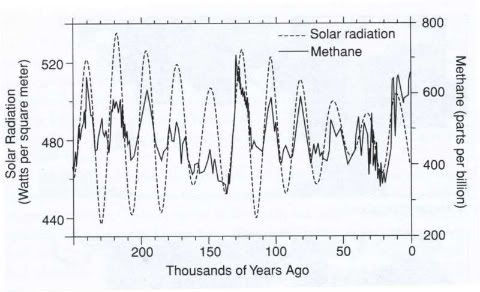
So you can say that that the "solar radiation" curve on this plot should be thrown out because it was "computer invented", but the fact that it lines up so well with methane levels measured from ice cores means that you'd be making a mistake.
So, anyhow, the key thing I get out of the orbital cycle/climate variation correlation is that earth's interglacial periods have been pretty similar for at least the last 4 ice age cycles. (That's about 400,000 years) But the current warm period is quite different. I have plots to illustrate e
NOTIFY: Y | REPLY | REPLY WITH QUOTE | PERMALINK | TOP | HOME

http://whiskeyandgunpowder.com/saving-america-from-corporate-statism/
NOTIFY: Y | REPLY | REPLY WITH QUOTE | PERMALINK | TOP | HOME