

How the 'verse works.
POSTED BY: meimeiCobb
UPDATED: Friday, April 11, 2008 03:13
VIEWED: 14554
PAGE 3 of 3

meimeicobb - what image are you referring to? Is it in a book, DVD, or online?
Quote:
Originally posted by mal4prez:Quote:Since you ask... This looks to be funner than work.
Originally posted by jewelstaitefan:
Anybody know enough to reject these ideas? I would like to know if they are not scientifically valid.Quote:The sun is indeed gradually heating and becoming brighter. It lives in a state of balance between the collapsing force of gravity and the outward pressure of fusion in its core. As there's less and less fuel to burn, it burns hotter to maintain the balance. I don't think it's getting larger so much - that will happen suddenly (on the cosmic time scale), when it uses up all its core's hydrogen and starts fusing hydrogen in its shell. Then it'll be a red giant, and things will look very different!
Regarding Mars, if I understand some things, the Sun is getting larger, and will eventually consume Earth.
Before that though, the gradual heating doesn't make the solar system more or less habitable. Certainly it moves the "habitable zone" ( http://en.wikipedia.org/wiki/Habitable_zone#Circumstellar_habitable_zo
ne) out toward Mars rather than at Earth, but it doesn't put a significantly larger portion of the solar system in the happy temperature zone.

I had read that it was projected that the sun wold continue growing and would swallow earth in some billions of years - perhaps that theory has been discounted.
Quote:Quote:I think you misspeak here - the sun is in the Milky Way Galaxy. It didn't exist when the Milky Way was formed.
Mars has evidence of a major collision, a large asteroid, right? The Asteroid belt, which some theorize was a planet, or unformed mass, may have broken upn and impacted Mars, destroying it's atmo - with the Sun hotter than when Milky Way was formed, Mars was unalbe to recover it's atmo.
I wasn't clear. I meant the atmo mars got from the formative years of our galaxy - clearly mars formed after the sun. But I meant tha the conditions were different when mars first got it's atmo, and were sufficieently different after impact/collision that it had difficulty revcovering it's atmo. Also, the collision would have been fatal for the asteriod as well, whcih mayu have originated from the asteriod belt, but would not have returned there. And the asteroid belt woold or could have already existed before the colliosion of mars. I'm thinking something like the yucatan impact - wiping out mars' atmo, not creating more asteroids or large rubble.
Quote:
Anyhow, I'm sure Mars has been hit by stuff, same as Earth has. But it'd be hard for a body to hit Mars, then retreat to where the asteroid belt is now. Impossible, really. The rubble of the collision would have stayed in Mars's orbit.
A note about the belt: current threory says that the belt is a planet that never formed because Jupiter's gravity was always disturbing things. Which is in line with my argument that two suns wouldn't make for a stable planetary system. If the body in Jupiter's orbit had 75 times the mass, its gravity might have kept Mars and perhaps even Earth and Saturn from forming. The area of the solar system available for stable planetary formation and orbit would be greatly limited.Quote:I agree that gas giants don't provide heat. Jupiter and Saturn don't even heat their own moons, how could they heat distant planets?
Also, the largest bodies will be in the middle of the orbital rings - Jupiter and Saturn are the largest, with progressively smaller bodies as one gets farther or closer to the Sun. Gas bodies are there for mass - I don't see them providing heat for neighboring bodies.
However, there's no rule about where the big bodies need to be. A different solar system doesn't need to mirror ours, with the big planets at a certain distance. There may be a limit as to how close in they can be and still have a stable system of many planets, but Jupiter could certainly be further out.Quote:
I didn't see a reason that terraformingNOTIFY: Y | REPLY | REPLY WITH QUOTE | PERMALINK | TOP | HOME

Quote:No, it hasn't been discounted. It's just the time dependence that I'm nitpicking about. The swallowing-the-earth thing isn't a gradual expansion of the sun, but a sudden change that will occur way way in the future.
Originally posted by jewelstaitefan:
I had read that it was projected that the sun wold continue growing and would swallow earth in some billions of years - perhaps that theory has been discounted.
Quote:So... how could Mars have formed an atmosphere in the first place, if it can't recover one after a collision? (Yes, I'm nitpicking again...)
I wasn't clear. I meant the atmo mars got from the formative years of our galaxy - clearly mars formed after the sun. But I meant tha the conditions were different when mars first got it's atmo, and were sufficieently different after impact/collision that it had difficulty revcovering it's atmo.
Quote:Length of day is certainly a factor, but the angle of the sunlight is a bigger one. To quote wikipedia (though lots of other web sites and textbooks would tell you the same):
I don't agree about summer/winter. Winter is when that portion of the globe is tilted away from the sun - not getting the rays PER DAY. the rays per area of the globe remain constant, holding the globe's overall temps consistent - or as consistent as the fluctuatuions of sun output allow.
"Seasonal change in the angle of sunlight, caused by the tilt of the earth's axis, is the basic mechanism that results in warmer weather in summer than in winter (see Figure 1). Change in day length is another factor."
http://en.wikipedia.org/wiki/Effect_of_sun_angle_on_climate
Quote:You're still confusing terminology here. The galaxy - the Milky Way - is the huge huge conglomerate of stars that the sun and all it's planets is a tiny part of. "Galaxy" and "solar system" are two completely different things.
Regarding proportion mentioned below, was recalling th4e galaxy incorrectly, and mercury to jupiter is too much of an extreme example.
As for Mercury and Jupiter being extreme examples - isn't that the point of this whole discussion? Seeing if a single planetary system could have so many terraform-able planets as the `verse requires?
Quote:I understand what you're saying, but you're inventing your own physics. Your basic assumptions are incorrect. This is the thing:
consider one or two beams of rays. the amount of energy the beam has at earth's orbit versus the amount of energy the same, uninterrupted beam would have at neptune's orbit shoud not be that different. I am talking about the energy of the beams, you are still talking about the amont of beams reaching the same square foot - which i addressd above, and was done with by this point. understand?
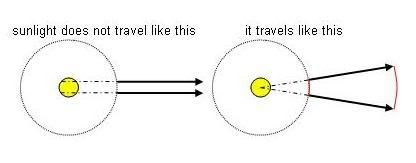
Sunlight is not a laser beam. Rays may appear to be parallel here on earth and we often use that assumption for applications on the scale of our planet. The distance involve - the top of our atmosphere down to the surface - is tiny compared to the sun/earth distance, so the divergence of the rays is negligible in our little world.
But when you're talking about the distance from earth to neptune, or even earth to mars, the rays are most certainly not parallel, and the beam of light diverges - geometrical spreading. This is a well understood and accepted phenomenon of physics.
You can insist on drawing a rectangular beam if you want, but it'll look like this:
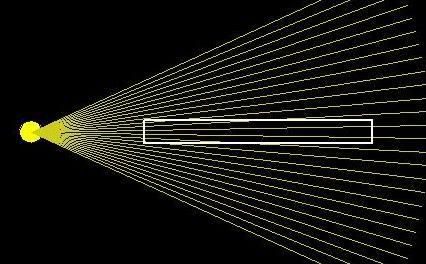
The sunlight doesn't follow the white rectangle. The rays are denser - the light more intense - at the left end of the white box than the right end.
I like making pictures.

-----------------------------------------------
hmm-burble-blah, blah-blah-blah, take a left
NOTIFY: Y | REPLY | REPLY WITH QUOTE | PERMALINK | TOP | HOME

Quote:I believe current theory is actually that because Mars hasn't a magnetosphere anything like Earths, the 'pressure' of the solar wind actually blew the Martian atmosphere away.
Originally posted by jewelstaitefan:
I wasn't clear. I meant the atmo mars got from the formative years of our galaxy - clearly mars formed after the sun. But I meant tha the conditions were different when mars first got it's atmo, and were sufficieently different after impact/collision that it had difficulty revcovering it's atmo. Also, the collision would have been fatal for the asteriod as well, whcih mayu have originated from the asteriod belt, but would not have returned there. And the asteroid belt woold or could have already existed before the colliosion of mars. I'm thinking something like the yucatan impact - wiping out mars' atmo, not creating more asteroids or large rubble.
Quote:I believe what you are trying to say is that a photon from the sun, will have the same energy at Earth as it will at Neptune. For simplicities sake, yes it will, but the energy of any single photon is entirely unimportant overall, its the number of of photons that's more important. The energy of received by the sun is subject to the inverse square law, that is if you double the distance the energy will drop to a quarter.
consider one or two beams of rays. the amount of energy the beam has at earth's orbit versus the amount of energy the same, uninterrupted beam would have at neptune's orbit shoud not be that different. I am talking about the energy of the beams, you are still talking about the amont of beams reaching the same square foot - which i addressd above, and was done witth by this point. understand?
More insane ramblings by the people who brought you beeeer milkshakes!
No one can see their reflection in running water. It is only in still water that we can see.

NOTIFY: Y | REPLY | REPLY WITH QUOTE | PERMALINK | TOP | HOME

... what they said.
Basically what ends up happening is that yes, Neptune gets sunlight, but as I mentioned before, the intensity of that light at noon there is the same as the intensity of light at a dim dusk here. Something else to consider, is the dispersion of the light, which is what Mal was trying to get at. It's very true that the rays travel outwards from the sun, but they do so in a wave instead of a beam, much like the light from the porch that I was trying to convey. Over space the light (and heat) gets dispersed and thus is weaker; you can still see it but it's the watered-down version.
That is also something that I didn't have time to mention that citizen did; the atmosphere of Mars was blown away by solar wind. The energy put out by the sun is more than light and heat, it's also electromagnetic energy, and a bit of kinetic energy. There is a vacuum in space, it's true, but the amount of energy produced by stars is enough to affect something as delicate as an atmo. When there are other factors aside from the solar wind affecting the atmo, such as a cooling core, planetary collisions, and a number of other things, yes, you could expect an atmosphere to blow away. Couldn't really pin it on one or the other of those things though.
^^
Are there any more points that I missed?
http://outofgas.proboards88.com && www.myspace.com/amazonprincezz
{Please send a wave and say who you are.}
NOTIFY: Y | REPLY | REPLY WITH QUOTE | PERMALINK | TOP | HOME
Quote:I think it's probably a fair bit less than a dim dusk
Originally posted by meimeiCobb:
Basically what ends up happening is that yes, Neptune gets sunlight, but as I mentioned before, the intensity of that light at noon there is the same as the intensity of light at a dim dusk here.
 .
.Quote:A small nit-pick, Light is always a wave, even if its a highly coherent laser beam. Well, actually just like everything else it's also a particle, Wave Particle Duality, confusing physicists since 1905.
It's very true that the rays travel outwards from the sun, but they do so in a wave instead of a beam, much like the light from the porch that I was trying to convey.
Quote:Actually there's much more to solar wind than em radiation. I'd also note that heat and light from the sun is electromagnetic radiation.
That is also something that I didn't have time to mention that citizen did; the atmosphere of Mars was blown away by solar wind. The energy put out by the sun is more than light and heat, it's also electromagnetic energy, and a bit of kinetic energy. There is a vacuum in space, it's true, but the amount of energy produced by stars is enough to affect something as delicate as an atmo.
Space it self isn't a true vacuum, there's actually a lot of stuff out there, around Earth the density is roughly 5 particles per cubic centimetre, mostly charged plasma. It's this Plasma which is basically what we call the solar wind, and also causes the Aurora Borealis and Aurora Australis. These particles tend to whip along at a fair rate, both because they're shot out of the sun at high speed, and driven by the Sun's magnetic field (which is also strengthened by the solar medium, essentially the whole system acts like a giant Magneto-hydrodynamic generator).
Quote:I think we're looking at the process starting as the Martian core cooled. Current theory has it (and certainly seems to be supported by available evidence) that its a molten rotating Iron core that generates a planets magnetosphere, the invisible 'forcefield' that literally stops the solar wind impacting a planet. As the core cools, it stops spinning, it stops generating the planets magnetosphere, the solar wind can get at it. There's a lot of power in the solar wind, acting over a long time. I suspect that the solar wind alone could strip a planets atmosphere, no collisions required.
When there are other factors aside from the solar wind affecting the atmo, such as a cooling core, planetary collisions, and a number of other things, yes, you could expect an atmosphere to blow away. Couldn't really pin it on one or the other of those things though.
More insane ramblings by the people who brought you beeeer milkshakes!
No one can see their reflection in running water. It is only in still water that we can see.
NOTIFY: Y | REPLY | REPLY WITH QUOTE | PERMALINK | TOP | HOME
Quote:
Originally posted by mal4prez:
Meimei - have you heard of Lagrangian points? It's one way to get more bodies into a solar system. ( http://en.wikipedia.org/wiki/Lagrangian_point)
Oh, and which image do you mean? The one you included isn't working for me.
I hadn't heard of that; thank you for that link, very informative.
And I fixed the link; you have to copy and paste it now.
http://www.leavemethewhite.com/
caps/albums/movies/serenity/
Serenity_0007.jpg
(COPY THE URL & PASTE IT INTO YOUR BROWSER)
http://outofgas.proboards88.com && www.myspace.com/amazonprincezz
{Please send a wave and say who you are.}
NOTIFY: Y | REPLY | REPLY WITH QUOTE | PERMALINK | TOP | HOME