

Form follows Function
POSTED BY: dreamtrove
UPDATED: Thursday, May 5, 2011 20:17
VIEWED: 6176
PAGE 1 of 1

A continuation, or threadjack of Steampunky goodness
http://www.fireflyfans.net/mthread.asp?b=17&t=48352
I thought this should have its own thread.Quote:
It is the pervading law of all things organic and inorganic,
Of all things physical and metaphysical,
Of all things human and all things super-human,
Of all true manifestations of the head,
Of the heart, of the soul,
That the life is recognizable in its expression,
That form ever follows function. This is the law.
- Louis Sullivan who coined the phrase, in 1896 - Wikipedia
Summarized a rule of http://en.wikipedia.org/wiki/Machine_Age
As one of the architects of the Columbian Exposition, he had built this Transportation building.
People would be coming in, they might have to wait to get in, even in the rain, when they came in, many would be coming in at once to a hall that needed a lot of light. All of that was considered in function, and altered the form, as seen, and then ornamental form was built on this.
Adolf Loos took a rather radical turn on this to basically say that because of this there was no point in form at all, and he built this:
And thus modernism was born
I find a lot of pre industrial era form fascinating. Much of it denies function altogether though, and other considers such a minimal effort and materials enter into all but the most lavish construction. The Post-industrial age split into the common modernism, which in its worst case is stalinism, visible all over eastern europe utilitarian functionism meets minimalism,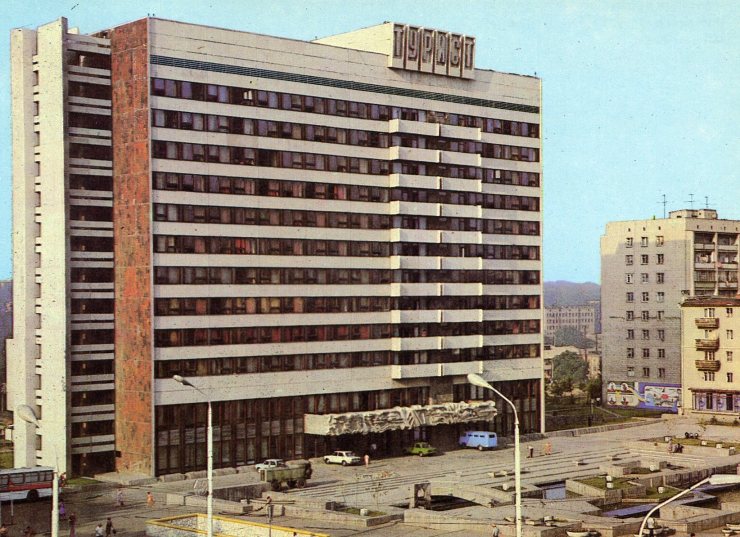
and on the other hand, the post-modernist abstract design which served no function at all.
For me, form follows function is about considering every possible function, and working it into the eventual form as a complete arrangement, and once you have that functional structure, to take the form and adorn it in the way which most compliments the whole.
Thoughts?
That's what a ship is, you know - it's not just a keel and a hull and a deck and sails, that's what a ship needs.
NOTIFY: Y | REPLY | REPLY WITH QUOTE | PERMALINK | TOP | HOME

I dislike the modernist movement. I know it was influenced from dada and a rejection of architectural flourish, and overdoing the ornament gets ostentatious, but I'm really not into the cement and glass look. I'm also not fond of pointless cement and glass sculpture stuck randomly onto buildings.
NOTIFY: Y | REPLY | REPLY WITH QUOTE | PERMALINK | TOP | HOME