

Saving Wildlife; The California Marine Mammal Center
POSTED BY: Niki2
UPDATED: Tuesday, June 8, 2010 20:04
VIEWED: 2186
PAGE 1 of 1
Because of a bunch of the Browncoats here, I will get to represent Browncoats everywhere by going to the Gulf and helping out.
A number of our members, knowing my love of such things and my rehabilitation and oil cleanup in the past, got together and are paying my air fare out there. It may not be for quite some time, as they've got tons of volunteers now and when some of them get sick (as some already have), have to return to work, or just burn out, that's when they'll need the rest of us.
I'm proud to go and can't wait; they may have to retrain me (since my oil work was back in the late '70s and in 2007 when the Cosco Busan hit the Bay Bridge here in SF), but if they don't want to, I'll do whatever job they give me.
This is Rodeo Beach, on the Marin Headlands, and the barge that washed ashore there which gave me my only experience cleaning oil-soaked birds. Thankfully it was only a small one; I cannot conceive of what they're experiencing down on the Gulf!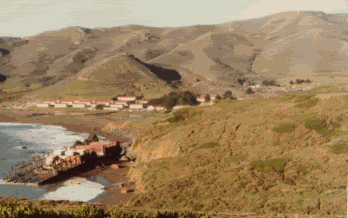
The old Marine Mammal Center where I was working at the time is barely visible up the hill on the right; all the other buildings were army buildings which were left when the military abandoned the facility and which are now inhabited by many non-profit organizations.
All this got me to thinking of my previous rehab work at Marine Mammal Center, which began in 1975 and is now a huge, gorgeous facility. But when I wroked there in the late '70s, we were a fledgling organization, so for the fun of it I scanned some of my photos from back then to show and tell you a bit about them.
MMC rehabs seals and sea lions. It was begun in the Marin Headlands on top of two abandoned Nike missle silohs by three people. When I began work there, we had nothing but a paved surface, one building and the silohs (which are still used to house the freezers where they keep the food). The first pens were no more than three feet high and as such we couldn't take in sea lions, and even the elephant seals and harbor seals we took in often pushed the fences over, making us chase them around on foot and with our cars to get them back in pens.
These are of my husband, Jim, who worked there briefly, with the old pens (everything then was made by volunteers) and an elephant seal. You can see how primitive it was: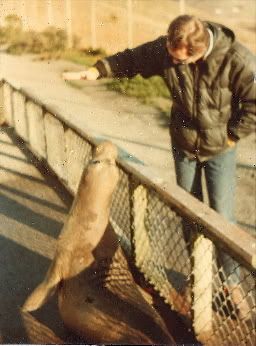
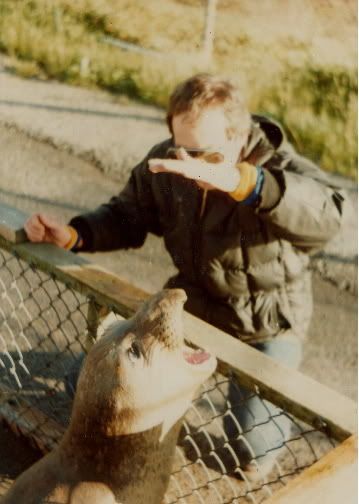
We got chain-link fences in a couple of years, but still only had donated bathtubs and tarp ground cover for the animals. This is several sea lion pups lounging around and in the bathtubs: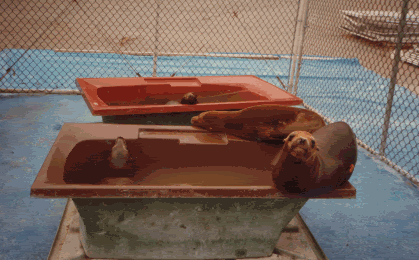
This was the entire facility back then. You can't see the one building that was there when it was begun, it's below the pens down the hill, but the only other building we had was the one on the left, a portable unit donated, and we couldn't handle many animals, as you can see.]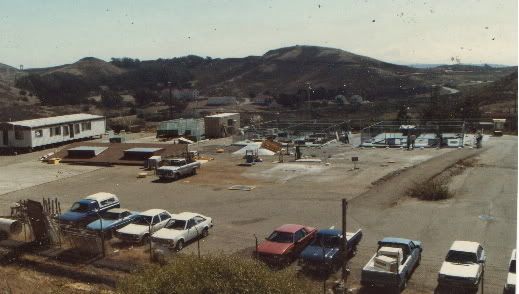
Someone donated materials and time to build cement flooring under the pens, and it improved a bit. This is Charles, one of the guys on the crew I was on, going down into one of the silohs to retrieve fish: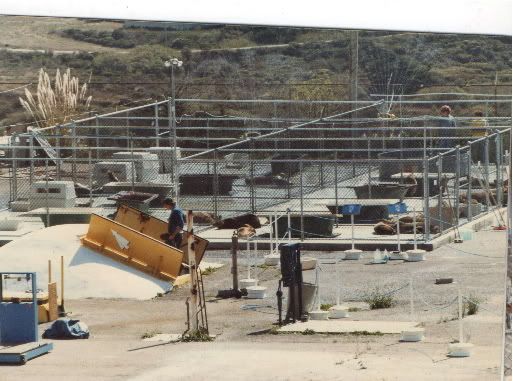
Next we had a bunch of huge metal tubs donated, which replaced the bathtubs and was much nicer for the seals. But they had to be emptied, turned over and scrubbed out daily, so it was hard physical labor: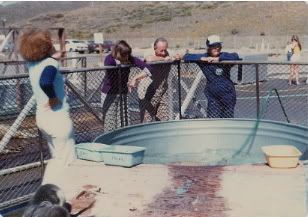
Volunteers built wooden ramps up to the tubs for the seals to get in and out. This is some of what I was proudest of the things we did in this photo. This little harbor seal came in horribly mangled from getting hit by a propeller. I, and others, didn't think he could possibly make it. But he did--this photo is about halfway through his re
NOTIFY: Y | REPLY | REPLY WITH QUOTE | PERMALINK | TOP | HOME