

Might the star , Betelgeuse, explode ( go super nova ) in our life time ? Has it already done so ?
POSTED BY: AURaptor
UPDATED: Tuesday, May 11, 2010 23:40
VIEWED: 9908
PAGE 1 of 1

Betelgeuse is a star which has likely exhausted its supply of hydrogen and has been fusing helium into carbon and oxygen. It has moved off the main sequence and swelled and cooled to become the red supergiant we see today. Its ultimate fate depends on its mass; if it is 15 solar masses or more, then it will likely continue to burn and fuse elements until its core is iron, at which point it will explode as a supernova before collapsing down into a neutron star some 20 km in diameter. If this is the case, it will be the brightest recorded, outshining the Moon in the night sky and easily visible in broad daylight. Considering its size and age of 8.5 million years, old for its size class, it may explode within the next thousand years, assuming it hasn't already. Since its rotational axis is not toward the Earth, Betelgeuse's supernova will not cause a gamma ray burst in the direction of Earth large enough to damage its ecosystems.
However, if it is at the lighter end of estimated mass, it may well contract to become a white dwarf instead.
Nobel Laureate Charles Townes announced evidence that 15 consecutive years of stellar contraction has been observed by UC Berkeley's Infrared Spatial Interferometer (ISI) atop Mt. Wilson Observatory in Southern California. Reported on June 9, 2009, the star has shrunk 15% since 1993 with an increasing rate. The average speed at which the radius of the star is shrinking over the last 15 years is around 210–219 m/s (470–490 mph).
According to the university, Betelgeuse's diameter is about 5.5 A.U., and the star's radius has shrunk by a distance equal to half an astronomical unit, or about the orbit of Venus. Some theorists[who?] have speculated that this behavior is expected for a star at the beginning of the gravitational collapse at the end of its life.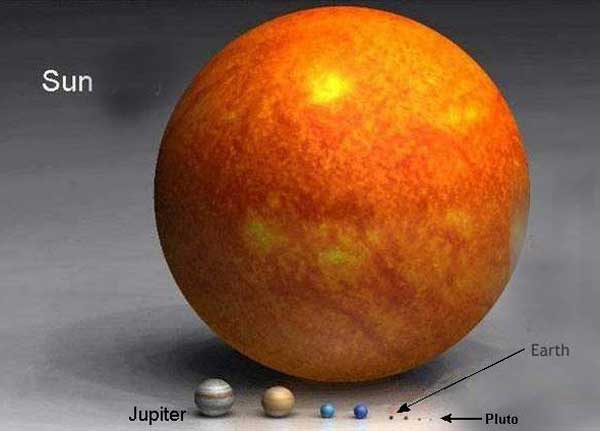
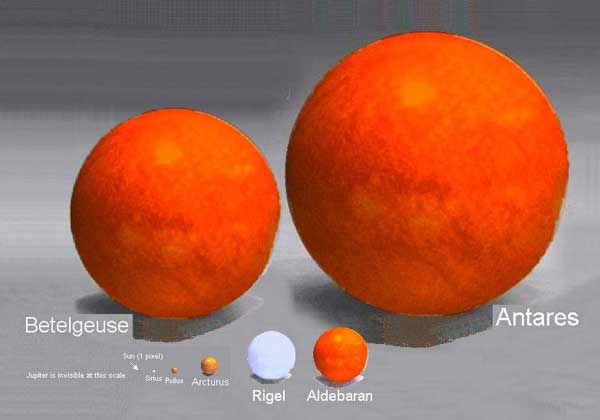
( Our own sun is represented by a single pixel size in comparison. Jupiter, our solar system's largest planet, is no where near visible on this scale. )


Bones: "Don't 'rawr' her!"
Booth: "What? she'rawred' me first."
NOTIFY: N | REPLY | REPLY WITH QUOTE | PERMALINK | TOP | HOME

It's sad stars have to die...who knows what they take with them when they explode...unexplored worlds, unknown beings...we'll never know because it all happens outside our known time frame.
NOTIFY: Y | REPLY | REPLY WITH QUOTE | PERMALINK | TOP | HOME

It's not so sad, because when stars go nova they leave a beautiful and colorful cloud of gaseous and nebulous material. Often these nebulae become cosmic incubators for new stellar nurseries, giving rise eventually to new stars, planets, and moons.
NOTIFY: Y | REPLY | REPLY WITH QUOTE | PERMALINK | TOP | HOME

If it's going to happen within our lifetimes, then it happened already, about 600 years or more ago.
NOTIFY: Y | REPLY | REPLY WITH QUOTE | PERMALINK | TOP | HOME

Yes, it already exploded. 
We have all lived inside of stars, and personally survived several super novae. As Carl Sagan says, we are made of starstuff. We are all 15-billion years old (not counting whatever the heck we were before the Big Bang). We are eternal.
NOTIFY: N | REPLY | REPLY WITH QUOTE | PERMALINK | TOP | HOME

The Wiki article says Betelgiese size is between the diameters of Mars' and Jupiter's orbits. And that when we look at the star from Earth we see (with Hubble's help) one of its poles.
My crazy, easily refutable theory #1: Maybe Betelgeuse isn't collapsing, but instead is making a small solar system. What if the bright pole is the star itself, and the rest of the mass is fiery, pre-planetary molecular gas?
*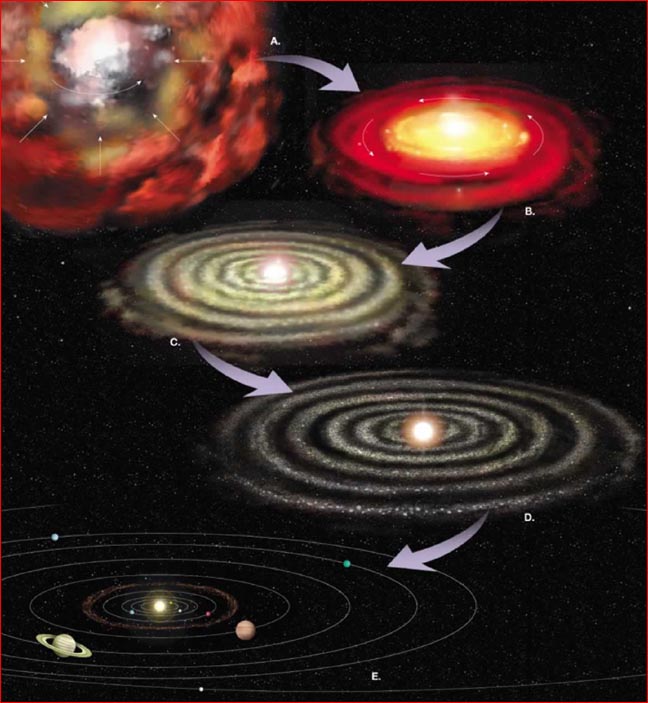
Like step B.
My more plausible theory #2: If Betelgeuse is collapsing, the bright pole could be a jet of some kind.
*ETA
--------------------------------------------------
Find here the Serenity you seek. -Tara Maclay
NOTIFY: Y | REPLY | REPLY WITH QUOTE | PERMALINK | TOP | HOME

I understand that stars often die in threes. Maybe somebody should take Sol's temp?
--WhoDied
_______________________
Yeah, we're mostly just giving each other significant glances and laughing incessantly.
NOTIFY: Y | REPLY | REPLY WITH QUOTE | PERMALINK | TOP | HOME

Quote:
Originally posted by WhoDied:
I understand that stars often die in threes. Maybe somebody should take Sol's temp?
O U R A FUNNY 1!
------------------------
I pray for one last landing,
on the globe that gave me birth.
Let me rest my eyes on the fleecy skies
and the cool, green hills of Earth.
http://www.blogiversity.org/blogs/dmi/default.aspx
NOTIFY: Y | REPLY | REPLY WITH QUOTE | PERMALINK | TOP | HOME

Quote:
Originally posted by RahlMaclaren:
What if the bright pole is the star itself, and the rest of the mass is fiery, pre-planetary molecular gas?
The spectrum would look different. More hydrogen less carbon, oxygen, iron and such.
David
'Begone, sugar-free candy antichrist!' - Nathan Rabin.
'Geeks can't admit that anything worthwhile was invented before 1981. Soon, "making cocoa" will be called "milk hacking."' - Lore Sjoberg
http://xkcd.com/386/
"Don't worry. Captain Hammer will save us." - Penny.
I has myspace - http://www.myspace.com/daveshayneforpresident
NOTIFY: Y | REPLY | REPLY WITH QUOTE | PERMALINK | TOP | HOME